It's hard not to become ensnared by words beginning with the letter B, when attempting to describe Cloud Atlas, David Mitchell's third novel. It's a big book, for start, bold in scope and execution--a bravura literary performance, possibly. (Let's steer clear of breathtaking for now.) Then, of course, Mitchell was among Granta's Best of Young British Novelists and his second novel number9dreamwas shortlisted for the Booker Prize. Characters with birthmarks in the shape of comets are a motif; as are boats. Oh and one of the six narratives strands of the book--where coincidentally Robert Frobisher, a young composer, dreams up "a sextet for overlapping soloists" entitled Cloud Atlas--is set in Belgium, not far from Bruges. (See what I mean?) Structured rather akin to a Chinese puzzle or a set of Matrioshka dolls, there are dazzling shifts in genre and voice and the stories leak into each other with incidents and people being passed on like batons in a relay race. The 19th-century journals of an American notary in the Pacific that open the novel are subsequently unearthed 80 years later on by Frobisher in the library of the ageing, syphilitic maestro he's trying to fleece. Frobisher's waspish letters to his old Cambridge crony, Rufus Sexsmith, in turn surface when Rufus, (by the 1970s a leading nuclear scientist) is murdered. A novelistic account of the journalist Luisa Rey's investigation into Rufus' death finds its way to Timothy Cavendish, a London vanity publisher with an author who has an ingenious method of silencing a snide reviewer. And in a near-dystopian Blade Runner-esque future, a genetically engineered fast food waitress sees a movie based on Cavendish's unfortunate internment in a Hull retirement home. (Cavendish himself wonders how a director called Lars might wish to tackle his plight). All this is less tricky than it sounds, only the lone "Zachary" chapter, told in Pacific Islander dialect (all "dingos'n'ravens", "brekker" and "f'llowin'"s) is an exercise in style too far. Not all the threads quite connect but nonetheless Mitchell binds them into a quite spellbinding rumination on human nature, power, oppression, race, colonialism and consumerism. --Travis Elborough --
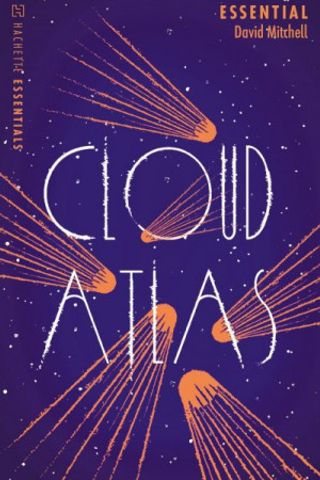
Cloud Atlas - (Flipback Edition)
David Mitchell

Quase impecável!
Existem tantos motivos pelos quais este livro é genial: a linguagem riquíssima e deslumbrante de cada época, os personagens que se mantêm vivos na memória, as excelentes e inesquecíveis histórias, os hilários aforismos de Cavendish, a estruturação dos capítulos, o ritmo misterioso da narrativa, a ligação semi-mística entre os personagens centrais das histórias (que apenas sugere reencarnações de uma mesma alma em diferentes épocas, apesar do autor não ser muito fã do fenômeno), as ligações físicas e reais entre os personagens, as brincadeiras veladas com os nomes dos personagens, a noção explícita de que há uma mente prodigiosa e muito bem versada por trás de cada linha de texto... Mas, além das ligações táteis e incorpóreas entre os seis personagens principais – as quais abrangem um período de cerca de 1000 anos- , existe um tema unificador em “Cloud Atlas”. E ele é, muito infelizmente, o pior ponto do livro. O que é triste. Uma obra deste porte ser cosida com uma linha tão tênue e rota é o equivalente a Luke Skywalker descobrir, ao final do segundo Guerra nas Estrelas, quando Darth Vader revela que é seu pai, que tudo não passou de um sonho psicodélico movido a LSD e acordar suado, enrolado no cobertor em um apartamento no Brooklyn dos anos 70, segurando uma lava lamp à guisa de sabre de luz. Para a sorte do leitor, o tema unificador não é explícito (e nem de longe tão ruim quanto o sonho de Luke!): é possível curtir os ótimos lados positivos relevando-se aqui e ali as passagens nas quais o tema ameaça dar as caras. E qual seria o tal “tema unificador”? Caso não fique patente durante a leitura, Mitchell revela em uma entrevista: “[...] o tema do livro é o instinto predatório, a maneira como indivíduos predam indivíduos, grupos predam grupos, nações predam nações, tribos predam tribos. Então eu pego este tema e de certa maneira o reencarno em outros contextos [...]”. Durante os estudos para a confecção dos capítulos de Adam (ou Adão, o “primeiro” narrador) Ewing, Mitchell se baseou em “Guns, Germs and Steel”, de Jared Diamond. Numa má leitura da boa obra, deve ter pegado daí um afã incontrolável de criticar o progresso com base em argumentos fraquinhos e cheios de “–ismos” (colonialismo, eurocentrismo), retirados poeirentos do arco da velha e espanados com um ou outro “–ismo” moderno (como o ambientalismo). Esta visão cínica da humanidade, esta história do mundo “dog eats dog”, tão batida, fica muito aquém do que um escritor inteligente, criativo e, principalmente, inovador como Mitchell é capaz. O melhor de tudo? É que os dois parágrafos acima, um pouco mais críticos ao livro, são um grãozinho de poeira incômodo em uma obra maravilhosa, estilisticamente impecável, artisticamente genial, original ao quadrado e que deve ser lida com grande prazer.
Estatísticas
Avaliações
4.3 / 152- 5 estrelas51%
- 4 estrelas30%
- 3 estrelas13%
- 2 estrelas4%
- 1 estrelas1%