Richard Dawkins is not a shy man. Edward Larson's research shows that most scientists today are not formally religious, but Dawkins is an in-your-face atheist in the witty British style: I want to persuade the reader, not just that the Darwinian world-view happens to be true, but that it is the only known theory that could, in principle, solve the mystery of our existence. The title of this 1986 work, Dawkins's second book, refers to the Rev. William Paley's 1802 work, Natural Theology, which argued that just as finding a watch would lead you to conclude that a watchmaker must exist, the complexity of living organisms proves that a Creator exists. Not so, says Dawkins: "All appearances to the contrary, the only watchmaker in nature is the blind forces of physics, albeit deployed in a very special way... it is the blind watchmaker." Dawkins is a hard-core scientist: he doesn't just tell you what is so, he shows you how to find out for yourself. For this book, he wrote Biomorph, one of the first artificial life programs. You can check Dawkins's results on your own Mac or PC.
The Blind Watchmaker -
Richard Dawkins
W. W. Norton & Company
1996
469 páginas
15h 38m
ISBN-13: 9780393315707
Edições (1)
Ver mais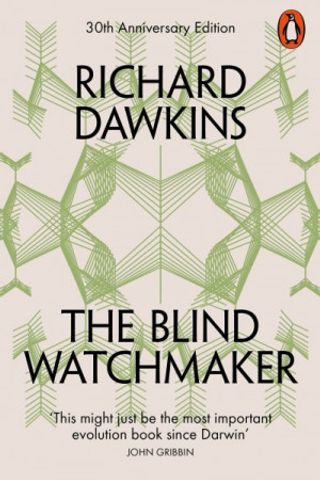
Resenhas (1)Ver mais

Mario24/10/2023Resenhou um livro
The antithesis of chance
You may throw every structure of a watch together at random, over and over again for a billion years, and the chance of it becoming a perfectly functioning would be so remote that it could only be explained as craftsmanship. What about human beings? How could such a simple matter emerge from a bath of neurotransmitters inside the strangeness of quanta and acquire an integrated system that is able to think, calculate and move with precision? This couldnt happen by chance, right? Random forces in William Paley words: cannot explain how all these beautiful springs and gears came together to tell time. Nor can they explain the organs of living things. No purposeless process could ever such intricate detail and no blind leap of chance could ever construct such complex machinery. Just as watches requires the existence of a Watchmaker, so nature requires the existence of an omnipotent designer...That seems like a very good explanation, right? Professor and Dr. Richard Dawkins is one-of-a-kind ethologist and biologist responsible for passing along, refining and breaking paradigms of the evolutionary system. Ascending one order of magnitude from reductionism, we have what we understand as living creatures. Such creatures, as science explains, arise from a very long excruciating process regimented by a selective process which punishes the indulgent and passes along the eternal gene. Picture this: With a population of certain animals which has many different configurations, some percentage of animals may be eaten less often. A simple differential edge of survival from animals who can blend, say, with the environment is enough to propel evolution and to turn the majority of the population into something entirely new. Then, this propulsive force of selection carries on the differential survival all the way up, until we come to the point that 99% of animals have, for example, the same colors as leafs, which are better for hiding. As expected for any book written by Professor Dawkins, he goes even further by questioning what really is beneath sheer luck, miracles, major improbabilities and fantastic coincidences. The main thesis is focused on breaking the events into a cumulative series of small chance events like the waiting period for random thermal jostling of atoms to generate a self-replicating molecule, the errors in high-fidelity copying genes, the classification of cells to produce large different bodies, the conditions tracking the environment, the impossibility of an absolute taxonomy, and so on. Suddenly, the watchmaker in Mr. Paleys analogy becomes blind and chance becomes a minor ingredient in the recipe. Our framework thanks to many like Darwin and Professor Dawkins, can now fathom the cumulative selection timescales, can imagine internal models using visual and sound information in very different ways from ours, like the echolocation of bats, and can even recognize that our fine chiseled large body equipped with fine networks, is equally an impressive accomplishment, but far from perfection. This is a very important work written by the polemic, Mr. Dawkins. I feel very honored to live in the same era as him and I admire his courage to fight, with pure logical reason and for so many decades, the dogmas (Which are still very strong to this day). The cherries on top of this work to sustain arguments and break some fallacies makes the book relatively extensive, but it definitely corroborates to the full and right scope about ethology, biology and natural selection. Link to my highlights: https://drive.google.com/file/d/19Iz3hhzCc5uhbhBogemWg7eM2m4Kwdmh/view?usp=sharing
curtir
Estatísticas
Avaliações
4.6 / 19- 5 estrelas63%
- 4 estrelas37%
- 3 estrelas0%
- 2 estrelas0%
- 1 estrelas0%