In Focus, Psychologist and journalist Daniel Goleman, author of the #1 international bestseller Emotional Intelligence, offers a groundbreaking look at today’s scarcest resource and the secret to high performance and fulfillment: attention. Combining cutting-edge research with practical findings, Focus delves into the science of attention in all its varieties, presenting a long overdue discussion of this little-noticed and under-rated mental asset. In an era of unstoppable distractions, Goleman persuasively argues that now more than ever we must learn to sharpen focus if we are to survive in a complex world. Goleman boils down attention research into a threesome: inner, other, and outer focus. Drawing on rich case studies from fields as diverse as competitive sports, education, the arts, and business, he shows why high-achievers need all three kinds of focus, and explains how those who rely on Smart Practices—mindfulness meditation, focused preparation and recovery, positive emotions and connections, and mental “prosthetics” that help them improve habits, add new skills, and sustain greatness—excel while others do not.
Focus - The Hidden Driver of Excellence
Daniel Goleman
Harper
2013
323 páginas
10h 46m
ISBN-10: B00BATG220
Edições (1)
Ver mais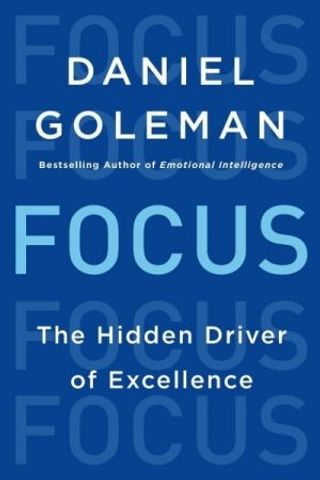
Resenhas (1)Ver mais

Felipe Moitta10/06/2016Resenhou um livro
“For leaders to get results they need all three kinds of focus. Inner focus attunes us to our intuitions, guiding values, and better decisions. Other focus smooths our connections to the people in our lives. And outer focus lets us navigate in the larger world. A leader tuned out of his internal world will be rudderless; one blind to the world of others will be clueless; those indifferent to the larger systems within which they operate will be blindsided.” “how we deploy our attention determines what we see. Or as Yoda says, ‘Your focus is your reality’.” “what information consumes is the attention of its recipients. Hence a wealth of information creates a poverty of attention.” “The dividing line between fruitless rumination and productive reflection lies in whether or not we come up with some tentative solution or insight and then can let those distressing thoughts go - or if, on the other hand, we just keep obsesing over the same loop of worry.” “Since focus demands we tune out our emotional distractions, our neural wiring for selective attention includes that for inhibiting emotion. That means those who focus best are relatively immune to emotional turbulence, more able to stay unflappable in a crisis and to keep on an even keel despite life’s emotional waves.” “The power to disengage our attention from one thing and move it to another is essential for well-being.” “attention can be seen as a capacity distributed among many people, as can memory or any cognitive expertise. “What’s trending now” indexes how we are allotting our collective attention.” “Full absorption in what we do feels good, and pleasure is the emotional marker for flow.” “Apart from a career change, there are several doorways to flow. One may open when we tackle a task that challenges our abilities to the maximum - a “just-manageable” demand on our skills. Another entryway can come via doing what we are passionate about; motivation sometimes drives us into flow. But either way the final common pathway is full focus: these are each ways to ratchet up attention. No matter how you get there, a keen focus jump-starts flow.” “On the other hand, another large group are stuck in the state neurobiologists call “frazzle,” where constant stress overloads their nervous system with floods of cortisol and adrenaline. Their attention fixates on their worries, not their job. This emotional exhaustion can lead to burnout.” “Bottom-up has become the phrase of choice in cognitive science for such workings of this lower-brains neural machinery. By the same token, ‘top-down’ refers to mental activity, mainly within the neocortex, that can monitor and impose its goals on the subcortical machinery. It’s as though there were two minds at work. The bottom-up is: - faster in brain time, which operates in milliseconds - involuntary and automatic: always on - intuitive, operating through networks of association - impulsive, driven by emotions - executor of our habitual routines and guide for our actions - manager for our mental models of the world By contrast, the top-down mind is: - slower - voluntary - effortful - the seat of self-control, which can (sometimes) overpower automatic routines and mute emotionally driven impulses - able to learn new models, make new plans, and take charge of our automatic repertoire - to an extent” “Through what amounts to an optical illusion of the mind, we take what’s within our awareness to equal the whole of the mind’s operations. But in fact the vast majority of mental operations occur in the mind’s backstage, amid the purr of bottom-up systems. Much (come say all) of what the top-down mind believes it has chosen to focus on, think about, and do is actually plans dictated bottom-up. If this were a movie, psychologist Daniel Kahneman wryly notes, the top-down mind would be a ’supporting character who believes herself to be the hero.’” “The survival demands of early evolution packed our brains with preset bottom-up programs for procreation and child-rearing, for what’s pleasurable and what’s disgusting, for running from a threat or toward food, and the like. Fast-forward to today’s very different world: we so often need to navigate life top-down despite the constant underflow of bottom-up whims and drives.” “Another example: obesity. Researchers find that the prevalence of obesity in the United States over the last thirty years tracks the explosion of computers and tech gadgets in people’s lives - and suspect this is no accidental correlation. Life immersed in digital distractions creates a near-constant overload. And that overload wears out self-control.” “The automatic system works well most of the time: we know what’s going on and what to do and can meander through the demands of the day well enough while we think about other things. But this system has weaknesses, too: our emotions and our motives create skews and biases in our attention that we typically don’t notice, and don’t notice that we don’t notice. Take social anxiety. In general, anxious people fixate on anything even vaguely threatening; those with social anxiety compulsively spot the least sign of rejection, such as a fleeting expression of disgust on someone’s face - a reflection of their habitual assumption that they will be social flops. Most of this emotional transaction goes on out of awareness, leading people to avoid situations where they might get anxious.” “Walk into someone’s office, and what’s the first thing you notice? That’s a clue to what’s driving your bottom-up focus in that moment.” “We’re most prone to emotions driving focus this way when our minds are wandering, when we are distracted, or when we’re overwhelmed by information - or all three.” “That amygdala-prefrontal neuronal superhighway has branches to the left and right prefrontal sides. When we are hijacked the amygdala circuitry captures the right side and takes over. But the left side can send signals downward that calm the hijack.” “Active engagement of attention signifies top-down activity, an antidote to going through the day with a zombie-like automaticity. We can talk back to commercials, stay alert to what’s happening around us, question automatic routines or improve them. This focused, often goal-oriented attention, inhibits mindless mental habits.” “Every variety of attention has its uses. The very fact that about half of our thoughts are daydreams suggests there may well be some advantages to a mind that can entertain the fanciful. We might revise our own thinking about a ‘wandering mind’, by considering that rather than wandering away form what counts, we may well be wandering toward something of value.” “But once we’ve hit upon a great creative insight, we need to capture the prize by switching to a keen focus on how to apply it. Serendipity comes with openness to possibility, then honing in on putting it to use.” “A classic model of the stages of creativity roughly translates to three modes of focus: orienting, where we search out and immerse ourselves in all kinds of input; selective attention on the specific creative challenge; and open awareness, where we associate freely to let the solution emerge - then home in on the solution.” “The intuitive mind is a sacred gift and the rational mind is a faithful servant’, Albert Einstein once said. ‘We have created a society that honors the servant and has forgotten the gift’.” “Where do our thought wander when we’re not thinking of anything in particular? Most often, they are all about me. The “me” weaves together our sense of self by telling our story - fitting random bits of life into a cohesive narrative. This it’s -all-about-me story line fabricates a feeling of permanence behind our ever-shifting moment-to-moment experience.” “It’s not the chatter of people around us that is the most powerful distractor, but rather the chatter of our own minds. Utter concentration demands these inner voices be stilled. Start to subtract sevens successively from 100 and, if you keep your focus on the task, your chatter zone goes quiet.” “In Huxley’s vision the eternal now harbors everything we need to fulfillment. Yet the human ability to think about things not happening in that eternal present represents a prerequisite for all the achievements of our species that required planning, imagination, or logistic skill. And that’s just about everything that’s a uniquely human accomplishment.” “Noticing that our mind has wandered marks a shift in brain activity; the greater this meta-awareness, the weaker the mind wandering becomes.” “The capacity to remain with your attention open in a panoramic awareness lets you attend with equanimity, without getting caught in a bottom-up capture that ensnares the mind in judging and reactivity, whether negative or positive. It also decreases the mind wandering. The goal, is to be better able to engage in mind wandering when you want to, and not otherwise” “Tightly focused attention gets fatigued - much like an overworked muscle - when we push to the point of cognitive exhaustion. The signs of mental fatigue, such as a drop in effectiveness and a rise in distractedness and irritability, signify that the mental effort needed to sustain focus has depleted the glucose that feeds neural energy.” “What allows people to have such a strong inner compass, a North Star that steers them through life according to the dictates of their deepest values and purposes? Self-awareness, particularly accuracy in decoding the internal cues of our body’s murmurs, holds the key.” “The brain harbors our deepest sense of purpose and meaning in these subcortical regions - areas connected poorly to the verbal areas of the neocortex, but richly to the gut.” “People who are oblivious to their own emotions (and also to how other people feel) have sluggish insula activity compared with the high activation found in people highly attuned to their inner emotional life.” “Our ‘gut feelings’ are messages from the insula and other bottom-up circuits that simplify life decision for us by guiding our attention toward smarter options. The better we are at reading these messages, the better out intuition.” “There are two major streams of self-awareness: “me”, which builds narratives about our past and future; and “I”, which brings us into the immediate present.” “All to often when we ‘lose it’ and fall back on a less desirable way of acting, we’re oblivious to what we do. And if no one tells us, we stay that way.” “I am what I think you think I am.” “self-knowledge begins with self-revelation.” “President Bush’s inner circle and their decision to invade Iraq based on imaginary ‘weapons of mass destruction’ offers a classic example. So do the circles of financial players who fostered the mortgage derivatives meltdown. Both instances of catastrophic groupthink entailed insulated groups of decision-makers who failed to ask the right questions or ignores disconfirming data on a self-affirming downward spiral. Cognition is distributed among members of a group or network: some people are specialists in one area, while others have complementary strengths of expertise. When information flows most freely among the group and into it, the best decisions will be made. But groupthink begins with the unstated assumption We known everything we need to.” “It takes meta-cognition - in this case, awareness of our lack of awareness - to bring to light what the group has buried in a grave of indifference or suppression. Clarity begins with realising what we do not notice - and don’t notice that we don’t notice.” “Another antidote to groupthink: expand your circle of connection beyond your comfort zone and inoculate against in-group isolation by building an ample circle of no-BS confidants who keep you honest.” “Attention regulates emotion” “Willpower emerged as a completely independent force in life success - in fact, for financial success, self-control in childhood proved a stronger predictor than either IQ or social class of the family of origin.” “Botton line: kids can have the most economically privileged childhood, yet if they don’t master how to delay gratification in pursuit of their goals those early advantages may wash out in the course of life.” “The epidemics of obesity in developed countries, research suggests, may be due in part to our greater susceptibility, while distracted, to go on automatic and reach for sugary fatty foods.” “We cannot not make meaning out of what someone tells us, whether in words or just gestures, or both together. Everything we attend to in another person generates meaning at an unconscious level, and our bottom-up circuitry constantly reads it.” “online we rely on cognitive empathy, the variety of mind-reading that lets us infer what’s going on in someone else’s mind. Cognitive empathy gives us the ability to understand another person’s ways of seeing and of thinking. Seeing through the eyes of other and thinking along their lines helps you choose language that fits their way of understanding.” “Compassion builds on empathy, which in turn requires a focus on others. In self-absorbed, we simply do not notice other people.” “Watch where people’s eyes go when someone brings an adorable baby into a room, and you see the mammalian brain center for caring leap into action.” “Those in whom the stirring of sympathetic feelings becomes too strong can suffer themselves - in the helping professions this can sometimes lead to emotional exhaustion and compassion fatigue. And those who protect themselves against sympathetic distress by deadening feeling can lose touch with empathy. The neural road to empathic concern takes top-down management of personal distress but without numbing us to the pain of others.” “But there are exceptions. For one, pain empathy ends if we don’t like the people in pain - for instance, if we think they have been unfair - or if we see them as a part of a group we dislike.” “When resources are scarce the need to compete for them can sometimes suppress empathic concern, and competition is part of life in almost any social group, whether for food, mates, or power - or an appointment with a doctor.” “Let me see if I have this right…’ It argues that taking just a few moments to pay attention to how a patient feels about her illness builds emotions connection.” “The TPJ (temporal-parietal junction) protects focus by wailing off emotions along with other distractions, and helps keep a distance between oneself and others.” “The cost of being too empathic is having upsetting, intrusive thoughts that compete for attention with medical imperatives.” “They instinctively follow the universal algorithm for etiquette, to behave in ways that put others at ease.” “The workshop employs methods of the theater of the oppressed, which is designed to help a relatively privileged audience empathise with the emotional reality of victims of oppression.” “When the method works, people like Miguel gain a new perspective on themselves by watching their stories as seen through another person’s eyes.” “Those with few resources and a fragile perch on stability ‘need to lean on people’. So the poor are particularly attentive to other people and their needs. The wealthy, on the other hand, can hire help - pay for a day care center or even an au pair. This means that rich people can affor to be less aware of the needs of other people, and so can be less attentive to them and their suffering.” “The longer someone ignores an email before finally responding, the more relative social power that person has.” “Where we see ourselves on the social ladder seems to determine how much attention we pay: more vigilant when we feel subordinate, less so when superior. The corollary: the more you care about someone, the more attention you pay - and the more attention you pay, the more you care. Attention interweaves with love.” “Systems are virtually invisible to the naked eye, but their workings can be rendered visible by gathering data from enough points that the outlines of their dynamics come into focus. The more data, the clearer the map becomes. Enter the era of big data.” “Big data lets us know where the collective attention focuses.” “We are prepared by our biology to eat and sleep, mate and nurture, fight-or-flee, and exhibit all the other built-in survival responses in the human repertoire. But as we’ve seen, there are no neural systems dedicated to understanding the larger systems within which all this occurs. Systems are, at first glance, invisible in our brain - we have no direct perception of any of the multitude of systems that dictate the realities of our lives. We understand them indirectly, through mental models (the meanings of wave swells, constellations, and the flight of seabirds are each such models) and take action based on those models.” “The invention of culture was a huge innovation for homo sapiens: creating language and a shared cognitive web of understanding that transcends any individual’s knowledge and life span - and that can be drawn on as needed and passed on to new generations. Cultures divide up expertise: there are midwives and healers, warriors and builders, farmers and weavers. Each of these domains of expertise can be shared, and those who hold the deepest reservoir of understanding in each are the guides and teachers for others.” “When one part of the chain optimizes for herself, it tends to suboptmize the whole.” “The first breakthrough in the magazine dilemma was simply getting all these players together - and getting the system into the room.” “His classic textbook on system thinking applied to organizations and other complex entities makes the fundamental point that what we think of as ‘side effects’ are misnamed. In a system there are no side effects - just effects, anticipated or not. What we see as ‘side effects’ simply reflect our flawed understanding of the system. In a complex system, cause and effect may be more distante in time and space than we realize.” “The disconnect between such systems and how we relate to them begins with distortions in our mental models. We blame those other drivers clogging the road but fail to take into account the systems dynamics that put them there. Much of the time people attribute what happens to them to events close in time and space, when in reality it’s the result of the dynamics of the larger system within which they are embedded” “But this does not happen if we hear of potential dangers that might emerge in years or centuries to come; the amygdala hardly blinks.” “So to meet the challenge of impending system collapse we need what amounts to a prosthesis for the mind.” “The future is already here. It’s just not evenly distributed.” “The arbiter of this cognitive tipping point resides in the same neurons that keep the turbulent impulses of the amygdala damped down. When we hit cognitive overwhelm, the dorsolateral gives up, and our decisions and choices get worse as our anxiety rises. We’ve reached the pivot where more data leads to poor choices.” “Our cortical pattern detector seems designed to simplify complexity into manageable decision rules.” “When we are motivated by positive emotions, what we do feels more meaningful and the urge to act lasts longer. It all stays longer in attention. In contrast, fear of global warming’s impacts may get our attention quickly, but once we do one thing and feel a little better, we think we’re done.” “It takes a panoramic attention to appreciate system-level interactions. You need to be attentionally flexible, so you can expand and contract your focus, like a zoom lens, to see the elements big and small.” “The more well-informed minds the better. When we confront an immense system, attention needs to be widely distributed. One set of eyes can see only so far; a swarm grasps much more. The most robust entity takes in the greatest amount of relevant information, understands it most deeply, and responds most nimbly. We, collectively, can become that entity.” “For instance, in his much-cited study of violinists—the one that showed the top tier had practiced more than 10,000 hours—Ericsson found the experts did so with full concentration on improving a particular aspect of their performance that a master teacher identified.” “The mental analog of lifting a free weight over and over is noticing when our mind wanders and bringing it back to target.” “Negativity focuses us on a narrow range—what’s upsetting us.” “when we’re feeling good our awareness expands from our usual self-centered focus on “me” to a more inclusive and warm focus on “we.” “Talking about your positive goals and dreams activates brain centers that open you up to new possibilities. But if you change the conversation to what you should do to fix yourself, it closes you down,” “A focus on our strengths, Boyatzis argues, urges us toward a desired future and stimulates openness to new ideas, people, and plans. In contrast, spotlighting our weaknesses elicits a defensive sense of obligation and guilt, closing us down.” “You need the negative focus to survive, but a positive one to thrive,” says Boyatzis. “You need both, but in the right ratio.” “Analyzing hundreds of teams, Losada determined that the most effective had a positive/negative ratio of at least 2.9 good feelings to every negative moment (there’s an upper limit to positivity: above a Losada ratio of about 11:1, teams apparently become too giddy to be effective). The same ratio range holds for people who flourish in life, according to research by Barbara Fredrickson, who is a psychologist at the University of North Carolina (and a former research associate of Losada).” “A conversation that starts with a person’s dreams and hopes can lead to a learning path yielding that vision. This conversation might extract some concrete goals from the general vision, then look at what it would take to accomplish those goals—and what capacities we might want to work on improving to get there.” “Whether we’re trying to hone a skill in sports or music, enhance our memory power, or listen better, the core elements of smart practice are the same: ideally, a potent combination of joy, smart tactics, and full focus.” “But you’ll see a child who is really frustrated or upset go over to the peace corner and apply some strategies they’ve learned. The big lesson is to tune in and know what to do to care for yourself.” “The stoplight strengthens circuitry between the prefrontal cortex—the brain’s executive center, just behind the forehead—and the midbrain limbic centers, that cauldron of id-driven impulses. The feeling faces encourage connectivity across the two halves of the brain, boosting the ability to reason about feelings. This up-down, left-right linkage knits a child’s brain together, seamlessly integrating systems that, if left to themselves, create the chaotic universe of a three-year-old.” “Walter Mischel taught four-year-olds how to resist those luscious marshmallows by seeing them differently—for example, focusing on their color. And Mischel is the first to say that even a four-year-old who just can’t wait and grabs the marshmallow right off the bat can still learn to delay gratification—impulsivity is not necessarily something he’s stuck with for life.” “One strong conclusion by the scientists who studied the Dunedin, New Zealand, kids was the need for interventions that boost self-control, particularly during early childhood and the teen years.” “saw lessons in emotional intelligence—that is, in self-awareness, self-management, empathy, and social skills—as synergistic with standard academic courses. Now I’m realizing that the basics of attention training are a next step, a low-tech method for boosting neural circuitry at the heart of emotional intelligence.” “When you have elements like regular quiet time,” says Lantieri, “a Peace Corner where kids can go on their own when they need to calm down, and mindfulness, you get more calmness and self-management on the one hand, and enhanced focus and the ability to sustain it on the other. You change their physiology and self-awareness.” “By teaching kids the skills that help them calm down and focus, “we lay a foundation of self-awareness and self-management on which you can scaffold the other SEL skills like active listening, identifying feelings, and so on.” “The kids understand that when they don’t do well on a test, it’s not because they are stupid, but that ‘When I’m super-nervous it’s in there but I can’t access it. But I know how to focus and calm—then I’ll get to it.’ They have the attitude I’m in charge of myself now—I know what to do that can help.” “Wandering minds punch holes in comprehension. The antidote for mind wandering is meta-awareness, attention to attention itself, as in the ability to notice that you are not noticing what you should, and correcting your focus. Mindfulness makes this crucial attention muscle stronger.” “Our patients typically come in because they’re overwhelmed by stress or pain. But there’s something about paying attention to your own inner states, and seeing what needs to change in your life. People on their own stop smoking or change the way they eat and start losing weight, though as a rule we never say anything directly about these.” “Psychiatrist Daniel Siegel of the University of California, Los Angeles, describes the wiring that links attuning to ourselves and attuning to others as a “resonance circuit” that mindfulness practice strengthens. A well-connected life, Dr. Siegel argues, begins with the circuitry for mindfulness in the brain’s prefrontal executive centers, which do double duty: they are also at play when we attune in rapport.” “Enhanced executive function widens the gap between impulse and action, in part by building meta-awareness, the capacity to observe our mental processes rather than just be swept away by them. This creates decision points we did not have before” “Center for Contemplative Mind in Society, to design an experience that enhances self-awareness—for example, by using a body scan meditation to tune in to feelings. An inner compass helps greatly at Google,” “They’re building the muscle of attention deployment so they can choose what aspect of experience to attend to. It’s a volitional redirection of attention. And they’re more able to use these attention skills when they are really needed. “We also found a boost in empathic concern for others, and being able to listen better,” Goldin said. “One is an attitude, the other the actual skill, the muscle.” “Mindfulness gives us a greater level of choice in focus.” “Mindfulness develops our capacity to observe our moment-to-moment experience in an impartial, nonreactive manner. We practice letting go of thoughts about any one thing and open our focus to whatever comes to mind in the stream of awareness, without getting lost in a torrent of thoughts about any one thing.” “Building executive control helps especially for those of us for whom every setback, hurt, or disappointment creates endless cascades of rumination. Mindfulness lets us break the stream of thoughts that might otherwise lead to wallowing in misery, by changing our relationship to thought itself. Instead of being swept away by that stream we can pause and see that these are just thoughts—and choose whether or not to act on them.” “That disintegration of our shared focus was a moment familiar from hundreds of other meetings—a signal that the group’s efficiency was tanking. But suddenly one of the people there said, “Time for some mindful moments,” got up, and rang a small gong. We all sat there together in silence for a few minutes until the gong rang again, and then resumed our meeting—but with renewed energy.” “Mindfulness of self, Sachs argues, would include a more accurate reading of what makes us truly happy.” “Intangibles like warm connections with people we love and meaningful activities make people far happier than say, shopping or work. But we can be poor judges of what will make us feel good. Sachs argues that if we are more mindful of how we use our money we will be less likely to fall prey to seductive ads for products that will not make us any happier.” “Attention in organizations, as with individuals, has a limited capacity. Organizations, too, have to choose where to allocate attention, focusing on this while ignoring that. An organization’s core functions—finance, marketing, human resources, and the like—describe how a particular group focuses.” “Stories do more than grab our attention: they keep it.” “Leadership itself hinges on effectively capturing and directing the collective attention.” “Leading attention requires these elements: first, focusing your own attention, then attracting and directing attention from others, and getting and keeping the attention of employees and peers, of customers or clients.” “But he knew that in order to simplify effectively you need to understand the complexity that you are reducing.” “A single decision to simplify, like Jobs’s dictum that Apple products allow a user to do anything in three clicks or less, demanded a deep understanding of the function of the commands and buttons being given up, and finding elegant alternatives.” “Apple and Singer left fresh footprints in the snow that their competitors followed in a desperate game of catching up. Today a mini-industry of consultants stands ready to guide companies through a standard playbook of strategic choices. But those off-the-shelf strategies fine-tune an organization’s tactics—they don’t change the game.” “The original meaning of strategy was from the battlefield; it meant “the art of the leader”—back then, generals. Strategy was how you deployed your resources; tactics were how battles were fought.” “to find winning strategies “requires creativity and insight.” Those two ingredients take both inner and outer focus.” “The best leaders have systems awareness, helping them answer the constant query, Where should we head and how? The self-mastery and social skills built on self and other focus combine to build the emotional intelligence that drives the human engine needed to get there. A leader needs to check a potential strategic choice against everything she knows. And once the strategic choice gets made, the leader needs to communicate it with passion and skill, drawing on cognitive and emotional empathy. But those personal skills alone will founder if leaders lack strategic wisdom.” “The name of Grove’s book—Only the Paranoid Survive—tacitly nods to the necessity of vigilance, scanning for the telling detail on the horizon.” “First the people running the old system don’t notice the change. When they do, they assume it’s minor. Then it’s a niche, then a fad. And by the time they understand that the world has actually changed, they’ve squandered most of the time they had to adapt.” “An organization that focuses inwardly may execute superbly. But if it has not attuned to the larger world in which it operates,” “A mental balancing act—exploring the new while exploiting what’s working—does not come naturally.” “But those companies that can both exploit and explore—as Samsung has done with smartphones—are “ambidextrous”: they separate each strategy into units, with very different ways of operating and cultures.” “Being in survival mode narrows our focus.” [creative confidence - opção] “But prospering is no guarantee of ambidexterity, either. That switch can be hardest for those caught in what Intel’s Grove calls the “success trap.” He observes that every company will face a point when it will have to change dramatically to survive, let alone raise its performance. “Miss the moment,” he warns, “and you start to decline.” “Exploitation was accompanied by activity in the brain’s circuitry for anticipation and for reward—it feels good to coast along in a profitable, familiar routine. But exploration mobilized activity in the brain’s executive centers and those for controlling attention; searching for alternatives to a current strategy, it seems, demands intentional focus.” “Why did he buy them? “I bought what I liked,” he explains. “I go by my gut.” When we make a decision like that, subcortical systems operate outside conscious awareness, gathering the decision rules that guide us and store our life wisdom—and deliver their opinion as a felt sense. That subtle stirring—This feels right—sets our direction even before we can put that decision into words.” “The most successful entrepreneurs gather data that might be relevant to a key decision far more widely—and from a larger variety of sources—than most people would think relevant.” “The sweet spot for smart decisions, then, comes not just from being a domain expert, but also from having high self-awareness. If you know yourself as well as your business, then you can be shrewder in interpreting the facts (while, hopefully, safeguarding against the inner distortions that can blur your lens).” “Otherwise we’re left with cold rationality as embodied, for instance, in decision trees (applications of what’s known as “expected utility theory”), where we weight and compute the pros and cons of all relevant factors. One problem: life rarely arranges itself so neatly. Another: our bottom-up mind harbors crucial information that our top-down brain can’t access directly, let alone put into that decision tree. What looks good on paper may not be so great in actuality: say, unregulated markets for subprime derivatives or invading Iraq.” “The most successful leaders are constantly seeking out new information,” says Ruth Malloy, global director of Hay Group’s leadership and talent practice. “They want to understand the territory they operate in. They need to be alert to new trends, and to spot emerging patterns that might matter to them.” “Inspiring leadership demands attuning both to an inner emotional reality and to that of those we seek to inspire.” “Attention gets talked about only indirectly in the emotional intelligence world: as “self-awareness,” which is the basis of self-management; and as “empathy,” the foundation for relationship effectiveness. Yet awareness of our self and of others, and its application in managing our inner world and our relationships, is the essence of emotional intelligence.” “The neural circuits for attention and those for feelings overlap in many ways, sharing neural pathways or interacting.” “You can, but the question is how often you do this.” “Those who, like that too critical lawyer, have this high-achieving, super-focused style are called “pacesetters,” meaning they like to lead by example, setting a fast pace they assume others will imitate. Pacesetters tend to rely on a “command and coerce” leadership strategy where they simply give orders and expect obedience. Leaders who display just the pacesetting or command style—or both—but not any others create a toxic climate, one that dispirits those they lead. Such leaders may get short-term results through personal heroics, like going out and getting a deal themselves, but do so at the expense of building their organizations. “Every organization needs people with a keen focus on goals that matter, the talent to continually learn how to do even better, and the ability to tune out distractions. Innovation, productivity, and growth depend on such high-performers. But only to a point. Ambitious revenue targets or growth goals are not the only gauge of an organization’s health—and if they are achieved at a cost to other basics, the long-term downsides, like losing star employees, can outweigh short-term successes as those costs lead to later failures.” “Focus is not just selecting the right thing, but also saying no to the wrong ones. But focus goes too far when it says no to the right things, too.” “The antidote: realizing the need to listen, motivate, influence, cooperate—an interpersonal skill set that pacesetting leaders are typically not familiar with using.” “To anticipate how people will react, you have to read people’s reactions to you,” says Spencer. “That takes self-awareness and empathy in a self-reinforcing cycle. You become more aware of how you’re coming across to other people.” “If you manage yourself better, you will influence better,” “Academic abilities (and the IQ they roughly reflect) signal what level of cognitive complexity someone can handle,” “nonacademic abilities like empathy typically outweigh purely cognitive talents in the makeup of outstanding leaders.” “And yet self-awareness rarely shows up in those lists of competencies that organizations come up with by analyzing the strengths of their star performers. This subtle variety of focus may be too elusive, though abilities reflecting high cognitive control, which builds on this foundation of self-awareness, are frequent, and include persistence, resilience, and the drive to achieve goals.” “Empathy in its many forms, from simple listening to reading the paths of influence in an organization, shows up more often in leadership competence studies. Most of the competencies for high-performing leaders fall into a more visible category that builds on empathy: relationship strengths like influence and persuasion, teamwork and cooperation, and the like. But these most visible leadership abilities build not just on empathy, but also on managing ourselves and sensing how what we do affects others.” “that informal leader has strengths in empathy in balance with other abilities, the research shows, the team’s performance tends to be higher. “If the leader has low empathy,” Druskat told me, “and a high level of achievement drive, the leader’s goal-orientation drags down the team performance. But, importantly, if the leader has high levels of empathy and low levels of self-control, performance is also reduced—too much empathy gets in the way of calling people on their misbehaving.” “Despite his lofty role, chatting with workers on the factory floor was where he felt most comfortable. He knew he should be doing strategic thinking, but he preferred being a “people person.” “He didn’t have the right balance between his other focus and outer focus,” says Spreier. “He was misfocused, and he wasn’t coming up with strategy well. He didn’t enjoy it—intellectually he knew he should, but emotionally he just was not there.” “Of course companies need leaders who beam in on getting better results. But those results will be more robust in the long run when leaders don’t simply tell people what to do or just do it themselves, but have an other focus: they are motivated to help other people be successful, too. They realize, for instance, that if someone lacks a given strength today, they can work to develop it. Such leaders take the time to mentor and advise.” “One hurdle in such a wide-aperture view, it turns out, is the implicit attitude at work that professionalism demands we ignore our emotions. Some trace this emotional blind spot to the work ethic embedded in the norms of workplaces in the West, which sees work as a moral obligation that demands suppressing attention to our relationships and what we feel.” “Two of the main mental ruts that threaten the ability to notice are unquestioned assumptions and overly relied-on rules of thumb. These need to be tested and refined time and again against changing realities. One way to do this is through what Harvard psychologist Ellen Langer calls environmental mindfulness: constant questioning and listening; inquiry, probing, and reflecting—gathering insights and perspectives from other people.” “While some of us have a knack for systems, for many or most leaders—like this executive—it is an acquired strength. But systems awareness in the absence of self-awareness and empathy will not be sufficient for outstanding leadership. We need to balance the triple focus, not depend on having just one strength.” “An executive at one bank explained to me how the bank has created a career ladder for those with this talent set that allows them to progress in status and salary on the basis of their solo talents as brilliant systems analysts rather than by climbing the leadership ranks.” “top-performing teams follow norms that enhance the collective self-awareness, such as by surfacing simmering disagreements and settling them before they boil over.” “One resource for dealing with the team’s emotions: create time and space to talk about what’s on people’s mind.” “They all agreed to a norm that said, ‘Anyone, anytime, can pick up the elephant and say, “I want to raise an elephant,” ’ meaning bring up something that’s bothering them.” “To harvest the collective wisdom of a group, you need two things: mindful presence and a sense of safety,” “Being present,” Wolff clarifies, “means being aware of what’s going on and inquiring into it. I’ve learned to appreciate negative emotions—it’s not that I enjoy them, but that they signal a pot of gold at the end of the rainbow if we can stay present to them. When you feel a negative emotion, stop and ask yourself, ‘What’s going on here?’ so you can begin to understand the issue behind the feelings and then make what is going on within you visible to the team. But that requires the group be a safe container, so you can say what’s actually going on.” “Top teams also periodically reflect on their functioning as a group to make needed changes.” “having fun is a sign of shared flow. Tim Brown, CEO of IDEO, an innovations consultancy, calls it “serious play.” He says, “Play equals trust, a space where people can take risks. Only by taking risks do we get to the most valuable new ideas.” “Politicians are in charge of our welfare,” says Weber. “They need to know people will thank them later for a hard decision now. It’s like raising teenagers—sometimes thankless in the short term, but rewarding in the long.” “Reinventing business for the long future could mean finding shared values supported by all stakeholders, from stock owners to employees and customers to communities where a company operates. Some call it “conscious capitalism,” “a leader is to articulate such shared values effectively, he or she must first look within to find a genuinely heartfelt guiding vision.” “But there’s a hidden ingredient in any true solution: enhancing our attention and understanding—in ourselves, in others, in our communities and societies.” “Is it just for me, or for others? For the benefit of the few, or the many? For now, or for the future?"
curtir
Estatísticas
Avaliações
3.8 / 13- 5 estrelas38%
- 4 estrelas31%
- 3 estrelas23%
- 2 estrelas0%
- 1 estrelas8%
Daniel Goleman
Daniel Goleman (7 de março de 1946) é um psicólogo dos Estados Unidos da América. Escritor de renome internacional, psicólogo, jornalista da ciência e consultante incorporado. Ele é filho de um casal de professores universitários de Stockton, Califórnia, onde o seu pai ensinava literatura mundial no San Joaquin Delta College, enquanto sua mãe ensinava no departamento social, que é agora a University of the Pacific. Goleman recebeu o seu doutoramento em Harvard, onde também dava aulas.
31 Livros
190 Seguidores