As with all of Clark's previous books, this insightful and path-breaking Moscow sequel to her Petersburg will become an instant classic. Mixing ideology, literature, film, architecture, critical theory, politics, and everyday life, Clark has given us a landmark study, for no other book has encompassed the whole spectrum of Soviet cultural and intellectual history in the era of high Stalinism, conceptualized it so imaginatively and captured its pervasive terror. (Evgeny Dobrenko, University of Sheffield) With her study of Stalinist "cosmopolitanism" and the dream of Moscow as the mecca of world culture, Clark once again blazes a new trail that many others will follow. Four high-profile Soviet intellectuals–the "cosmopolitan patriots" Sergei Eisenstein, Mikhail Koltsov, Ilya Ehrenburg and Sergei Tretyakov–served as intermediaries with world (particularly germanophone) culture and European leftist intellectuals in the era of the Popular Front, and their colorful stories provide the backbone of an enthralling narrative whose subjects range from literary translation and Soviet worship of the word to the Moscow show trials and the Spanish Civil War. (Sheila Fitzpatrick, University of Chicago) A foundational challenge to the model of "insular Stalinism," this volume is essential to debates on trans-European cultural history and global cosmopolitanism. It will be an invaluable touchstone for a new generation of scholars to question the remnants of cold-war research. (Nancy Condee, University of Pittsburgh) Clark's field is the vast canvas of 1930s culture as a whole, particularly the nexus between literature, architecture, and power. Her agenda is nothing less than to insert a largely missing international dimension to our understanding of Stalinist culture. It is difficult to overstate the implications of this trailblazing work. (Michael David-Fox, author of Showcasing the Great Experiment: Cultural Diplomacy and Western Visitors to Soviet Russia, 1921-1941)
Moscow, the Fourth Rome - Stalinism, Cosmopolitanism, and the Evolution of Soviet Culture, 1931-1941
Katerina Clark
Harvard University Press
2011
432 páginas
14h 24m
ISBN-13: 9780674057876
Edições (1)
Ver mais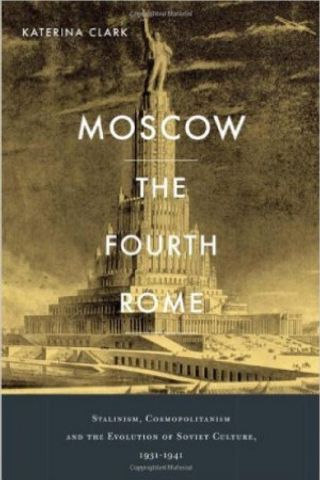
Estatísticas
Avaliações
0 / 0- 5 estrelas0%
- 4 estrelas0%
- 3 estrelas0%
- 2 estrelas0%
- 1 estrelas0%