The Gorky Poems / Poemas a Gorky by Jerome Rothenberg, released in 1966, represents a pivotal moment in the career of a major American poet whose investigative, transnational work as a poet, editor, translator, and writer has continued to break new ground and influence readers, writers, and scholars of poetry. It also offers a glimpse into the international and politicized aesthetics of its publisher, El Corno Emplumado (The Plumed Horn), an influential literary magazine and book imprint that provided rare opportunities for innovative writers and artists of different cultures from around the world to discover each other. The Gorky Poems was released by the Mexico City–based El Corno Emplumado as a Spanish-English bilingual volume. This book’s dual-language aspect situates it, along with other El Corno publications, as a bridge between the political, social, and literary movements that spanned two hemispheres. Emblematic of the entrepreneurial spirit of the Mimeo Revolution, when poets started their own presses with the self-conscious agenda of working outside of mainstream publishing channels, El Corno was founded in 1962 by American poet Margaret Randall and Mexican poet Sergio Mondragón. El Corno became a preeminent vehicle for global exchange. As a translator, proponent of international oral and written traditions, and poet whose work explores issues of diaspora—with a particular interest in his ancestry as the child of Eastern European Jewish immigrants—Jerome Rothenberg is a fitting author for the press. El Corno made a name for itself as a quarterly magazine featuring writing from around the world, including the United States, Latin America, Europe, and beyond. The Gorky Poems is one of El Corno’s single-author books that were published in bilingual editions. The collection was translated from English to Spanish by Mondragón, while Randall worked with Rothenberg on the development of the manuscript. The title of the collection references the acclaimed Armenian-American artist Arshile Gorky. After being uprooted by the Armenian genocide and following his mother’s death from starvation, Gorky emigrated to America and eventually settled in New York City in 1924. Influenced by Surrealism, he became a leading early figure of Abstract Expressionism. He committed suicide in 1948. The cover of The Gorky Poems features a painting by the artist, and the collection opens with a quote by him, which references “Mougouch,” his nickname for his second wife, née Agnes Magruder. In the acknowledgments at the front of the book, Rothenberg suggests a “diverse and often loose relationship to Gorky’s paintings, titles, poems, or to my ‘sense of Gorky.’” In particular, he notes the “structure of suspension in time & space” in the poems “Sightings (i-ix)” and “Further Sightings” as being related to Gorky’s work, but also asserts his poems “are not about these things.” In remarks made in 2017 (see the video in the Audio/Visual tab), Rothenberg has noted that the Abstract Expressionist painter Milton Resnick encouraged him to look at the paintings of Gorky, who had been Resnick’s friend, because he believed that “all painters should become poets and all poets should become painters.” Though Rothenberg did not ultimately become a painter, he was drawn to the artist’s work as well as to “Gorky’s European-ness, with his having come from the other place, as my parents had before me.” In addition to Gorky, modernist poet Gertrude Stein is a significant presence in this work, alongside rabbis, pirates, and other figures, all moving in a realm of dreams, symbols, and archetypes. In this complex poetic landscape, water, voyages, and ice are recurrent motifs alongside implications of violence and diaspora. The poem “The Betrothal” shares its name with the Gorky painting on the cover of the collection and features a watery place, where “boats meet like lovers / in couples, the heart of the diamond, the / cyclotron’s heart, its spaces / cleaving me, leaving me dead.” The “cyclotron” references a particle accelerator, which is used in nuclear technology, and in the poem it unleashes a dance of death and strewn debris, including “[a]n American flag. / A wishbone. / A derrick. / A place. / We called it a place by subtraction.” Throughout the book, poems cycle between themes of lost identity, statelessness, and antinationalist sentiments. Mexican poet and critic Heriberto Yépez wrote that “[o]ne can see the gradual change from a Romantic American Deep Image to a post-Romantic plural vision” in the transition from Rothenberg’s early work to The Gorky Poems, referencing two major poetic orientations established by Rothenberg. By the early 60s, Rothenberg had coined, with Robert Kelly, the term “deep image,” signifying a poetic envisioning that calls for (in the words of Rothenberg) “poets to get at the reality of things by turning inward: that the process of self-perception be united as far as possible with our means of perceiving the world around us.” In the second half of that decade, Rothenberg began developing his concept of “ethnopoetics,” which brought together oral poetries and global avant-garde movements and would be unveiled in his landmark anthology Technicians of the Sacred, published in 1968. The Gorky Poems is an indispensable touchstone for understanding the sweep of Jerome Rothenberg’s long, ambitious oeuvre, and it displays El Corno Emplumado’s essential role in bringing experimental works of the 1960s to multinational English-language and Spanish-language audiences. —Co-written by Poets House and Sarah Ruth Jacobs, a Poets House Special Collections Research and Writing Fellow, as part of a joint project with the CUNY Graduate Center.
The Gorky poems = Poemas a Gorky -
Jerome Rothenberg
EL Corno Emplumado
1966
61 páginas
2h 2m
ISBN-10: B000J1DLRO
Edições (1)
Ver mais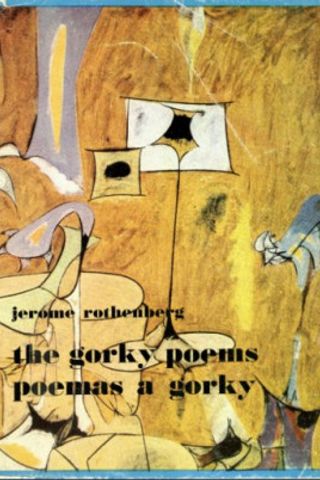
Estatísticas
Avaliações
0 / 0- 5 estrelas0%
- 4 estrelas0%
- 3 estrelas0%
- 2 estrelas0%
- 1 estrelas0%