By the summer of 1944, the war in Europe had reached a critical point. Both the western Allies and the Soviets possessed the initiative and forces capable of mounting strategic offensives against the German enemy. Writing a study of operations on first the Western then Eastern Front, respected military analyst C. J. Dick offers rare insight into the strengths and weaknesses of generalship on both fronts, especially the judgments, choices, and compromises made by senior commanders. At the same time, he clarifies the constraints imposed upon leadership--and upon operations--by doctrinal shortcomings, by logistics, and, not least, by the nature of coalition war. From Victory to Stalemate focuses on the Western Front, specifically American, British, and Canadian operations in France and the Low Countries. Dick's lens throughout is operational art, which links individual tactical battles to broader strategic aims. Beginning with the D-Day landings in Normandy and the strengths and weaknesses of the armies, including their military doctrines, Dick goes on to analyze the offensives launched in the high summer of 1944. He considers the strategic factors and plans that provide the context for his main concern: the Allied commanders' handling of army, army group, and theatre offensive operations. Dick’s analysis shows us an Allied command limited by thinking that is firmly rooted in the experience of small wars and the World War I. The resulting incremental approach was further complicated by a divergence in the ideas and interests of the Allied forces. The man responsible for pulling it all together, Dwight D. Eisenhower, proved remarkably capable in his role as statesman; he was to be less effective as a military technician who could govern such difficult subordinates as Bradley and Montgomery. As a result, the Allied offensive faltered and became a war of attrition, in contrast to the Soviet effort on the Eastern Front.
From Victory to Stalemate - The Western Front, Summer 1944?Decisive and Indecisive Military Operations 2
Charles J. Dick
University Press of Kansas
2016
485 páginas
16h 10m
ISBN-10: B01N44FNZI
Edições (1)
Ver mais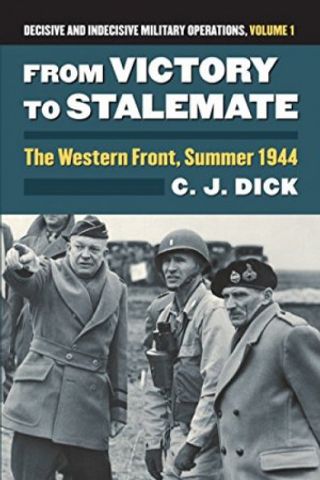
Estatísticas
Avaliações
0 / 0- 5 estrelas0%
- 4 estrelas0%
- 3 estrelas0%
- 2 estrelas0%
- 1 estrelas0%