This is the fourth book in Asimov's Lucky Starr series for juveniles, originally published under the pseudonym Paul French. In this volume, David Starr and his partner travel to Mercury to investigate a series of accidents and setbacks of a research project (using light [in hyperspace] to supply energy). A Senator in the Earth government is pressuring the Council of Science with claims of waste on science projects (a story very familiar to real researchers today). There also is some subtle similarities in this book to McCartyism. The enemy planetary system of Sirius is obviously based on the Soviet "threat" to the West in the 1950s. Once again, in an introduction written in 1978, Asimov apologizes for the scientific inaccuracies that crop up due to recent discoveries of the planet Mercury (of facts not known in 1956). The most obvious of these is the rotation of Mercury about its axis. Until the mid-1970s, it was believed that Mercury's rotation was such that it always presented the same face towards the Sun. Thus, one side of Mercury is extremely hot while the other side is very cold. It was thought at that time that there would be a small region between the two "hemispheres" that would have acceptible temperatures for a colony in the distant future. But space studies, particularly the Mariner 10 probe of 1974/1975, showed that this first planet from the Sun does indeed rotate (at a sidereal period of 58.6462 days). Since Mercury revolves around the sun in about 88 days, all of the planet's surface will get exposed to direct sunlight. However, the days and nights will be long. Probes show that the surface temperatures will reach to 600-700 Kelvin (or, 327-427 degrees Celcius). Thus, in daylight lead would melt. But, at nighttime the surface temperature is about 95 Kelvin (or, -178 degrees Celcius), which is just above the boiling point (at one atmosphere pressure) of molecular oxygen. Of course the surface pressure of Mercury isn't 1.0 atm (it is estimated to be above 10-13 bars).
Similares (9)
Ver mais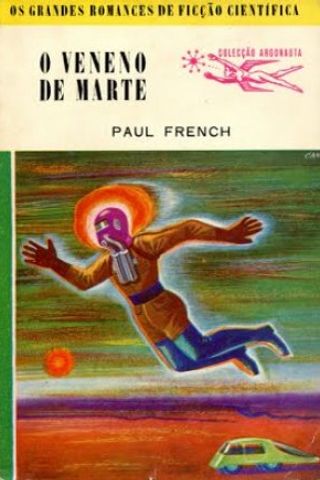

Resenhas (1)Ver mais

Fabio Serpa08/06/2010Resenhou um livro
1 curtida
Estatísticas
Avaliações
3.3 / 3- 5 estrelas0%
- 4 estrelas67%
- 3 estrelas0%
- 2 estrelas33%
- 1 estrelas0%

Isaak Judah Ozimov
Isaac Asimov (Petrovichi - Айзек Азимов -, 2 de janeiro de 1920 - 6 de abril de 1992); foi um escritor e bioquímico russo. A obra mais famosa de Asimov é a série da Fundação, também conhecida como Trilogia da Fundação, que faz parte da série do Império Galáctico e que logo combinou com sua outra grande série dos Robots. Também escreveu obras de mistério e fantasia, assim como uma grande quantidade de não-ficção. No total, escreveu ou editou mais de 500 volumes, aproximadamente 90.000 cartas ou postais, e tem obras em cada categoria importante do sistema de classificação bibliográfica de Dewey, exceto em filosofia. Asimov foi reconhecido como mestre do gênero da ficção científica. É o criador das "Três Leis da Robótica".
302 Livros
2.594 Seguidores