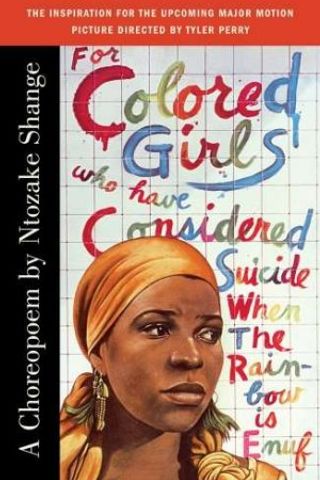
From its inception in California in 1974 to its highly acclaimed critical success at Joseph Papp’s Public Theater and on Broadway, the Obie Award-winning For Colored Girls Who Have Considered Suicide/When The Rainbow Is Enuf has excited, inspired, and transformed audiences all over the country. Passionate and fearless, Shange’s words reveal what it meant to be of color and female in the twentieth century. First published in 1975, when it was praised by The New Yorker for “encompassing . . . every feeling and experience a woman has ever had,” For Colored Girls Who Have Considered Suicide/When the Rainbow Is Enuf will be read and performed for generations to come. Here is a groundbreaking dramatic prose poem written in vivid and powerful language that resonates with unusual beauty in its fierce message to the world.
For Colored Girls Who Have Considered Suicide When the Rainbow Is Enuf -
Ntozake Shange

"ntozake 'her own things' / that's my name"
Before coming across “for colored girls”, I had never heard of the genre chorepoem; at least I did not recognize the English term. It reminded me of a sort of dramatic reading with chorus lines and repetitions that we used to do in school for national celebrations such as Mother’s day. The play I talk about , though, is nothing this amateur. “for colored girls” is an Obie Award-winning play, made it to Broadway stage and later became a movie, a PBS production, directed by Oz Scott. It is not the format this kind of poem present s that astonishes me, though. The voices in this poem do; as does the title. In the title, the “tribute” paid to women (or gilrs) of color carries quite a sad reminder to it – the fact that many consider suicide. Conversely, it is a bit of a paradox to come to the conclusion that the rainbow, or the colors one embodies, or the strength one finds in being colored is what keeps them alive. The rainbow then, is enough for colored girls not to commit suicide. In the introcution-preface Shange lets us know that “for colored girls” began to gain shape together with the writing of the novel “Sassafrass, Cypress and Indigo”. In order to figure out the character of Cypress, Shange kept a diary (which is does not appear in the narrative later). Sassafrass dedicates her diary to colored girls and says in the opening “I am outside St. Louis and this is for colored girls who have moved to the ends of their rainbows.” Moving to the end of one’s rainbow, I’ve learned, means coming to terms with one’s own possibilities, strengths and identity. The women (or the one woman, who comes in different colors) in “for colored girls” live their journey trying to fit in the spaces they share with others. Along the way they face rude men, abuse, tears and loneliness. They discover “(…) a friend is hard to press charges against (…) a rapist is always to be a stranger to be legitimate” They pray “round midnight / wont no young man / think I’m pretty in a dark morning” while waiting for the bus. They learn that they shouldn’t be sorry because “being sorry & colored at the same time / it’s so redundant in the modern world”. “for colored girls” is not a poem about the beauty of life, it is one about the reality in the life of a colored girl in the US, which had just undergone the banishment of segregation laws. The journey starts in adolescence and finishes in a troubled marriage; however, the tragic tone of this poem dies down at the end. When colored women reach the end of their rainbows and find their self-love and the freedom to love themselves.
Estatísticas
Avaliações
4.7 / 12- 5 estrelas75%
- 4 estrelas25%
- 3 estrelas0%
- 2 estrelas0%
- 1 estrelas0%