[A Série Arsène Lupin de Boileau-Narcejac] A direct sequel to The Hollow Needle (French: L'Aiguille Creuse) - featuring Arsène Lupin, gentleman thief, against La Griffe - is the novel "Le second visage d'Arsène Lupin" by Boileau-Narcejac in 1975: '(...) Après sa défaite dans L'aiguille creuse et la mort de celle qu'il aimait, Arsène Lupin s'est retiré des "affaires". Mais l'honneur du "gentleman-cambrioleur" est bafoué par une bande de criminels adeptes des méthodes violentes et expéditives : "La Griffe". Arsène Lupin doit réagir! Il va tenter de démanteler cette organisation et de démasquer son chef. Mais a-t-il encore la volonté de réussir? Est-il assez habile et maître de lui pour affronter une bande aussi terrible?' ===Arsène Lupin par Boileau-Narcejac: 'Le Secret d'Eunerville', Paris, Librairie des Champs-Élysées (1973) / 'La Poudrière', Paris, Librairie des Champs-Élysées (1974) / 'Le Second visage d'Arsène Lupin', Paris, Librairie des Champs-Élysées (1975) / 'La Justice d'Arsène Lupin', Paris, Librairie des Champs-Élysées (1977) / 'Le Serment d'Arsène Lupin', Paris, Librairie des Champs-Élysées (1979). ===Boileau-Narcejac est la signature commune de Pierre Louis Boileau (Paris, 28 avril 1906 - Beaulieu-sur-Mer, 16 janvier 1989) et Pierre Ayraud, dit Thomas Narcejac (Rochefort-sur-Mer, 3 juillet 1908 - Nice, 7 juin 1998), écrivains français de romans policiers, dont certains ont donné lieu à des adaptations cinématographiques par Henri-Georges Clouzot et Alfred Hitchcock. Ils ont aussi participé au scénario de Les Yeux sans visage, de Georges Franju. L'écrivain Jean-Philippe Arrou-Vignod s'est inspiré de leurs romans pour mettre en scène ceux de P-P Cul-Vert. ====Pierre Boileau et Thomas Narcejac ont écrit à quatre mains depuis 1948 jusqu'à la mort du premier en 1989. Ce grand tandem de la littérature policière a donné naissance à plus de quarante romans dont certains sont devenus des scénarios de films, comme "Celle qui n'était plus" — Les Diaboliques (1955), directed by Henri-Georges Clouzot — et "D'Entre Les Morts" [Sueurs froides aka Alfred Hitchcock's Vertigo (1958): "Um Corpo Que Cai" no Brasil]. ====Autres versions, autres exploits d'Arsène Lupin: [Review by François Truffaut (1955)]: Alfred Hitchcock's To Catch a Thief (aka "O Ladrão de Casaca" no Brasil): "John Robie (Cary Grant), an American thief who had worked in France before the Word War II, had such a personal technique that each of his crimes bore his stamp, and he had been dubbed "the Cat". (...) The film finds John Robie some years later, when he has completely retired to a villa in Saint-Paul-de-Vence to live in considerable comfort on the profits of his earlier career. His tranquility is soon spoiled by a series of jewel thefts in the great mansions and hotels of the French Riviera, thefts committed by someone as expert as he and in his style. He falls under suspicion and his retirement and daily routine are disrupted. So the ex-Cat decides that the only way to get back his peace and quiet is to unmask the plagiarist burglar who has baffled the police. To track down his imitator he employs a dialectic Arsène Lupin would not disavow: 'To unmask the new Cat, I must catch him in the act during his next theft; to figure out who his next victim will be (since "he" reasons by imagining himself in "my" place) all I have to do is imagine what I would once have done, or what I would do now if I were in his place; that is, in the final analysis, in my own place." Naturally, Robie succeeds.(...) Without wanting to reveal the outcome of 'To Catch a Thief', I am sure that it is no accident that Brigitte Auber resembles Grant and wears an identical striped jersey: blue-and-white for Grant, red-and-white for Auber. Grant's hair is parted on the right, Auber's on the left. They are look-alikes and opposites at the same time, so that there is a perfect symmetry throughout the work, a symmetry that carries over to the smallest details in the intrigue.(...) I mentioned Arsène Lupin before because this new film of Hitchcock's is elegant, humorous, sentimental almost to the point of bitterness, somewhat in the manner of Maurice Leblanc's «813» or «L'Aiguille Creuse». It is, of course, a crime story that is designed to make us laugh, but nonetheless Hitchcock's basic idea led him to Jacques Becker's formula in "Touchez pas au Grisbi" (1954) [aka Grisbi, Ouro Maldito no Brasil, um filme com Jean Gabin]: the thieves are burned out. The protagonist, admirably portrayed by Cary Grant, is disillusioned, finished. This last job, which forces him to use all his skill as a burglar for the ends of a policeman, fills him with nostalgia for action. You may be surprised that I consider 'To Catch a Thief' a pessimistic film, but you have only to listen to Georgie Auld's and Lyn Murray's melancholy music and watch Grant's unusual performance. As in 'Dial M for Murder' and 'Rear Window' [Janela Indiscreta], Hitchcock's use of Grace Kelly is critical: here she embodies the character of a superb yankee Marie-Chantal, and she's the one who finally catches Cary Grant, o "Ladrão de Casaca", by getting him to marry her"...
Le second visage d'Arsène Lupin - Collection "Mot de passe"
Maurice Leblanc
Deux Coqs D'Or / Hachette
1994
235 páginas
7h 50m
ISBN-13: 9782013919845
Similares (20)
Ver mais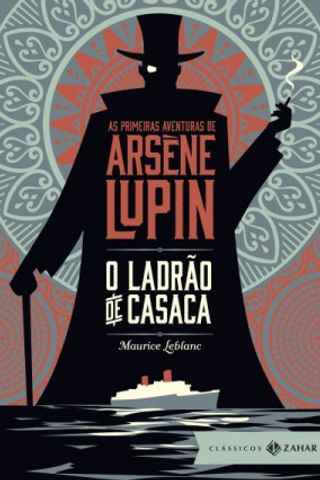
Estatísticas
Avaliações
4 / 1- 5 estrelas0%
- 4 estrelas100%
- 3 estrelas0%
- 2 estrelas0%
- 1 estrelas0%

Maurice Leblanc
Foi um renomado escritor e jornalista francês. Nascido em Rouen, estudou entre França, Itália e Alemanha até abandonar a faculdade de Direito e mudar-se para Paris com o objetivo de se tornar escritor. Fez parte do círculo literário da cidade, trabalhou como jornalista e atingiu reconhecimento como escritor, em especial com o grande sucesso da série Arsène Lupin, seu personagem mais famoso.
187 Livros
105 Seguidores
Normandia, França