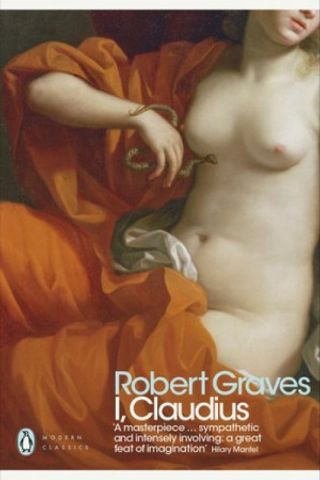
I, Claudius ©1934 [Paperback Edition - ISBN: 067972477X] Considered an idiot because of his physical infirmities, Claudius survived the intrigues and poisonings of the reigns of Augustus, Tiberius, and the 'Mad' Caligula to become emperor in 41 A.D. A masterpiece. |...| Editorial Reviews -- Amazon.com: "Having never seen the famous 1970s television series based on Graves' historical novel of ancient Rome and being generally uneducated about matters both ancient and Roman, I wasn't prepared for such an engaging book. But it's a ripping good read, this fictional autobiography set in the Roman Empire's days of glory and decadence. As a history lesson, it's fabulous; as a novel it's also wonderful. Best is Claudius himself, the stutterer who let everyone think he was an idiot (to avoid getting poisoned) but who reveals himself in the narrative to be a wry and likable observer. His story continues in Claudius the God". |...| Publishers Weekly Starred Review: "Graves's legendary tale of Claudius, a nobleman in the corrupt and cruel world of ancient Rome during the rule of Augustus, Tiberius and Caligula, is a truly compelling listening experience. Derek Jacobi returns to the role that defined his career when he starred in the 1976 Masterpiece Theatre miniseries I, Claudius. Jacobi is so strong in this role, it seems created especially for him. Jacobi's compelling voice demands his audience's undivided attention from start to finish and in doing so delivers an unforgettable performance as Claudius yet again. So incredibly personal is Jacobi's performance that listeners feel almost as if eavesdropping on someone's private life, which only draws us deeper into this gem of modern literature". [This text refers to the Audio CD edition]. ===ROBERT GRAVES (1895-1985) was an English poet, translator, and novelist, one of the leading English men of letters in the twentieth century. He fought in World War I and won international acclaim in 1929 with the publication of his memoir of the First World War, Good-bye to All That. After the war, he was granted a classical scholarship at Oxford and subsequently went to Egypt as the first professor of English at the University of Cairo. He is most noted for his series of novels about the Roman emperor Claudius and his works on mythology, such as The White Goddess. |...| Amazon Customer Review: -- "Arguably the great historical novel of the 20th Century" By Robert Moore on August 10, 2004: "This novel by Robert Graves represents the supreme instance in the twentieth century to write a literarily serious historical novel. There has, of course, been no shortage of historical novels during the past century, but for the most part "historical" fiction has become a species of genre fiction, like Sci-Fi, detective fiction, spy fiction, and Westerns. I, CLAUDIUS, on the other hand, is a historical novel composed by someone otherwise regarded as a serious writer. This relationship between serious writers and the genre of historical fiction has not always been the case. Until the mid-19th century, a host of novels attempted to recreate a historical era, not least Dickens in A TALE OF TWO CITIES, William Thackeray in HENRY ESMOND, Flaubert in SALAMBO, Tolstoy in WAR AND PEACE, and Pynchon's GRAVITY'S RAINBOW. But for the most part, writers in the latter half of the nineteenth century and all of the twentieth century have forsaken historical fiction to write in the present tense, or at the latest of their childhood, as with Marcel Proust or Anthony Powell or Harper Lee. Because of his success in the writing of I, CLAUDIUS and its sequel CLAUDIUS THE GOD, many today think of Robert Graves as primarily a novelist, but in fact most of his writing falls into the nonfiction realm, much of that with a historical bent. Graves was a passionate student of antiquity, both the Greeks and the Romans, and his goal in writing I, CLAUDIUS was to chronicle the period in Roman history immediately after the collapse of the republic and near the beginning of the rule of the Caesars. On the one hand, he wanted to adhere as closely to the documentary evidence for the events in the period as is compatible with a work of fiction, and on the other produced a first rate historical novel. He succeeds splendidly on both counts. His history is not pristine, but it is very close, with imaginative additions only for the sake of making sense of the narrative. The historical details are sufficiently solid and comprehensive for this novel to serve an excellent introduction to the early days of Imperial Rome. In order to tell his story of Imperial Rome, Graves chooses as his narrator and eyewitnesses none other than the future emperor Claudius, once considered to be one of the weakest and most inept of the early Roman emperors, if also the least corrupt and ruthless. In the early 20th century several historians of Ancient Rome began revising their assessment of Claudius, not least the great Italian classicist (who relocated to England and America) Arnaldo Momigliano. Following the lead of these scholars, Graves presents Claudius as a cautious, sagacious, humble, unambitious, and scholarly soul, one who is simultaneously a gifted survivor and a closeted adherent to republican values. Though a stutterer and physically deficient, Grave's Claudius is a highly eloquent and intelligent observer of his world, a sage analyst of the personalities populating his Rome, and a gifted student of human nature. He also emerges as a highly likable and even admirable soul. One of the great achievements of Graves's novel has been to re-enforce on the popular level that reassessment of Claudius undertaken by the scholars mentioned above. The precise period covered by Grave's novel begins roughly midway through Augustus's (formerly Octavian) career, the reign of Tiberius, and the shorter but extraordinarily horrid (though immensely entertaining) rule by Caligula. A host of other characters populate the story, but two above all others. One is, not surprisingly, Claudius himself, but the other is in many ways the dominant personality in the entire book, Claudius's grandmother, Tiberius's mother, and Augustus's wife Livia. She emerges as one of the great villains in modern literature, larger than life and exceptionally vile. One of the most brilliant moments in the novel is when Livia confesses to Claudius what motivates and drives her wretched behavior. I, CLAUDIUS did not inspire a host of imitations among the other top fictional writers in the past century, but Graves did prove that it is a genre that still has potential to inspire, entertain, and educate. It also graphically illustrates the fact that the more things change, the more they stay the same. The world of Claudius may be long past, but the motives driving the actions of novel's characters are as alive now as then, and though the events of the novel took place two thousand years ago, Claudius feels very much our contemporary".
I, Claudius - From the Autobiography of Tiberius Claudius, Born 10 B.C. Murdered and Deified A.D. 54
Robert Graves
Vintage International
1989
468 páginas
15h 36m
ISBN-13: 9780679724773
Resenhas (1)Ver mais

Marcos Augusto03/07/2023Resenhou um livro
2 curtidas
Estatísticas
Avaliações
4.5 / 6- 5 estrelas50%
- 4 estrelas50%
- 3 estrelas0%
- 2 estrelas0%
- 1 estrelas0%