A small Scandinavian nation, with at most one and a half million people and scant internal resources of its own, there was small logic to how Sweden could become the dominant power on the Continent. That Sweden achieved this was due to its leadership—a case-study in history when pure military skill, and that alone, could override the demographic and economic factors which have in modern times been termed so pre-eminent. Once Protestantism emerged, via Martin Luther, the most devastating war in European history ensued, as the Holy Roman Empire sought to reassert its authority by force. Into this bloody maelstrom stepped Gustav Adolf of Sweden, a brilliant tactician and strategist, who with his finely honed Swedish legions proceeded to establish a new authority in northern Europe. Gustav, as brave as he was brilliant, was finally killed while leading a cavalry charge at the Battle of Lützen. He had innovated, however, tactics and weaponry that put his successors in good stead, as Sweden remained a great power, rivaled only by France and Spain in terms of territory in Europe. And then one of his successors, Karl XII, turned out to be just as great a military genius as Gustav himself, and as the year 1700 arrived, Swedish armies once more burst out in all directions. Karl, like Gustav, assumed the throne while still a teenager, but immediately displayed so much acumen, daring and skill that chroniclers could only compare him, like Gustav, to Alexander the Great. This book examines thoroughly, yet in highly readable fashion, the century during which Swedish military power set an example for all Europe. While the Continent was most visibly divided along religious lines—Catholic versus Protestant—geopolitical motives always underlied the conflicts. Sweden’s reliance on its military skill was especially noteworthy, as it veritably founded the modern concept of making wars pay through conquest. Karl XII finally let his ambitions lead him too far, as did Napoleon and Hitler in following centuries, into the vastness of the nascent Russian Empire, where he was finally defeated, at Poltava in Ukraine. Thus the period of Swedish supremacy in Europe came to a close, albeit not without leaving important lessons behind. In this work, by renowned author Henrik O. Lunde, these are clearly to be seen.
A Warrior Dynasty - The Rise and Fall of Sweden as a Military Superpower, 1611-1721
Henrik Lunde
Casemate
2014
320 páginas
10h 40m
ISBN-10: 1612002420
Edições (1)
Ver mais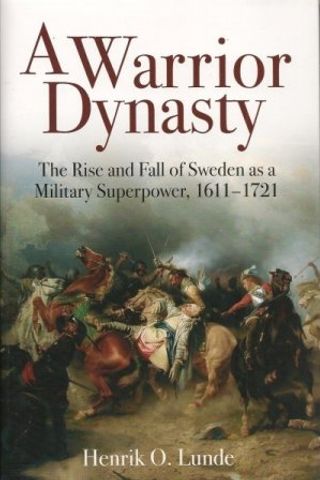
Estatísticas
Avaliações
3 / 2- 5 estrelas0%
- 4 estrelas0%
- 3 estrelas100%
- 2 estrelas0%
- 1 estrelas0%