Richardson developed a Heideggerian response to the central traditional problem in epistemology—whether we can have (objective) knowledge of the external world. I introduce the main philosophical terms and claims of Being and Time, and try to use this system to amplify the book's brief and elusive treatments of that problem. Because Heidegger's early system is crucially ‘existential’, it gives a critique of epistemology from an existential stance—or an existential epistemology. This critique claims to ‘dissolve’ or ‘undermine’ that traditional problem, by showing how it is misguided or misformed. Heidegger's ultimate argument is that the problem rests on a mistake about time, or about the temporal character of reality, and of humans—Dasein—in particular. Heidegger thinks this mistake infects not just epistemology, but our whole theoretical stance, how we try to go beyond our ‘everyday’, pre-theoretical understanding. But his point is not to return us to that ‘everydayness’, but to improve our thinking by turning it into a ‘phenomenology’, which—by Heidegger's existential twist—amounts to the same thing as authenticity. My three chapters focus respectively on these three basic stances—everydayness, epistemology, and phenomenology.
Existential Epistemology - A Heideggerian Critique of the Cartesian Project
John Richardson
Oxford Univ Press
1991
210 páginas
7h 0m
ISBN-13: 9780198239222
Edições (1)
Ver mais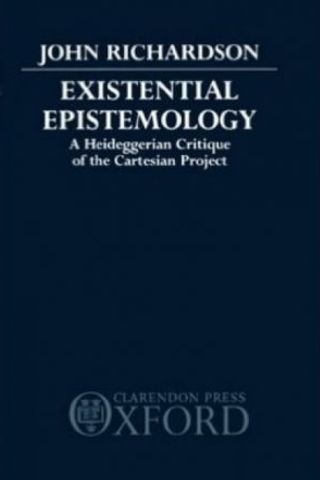
Estatísticas
Avaliações
3 / 1- 5 estrelas0%
- 4 estrelas0%
- 3 estrelas100%
- 2 estrelas0%
- 1 estrelas0%