The central contention of the “New Atheism” of Richard Dawkins, Daniel Dennett, Sam Harris, and Christopher Hitchens is that there has for several centuries been a war between science and religion, that religion has been steadily losing that war, and that at this point in human history a completely secular scientific account of the world has been worked out in such thorough and convincing detail that there is no longer any reason why a rational and educated person should find the claims of any religion the least bit worthy of attention. But as Edward Feser argues in The Last Superstition, in fact there is not, and never has been, any war between science and religion at all. There has instead been a conflict between two entirely philosophical conceptions of the natural order: on the one hand, the classical “teleological” vision of Plato, Aristotle, Augustine, and Aquinas, on which purpose or goal-directedness is as inherent a feature of the physical world as mass or electric charge; and the modern “mechanical” vision of Descartes, Hobbes, Locke, and Hume, according to which the physical world is comprised of nothing more than purposeless, meaningless particles in motion. As it happens, on the classical teleological picture, the existence of God, the immortality of the soul, and the natural-law conception of morality are rationally unavoidable. Modern atheism and secularism have thus always crucially depended for their rational credentials on the insinuation that the modern, mechanical picture of the world has somehow been established by science. Yet this modern “mechanical” picture has never been established by science, and cannot be, for it is not a scientific theory in the first place but merely a philosophical interpretation of science. Moreover, as Feser shows, the philosophical arguments in its favor given by the early modern philosophers were notable only for being surprisingly weak. The true reasons for its popularity were then, and are now, primarily political: It was a tool by which the intellectual foundations of ecclesiastical authority could be undermined and the way opened toward a new secular and liberal social order oriented toward commerce and technology. So as to further these political ends, it was simply stipulated, by fiat as it were, that no theory inconsistent with the mechanical picture of the world would be allowed to count as “scientific.” As the centuries have worn on and historical memory has dimmed, this act of dogmatic stipulation has falsely come to be remembered as a “discovery.” However, not only is this modern philosophical picture rationally unfounded, it is demonstrably false. For the “mechanical” conception of the natural world, when worked out consistently, absurdly entails that rationality, and indeed the human mind itself, are illusory. The so-called “scientific worldview” championed by the New Atheists thus inevitably undermines its own rational foundations; and into the bargain (and contrary to the moralistic posturing of the New Atheists) it undermines the foundations of any possible morality as well. By contrast, and as The Last Superstition demonstrates, the classical teleological picture of nature can be seen to find powerful confirmation in developments from contemporary philosophy, biology, and physics; moreover, morality and reason itself cannot possibly be made sense of apart from it. The teleological vision of the ancients and medievals is thereby rationally vindicated – and with it the religious worldview they based upon it.
The Last Superstition - A Refutation of the New Atheism
Edward Feser
St. Augustines Press
2010
312 páginas
10h 24m
ISBN-10: 1587314525
Edições (1)
Ver mais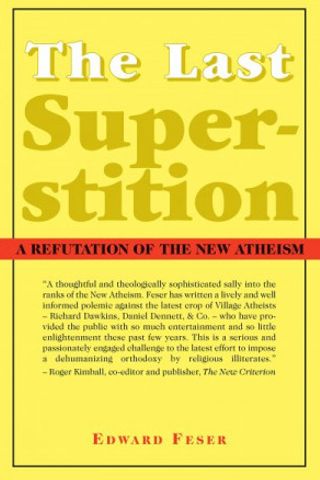
Estatísticas
Avaliações
5 / 1- 5 estrelas100%
- 4 estrelas0%
- 3 estrelas0%
- 2 estrelas0%
- 1 estrelas0%

Edward Feser
Edward C. Feser (nascido em 16 de abril de 1968) é um professor associado americano de filosofia no Pasadena City College. Ele também foi professor assistente de filosofia visitante na Universidade Loyola Marymount e estudante visitante no centro de filosofia social e política da Bowling Green State University, em Ohio. Graduou-se na Universidade da Califórnia, Santa Barbara em 1999 com um doutorado em filosofia; sua tese foi intitulada "Russell, Hayek, e o problema mente-corpo". Por sua própria conta, Feser tinha sido ateu por dez anos durante o início da idade adulta. No entanto, como estudante de pós-graduação em filosofia, suas leituras profundas de Aristóteles e Santo Tomás de Aquino o levaram de volta a uma crença cristã em Deus e na Igreja Católica (ele tinha sido batizado e confirmado como uma criança). Ele agora é duramente crítico dos " novos ateus" para o que ele alegações são suas homem de palha caricaturas e distorções de argumentos teológicos clássicos. Ele também considera o design inteligente incompatível com o tomista clássico argumentos para a existência de Deus. A Feser também expressou apoio para o desrespeito por crimes. Feser é o autor do livro polêmico, <i>The Last Superstition: A Refutation of the New Atheism</i>, no qual ele faz um argumento filosófico para a cosmovisão aristotélica-tomista clássica sobre e contra os pressupostos materialistas e os preconceitos científicos dos ateus contemporâneos como Richard Dawkins , de quem ele é particularmente crítico. Além disso, a Feser escreveu uma série de artigos para o site do politicamente conservador do Instituto Witherspoon. Feser foi chamado de "um dos melhores escritores contemporâneos sobre filosofia" pela National Review. Na Review of Metaphysics , Michael O'Halloran escreveu isso em <i>The Last Superstition</i>, Feser "melhora a perspicácia filosófica com um agudo senso de humor". Na Booklist , Ray Olson escreveu sobre o mesmo livro que "Com energia e humor, bem como exposição transparente, Feser restabelece a superioridade inatacável da filosofia clássica". DQ McInerny do Seminário Nossa Senhora de Guadalupeescreveu na Bolsa de Estudos Católicos Trimestralmente que "De todos os livros escritos em resposta a 'os novos ateus'... este deve ser contado entre os melhores". No entanto, uma revisão mais morna do livro veio de Mary McWay Seamen, que escreveu que "O Feser loquaz às vezes belabora argumentos bem-feitos, mas seus meandros em sombras alegóricas são muitas vezes deliciosos. Infelizmente, o seu breve discurso sobre o mal do mundo parece simplista, até mesmo desprezível com a proclamação de que "Deus pode e vai trazer para fora dos sofrimentos desta vida um bem que tão os ofusca que esta vida será vista em retrospecto para ter valido a pena.'"
9 Livros
6 Seguidores