Why do we sabotage our own best intentions? How can we eliminate procrastination from our lives for good? Based on current psychological research and supplemented with clear strategies for change, this concise guide will help readers finally break free from self-destructive ideas and habits, and move into freedom and accomplishment. With numerous practical tips for change, Solving the Procrastination Puzzle brings clarity and scientific studies—and a touch of humor!—to the quest for successfully achieving goals. This accessible guide is perfect for entrepreneurs, parents, students, and anyone who wants to get unstuck, stop delaying, and start living their most inspired life.
Solving the procrastination puzzle - A concise guide to strategies for change
Timothy A. Pychyl
Penguin Publishing Group
2013
107 páginas
3h 34m
ISBN-13: 9780399168123
Edições (1)
Ver mais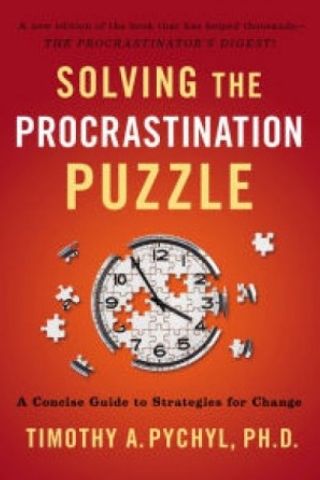
Resenhas (1)Ver mais

Felipe Moitta14/03/2019Resenhou um livro
Solving the procrastination puzzle
Procrastination is a needless voluntary delay. Procrastination, in contrast to other forms of delay, is that voluntary and quite deliberate turning away from an intended action even when we know we could act on our intention right now. There is nothing preventing us from acting in a timely manner except our own reluctance to act. This is the puzzling aspect of procrastination. Why are we reluctant to act? Why is it we become our own worst enemy? The conscious use of strategies to overcome our reluctance to act is essential, because procrastination for many people is a habit. That is, procrastination is a habitual response to tasks or situations, and like all habits it is an internalized, nonconscious process. It is what we do without really thinking about it. Habits are not easy to change. We need to make conscious effort with specific strategies for change to be successful. Throughout the book, I argue that we need to make predecisions to act in a different way, counter to the habitual response. Based largely on the work of Peter Gollwitzer (New York University), I emphasize many different ways that we can use predecisions to act when we intend to act, to reduce the effects of potential distractions, and to cope more effectively with setbacks and disappointments as we work toward changing our behavior. list those tasks, projects, activities, or “things” in your life on which you tend to procrastinate. Next to each, jot down what emotions and thoughts come to mind when you think of each of these moments of procrastination. Do not overthink this. It could be, for example, that you are uncertain about what to do to complete a task. One of the most important preconditions for successful change is a deep commitment to that change. You really have to value that change. It is one thing to know the cost of not acting; it is quite another to have a strong commitment to the goal itself. A strong goal intention, an intention for which you have a very strong commitment, is absolutely essential. As is commonly said, where there’s a will, there’s a way. To strengthen a goal intention, it is important to recognize the benefits of acting now, not just the costs of needless delay. Taking time to think about how your goals align with your values and larger, longer-term life goals, or simply the short-term benefit of getting a necessary task done, can be an important step in strengthening goal intentions. There are many types of self-regulation problems, including problem gambling, overeating, reckless spending, and drinking too much. Procrastination is best understood as a problem like these—a problem with our self-regulation. Why do we fail to self-regulate? Although there are many factors that contribute to this, the most important thing to understand is that we “give in to feel good.” That is, we want to feel good now and we will do whatever it takes for immediate mood repair, usually at the expense of long-term goals. When we give in to feel good, we give in to impulsive urges. These urges can take many forms. We might gamble, shop, or eat more than we need, ingest mood-altering substances, or procrastinate—all in an effort to avoid negative emotions. When facing a task we intend to do but do not want to, we feel a number of possible negative emotions. We may feel frustrated, angry, bored, resentful, depressed, anxious, or guilty. If you find that you are chronically procrastinating, it may well be that you are running away from negative feelings by putting off your tasks. Of course, this is temporarily rewarding. The moment we put off the task until tomorrow, we feel relief from the negative emotions. And, as you may have learned in a basic psychology course, behaviors that are rewarded get repeated. We are reinforcing our procrastination, and it becomes a problem. This “if . . . then” format of an intention has been labeled an implementation intention Irrationally, we think how we are feeling now is how we will feel later. Let go of the misconception that our motivational state must match the task at hand. In fact, social psychologists have demonstrated that attitudes follow behaviors more than (or at least as much as) behaviors follow attitudes. When you start to act on your intention as intended, you will see your attitude and motivation change. The problem is that future rewards seem less attractive to us than immediately available ones. I guess this should not surprise us too much. From an evolutionary perspective, a bird in the hand is worth two in the bush. Our brains seem programmed to prefer immediate rewards. This stone-age brain is not so adaptive in our modern world, where we need to meet distant deadlines by doing things today. It is also human nature to be overly optimistic. We assume we can get more done in less time than is reasonable, and we assume tasks will take less time than they usually do. This is at the heart of the issue—we are not really thinking about how long things usually take based on past experience. We focus on the singular event we are facing without taking into account distributive information about experience or similar events. What results from this optimistic bias is poor planning. To self-handicap is to provide an excuse for oneself. For example, if you were to wear weighted shoes and have a running race with a friend, your ability or competence as a runner would never come into question. If you lose the race, it is the fault of the handicap, the heavy shoes. If you win the race, however, that is extraordinarily meritorious. It is win-win for the individual’s sense of self. Certainly, self-esteem is never threatened. That said, not all coping mechanisms are adaptive. Quite consistently, research has demonstrated that techniques like distraction, forgetting, trivialization, and denial of responsibility are emotion-focused strategies that are not nearly as effective in the long term as planful problem-solving strategies. Perhaps a more accurate way to rephrase this oft-heard expression is that “we only work under pressure.” Why? Most probably because of the mistaken belief, presented in Chapter 4, that our motivational state must match the task at hand. When we do not feel motivated to work on a task, we put it off until finally the external time pressure to do the task motivates action (typically so late that a poorer overall performance is the result). When I face a task that I find aversive, a task I simply don’t want to do, a task that I find boring or tedious, or even a task for which I have doubts about my competence, it is tempting to walk away. I want to procrastinate. I find myself saying things like this to myself: “I’ll feel more like doing this later.” This is a flag for me. It is a signal that I have learned to identify that I am just about to procrastinate. At that very moment, I use this signal to just get started. I will immediately start on anything related to the task at hand. Our research shows us that getting started changes our perceptions of a task. It can also change our perception of ourselves in important ways. It is not as effective to make ourselves a “to do” list of goal intentions as it is to decide how, when, and where we are going to accomplish each of the tasks we need to get done. implementation intentions are a powerful tool to move from a goal intention to an action. these implementation intentions take the form of “if . . . then” statements. The “if” part of the statement sets out some stimulus for action. The “then” portion describes the action itself. The issue here really is one of a predecision. We are trying to delegate the control over the initiation of our behavior to a specified situation without requiring conscious decision. IF I say to myself things like “I’ll feel more like doing this later” or “I don’t feel like doing this now,” THEN I will just get started on some aspect of the task. Keep it as concrete as possible, too. Research by Sean McCrea (University of Konstanz) and his colleagues has shown that thinking abstractly about our goals leads us to believe that they are not that urgent or pressing. More-concrete thoughts about your goal or task, more-concrete plans, lead to more timely action. In other words, more-concrete plans will help you to just get started. There are two main approaches to predecisions regarding potential distractions. The first involves reducing the number of distractions before we begin to work. The second approach takes us back to implementation intentions to help us decide ahead of time what we will do when distractions, obstacles, or setbacks arise. Implementation intentions, as you may recall, are a form of predecision. You are deciding ahead of time what will be a stimulus for what response. there are many aspects of being human that contribute to our self-regulation failure. For example, we: like to feel good now, are prone to discount future rewards, are overly optimistic and biased in our planning, dislike dissonance and will resolve it by making excuses, have a limited amount of willpower, can be disorganized, undisciplined, and overly self-conscious, can be prone to distractions, and can have irrational beliefs about our expectations of ourselves. Be kind but firm with yourself, and be willing to forgive yourself when you do not live up to your own expectations. What we found was that self-forgiveness for procrastination was related to less procrastination in the future. This finding reflects the power of forgiveness to move us from an avoidance motivation to an approach motivation. If, for example, you had a transgression (e.g., fight or broken promise) with a friend, and you or your friend had not offered forgiveness, you would likely avoid that friend. In the case of procrastination, the transgression is against the self, and we end up avoiding the task associated with that transgression. What forgiveness does in both cases is to remove the avoidance motivation so that friendship can be reestablished or engagement with the task can happen again, respectively.
curtir
Estatísticas
Avaliações
4.1 / 15- 5 estrelas40%
- 4 estrelas27%
- 3 estrelas27%
- 2 estrelas7%
- 1 estrelas0%