Pyotr and Stavrogin are the leaders of a Russian revolutionary cell. Their aim is to overthrow the Tsar, destroy society, and seize power for themselves. Together they train terrorists who are willing to lay down their lives to accomplish their goals. But when the group is threatened with exposure, will their recruits be willing to kill one of their own to cover their tracks? Savage and powerful yet lively and often comic, Demons was inspired by a real-life political murder and is a scathing and eerily prescient indictment of those who use violence to serve their beliefs.
Demons -
Fyodor Dostoevsky
Penguin Classics
2008
880 páginas
1d 5h 20m
ISBN-13: 9780141441412
Edições (1)
Ver mais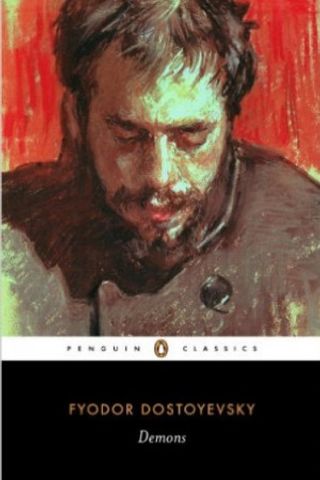
Resenhas (2)Ver mais

Mario24/01/2025Resenhou um livro
Over time, cultures that value life thrive, while those that dont create unbound suffering.
There are several reasons I keep telling myself to read Dostoevsky. His work is dense and profound, provoking and discomforting, investigative and elucidating. Some situations he develops in his novels are clearly relatable to my own experiences. However, psychological depth is not easily identifiableits almost like strands of a veil, woven and blended together. I remember characters who are alike to people I coexist with or have coexisted with at some point in my life. Theres nothing absolute in this world, so I reframe actions and words into a spectrum, but continuing to give the benefit of the doubt becomes bleaker with every act of aggression I observe. Theres something very positive about reading Dostoevsky almost 200 years after he published his works. Its like a tree full of ideas, many of which have arisen from pre-nineteenth-century Russia. It allows us to analyze his works from different facetssuch as movies inspired by them, books, videos, archives, and other findings. Its truly impressive how he encapsulated an entire universe at that time, with portrayals of czarism and the underbelly of society. Thankfully, we now have access to more content in this era of information and technology, which enhances the thrill of Russias vernacular tradition. By now, the average committed reader of Dostoevskyan novels should recognize patterns: the tireless effort to detail unsettling interpersonal moral affairs, the constant misunderstandings between characters and groups, the intensity of his language, the conflict between generations, the bewilderment, the whirlwind of events, the grotesquerie, and the uncanny atmosphere. In this edition, translator Richard Pevear encapsulates it in his foreword: It is not the idea itself that is the hero of Dostoevskys works but rather the person born of that idea. Dostoevskys writing style is an extensively entangled web of situations. Relational entanglement, where the complexity of a situation builds, is almost like a ball of woolits hard to remove the good aspects without unraveling the whole cloth. And when a person is able to intertwine their expressions with intentions, when the casuistry becomes as keen as a razor, it transpires as relentless authenticity. An authenticity so convincing that, as Nietzsche says in The Birth of Tragedy, Drama becomes just a reflex, an isolated silhouette of the idea. Have you ever thought about the lifecycle of revolutions? How do crazy ideas turn from impossible to inevitable? As Dostoevsky portrays, an idea can become so powerful that it begins to regiment lives, like demons acting upon us, against our purest hearts intentions. These "demons" gather so much power that they resemble modern godstricksters and devilish misleaders of men, inducing self-will and courage in entire masses in the name of God or the lack of one. But this double-edged sword can blindly bring bloody destruction and anarchism in senseless forms. As Dostoevsky subtly puts it: A hundred million heads, they shout, and maybe thats just a metaphor, but why be afraid of them if ? This scales up to the point of each nation developing its own idea of good and evil. In Dostoevskys own words: Every nation has its own idea of evil and good, and its own evil and good. When many nations start having common ideas of evil and good, then the nations die out and the very distinction between evil and good begins to fade and disappear. Reason has never been able to define evil and good, or even to separate evil from good, if only approximately. Half-science, then, becomes a word, and even the concept of reason is questioned, giving birth to a particular God. At last, Russias odyssey is, as the novelist puts it: Covered with an infinite network of knots. For its own part, each of the active groups, while proselytizing and spreading its side-branchings to infinity, has as its task, by a systematic denunciatory propaganda, ceaselessly to undermine the importance of the local powers, to produce bewilderment in communities, to engender cynicism and scandal, complete disbelief in anything whatsoever, a yearning for the better, and, finally, acting by means of fires as the popular means par excellence, to plunge the country, at the prescribed moment, if need be, even into despair. If you want to overcome the whole world, overcome yourself. Link to my highlights: https://drive.google.com/file/d/17Fif6O8y90YmgjpTTsN25r9ODlPykNm0/view?usp=sharing
1 curtida
Estatísticas
Avaliações
4.8 / 5- 5 estrelas80%
- 4 estrelas20%
- 3 estrelas0%
- 2 estrelas0%
- 1 estrelas0%