In one handy little volume, The Little Black Book of Junk Science, we provide an A to Z (okay, A to Y) guide to the most common myths and misunderstandings surrounding health fads, diets, chemicals, and other pseudoscience. We hope it provides a small dose of sanity in a world full of junk science.
Little Black Book of Junk Science -
Alex Berezow
American Council on Science and Health
2017
73 páginas
2h 26m
ISBN-13: 9780997253009
Edições (1)
Ver mais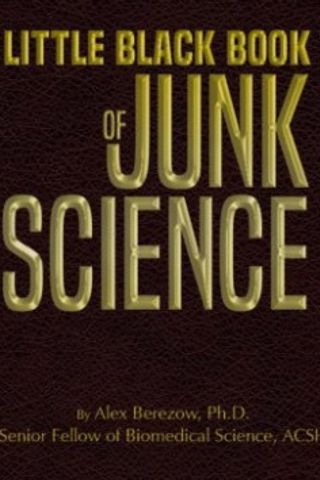
Resenhas (1)Ver mais

Usuário excluído24/11/2017Resenhou um livro
I indicate this book mostly to people that aren't gonna read it.
It seems targeted at very naive people that panic over news claiming something will give them cancer or autism, and that will buy chinese pills in an attempt to lose weight. As someone already familiar with critical thinking, I found it dangerously oversimplified. At times, those simplifications are great: they do make reading quicker and easier to understand even if you know little about the topic. However, if you're indeed someone new to the whole debating thing, you might completely misunderstand something like this: "Sex differences - Culture seems to be confused about the sexes. Biology has taught us that men and women are different, not just in basic plumbing, but physiologically and psychologically as well. Even our immune systems can differ from each other. Celebrate that diversity." Well, if you "do not believe" in transsexuals, homossexuals and other gender identities, you could use the paragraph above as a shield for your beliefs. "See, it's science!!!", you could say. I certainly do not argue that men and women ARE different, but this entrance makes it seem they're all there is. Some of their statements are very repetitive. Even though the book is tiny, the statement "To lose weight you simply need to burn more calories than you consume" appear 5 times. It's correct, of course, but it can be dull. I also dislike the "Solar Power" entrance. I understand that is targeted towards people thinking solar power could solve all the world's problems, however it seems to suggest that because solar power will never be the world's dominant power source, it's not a valid power source. Something not too different happens with "Wind Power", though in a smaller scale. "Science Education" seem slightly too patriotic for my taste. "(...)where we falter in K-12 tests we make up for in the world’s highest adult science literacy, because we teach how to think." That's why you elected Trump for president? I see. Not to mention it seems to be exactly in America where so many of the conspiracy theories originate and succeed. Don't get me wrong, I don't dispute the country has excellent universities, but the whole entrance doesn't provide a single link, a single source to prove their words. As sad as it seems, the book could very well be used in this sense for political purposes, even though it warns about this kind of pseudoscience only a few pages away. Some entrances are unnecessarily offensive. "Quinoa – also called “hippie porridge” by ACSH President Hank Campbell(...)". Well, if you're trying to make people that eat quinoa to read your book, you shouldn't mistreat them. Not to mention, a scientific book with short entrances should be to the point. Instead of wasting words with that, they could have provided more objective information as to why quinoa is bad or simply not as good as people think. Relevant and interesting entrances also suffer from the lack of depth. One of the entrances criticize the work of PETA (People for the Ethical Treatment of Animals). I don't doubt PETA's work hurts science, humans and even animals, however the example given is terrible. It doesn't clarify why PETA is an example of junk science and it's heavily gonna rely on the reader's previous feelings and views about the institution (which is equivalent to say this entrance is useless and could well be non-existant). Not everything about the book is bad, or I wouldn't have given it 3 stars. For someone that never heard about junk science/pseudoscience, don't understand what is is, and it's willing to open his mind (to close his mind, I guess?), the book is excellent in size and it does choose some very relevant topics. I specially liked the entrances about Absolute Risk, Relative Risk and Statistical Significance. It's one of the many reasons why we should be suspicious of statistics about foods that are transmitted by the media and changed every week. Also very relevant: Publication bias (the media won't focus on boring research, even if it's more correct), politicization of science (your political party doesn't own science, that's not how science works) and how the word theory is used in science (if it's not something widely accepted in the academy, it's a hypothesis at best and a speculation at worst). Finally, because it's been written by the American Council on Science and Health, the book is clearly targeted at Americans. A Brazilian that never left her country like me might be bored or clueless about some topics that were never "a thing" in Brazil. I certainly never heard about Silent Spring.
1 curtida
Estatísticas
Avaliações
3 / 1- 5 estrelas0%
- 4 estrelas0%
- 3 estrelas100%
- 2 estrelas0%
- 1 estrelas0%