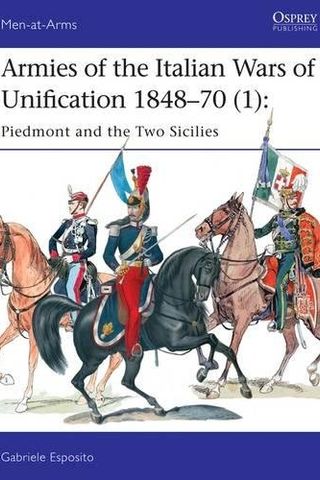
In the 1840s, post-Napoleonic Italy was 'a geographical expression'--not a country, but a patchwork of states. The north (Savoy/Piedmont, and Venice ) was ruled by Austria-Hungary, and most of the minor central states were more or less clients of Austria. From Naples, a Spanish-descended Bourbon monarchy ruled the south--'the Two Sicilies.' The European 'Year of Revolutions', 1848, saw popular uprisings against the regimes all over the peninsula. These were eventually crushed (First War of Independence, 1848-49); but they left King Victor Emmanuel of Savoy/Piedmont--and his able minister Cavour--determined to liberate and unify the country, while royal authority in the Two Sicilies was left deeply unpopular. Savoy/Piedmont endeavored to strengthen the relationship with France and Britain, by sending troops to fight alongside them in the Crimean War, 1854-56 and, as a result, it was actively supported by a French army in the Second War of Independence (1859), when the battles of Magenta and Solferino freed most of the north from Austrian rule. In the south, Garibaldi's 'Redshirts' led a successful rising against the Kingdom of the Two Sicilies (1860). Eventually the south voted to join the north in a unified kingdom (February 1861); nevertheless, northern troops had to enforce this by a ruthless occupation during the 1860s--a little-known campaign.
Gabriele Esposito
Osprey Publishing
2017
48 páginas
1h 36m
ISBN-13: 9781472819499
Estatísticas
Avaliações
0 / 0- 5 estrelas0%
- 4 estrelas0%
- 3 estrelas0%
- 2 estrelas0%
- 1 estrelas0%