This collection of the 20 essays comprising Season 1 essays from breakingsmart.com, with an introduction by Marc Andreessen, provides an in-depth look at how software is eating the world and transforming work, life, and society.
Breaking Smart - Season One: How Software is Eating the World
Venkatesh Rao
Ribbonfarm.com
2018
152 páginas
5h 4m
ISBN-10: B079Q77446
Edições (1)
Ver mais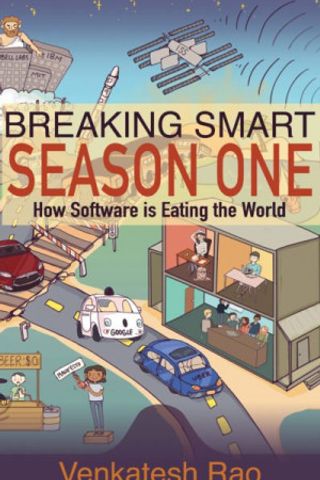
Resenhas (1)Ver mais

Felipe Moitta11/04/2018Resenhou um livro
Breaking Smart
People change, then forget that they changed, and act as though they always behaved a certain way and could never change again. Because of this, unexpected changes in human behavior are often dismissed as regressive rather than as potentially intelligent adaptations. As this set of essays argues — many of them inspired by a series of intensive conversations Venkat and I had — there is indeed such a case, and it follows naturally from the basic premise that people can and do change. To “break smart” is to adapt intelligently to new technological possibilities. Only a handful of general-purpose technologies – electricity, steam power, precision clocks, written language, token currencies, iron metallurgy and agriculture among them – have impacted our world in the sort of deeply transformative way that deserves the description eating. And only two of these, written language and money, were soft technologies: seemingly ephemeral, but capable of being embodied in a variety of specific physical forms. Software has the same relationship to any specific sort of computing hardware as money does to coins or credit cards or writing to clay tablets and paper books. Software eating the world is a story of the seen and the unseen: small, measurable effects that seem underwhelming or even negative, and large invisible and positive effects that are easy to miss, unless you know where to look. Writing is very flexible: we can write with a finger on sand or with an electron beam on a pinhead. Money is even more flexible: anything from cigarettes in a prison to pepper and salt in the ancient world to modern fiat currencies can work. But software can increasingly go wherever writing and money can go, and beyond. Software can also eat both, and take them to places they cannot go on their own. Partly as a consequence of how rarely soft, world-eating technologies erupt into human life, we have been systematically underestimating the magnitude of the forces being unleashed by software. While it might seem like software is constantly in the news, what we have already seen is dwarfed by what still remains unseen. The fourth reason we underestimate software, however, is a unique one: it is a revolution that is being led, in large measure, by brash young kids rather than sober adults. Within the current structure of the global economy, older generations can, and do, borrow unconditionally from the future at the expense of the young and the yet-to-be-born. But unlike most periods in history, young people today do not have to either “wait their turn” or directly confront a social order that is systematically stacked against them. Operating in the margins by a hacker ethos — a problem solving sensibility based on rapid trial-and-error and creative improvisation — they are able to use software leverage and loose digital forms of organization to create new economic, social and political wealth. In the process, young people are indirectly disrupting politics and economics and creating a new parallel social order. what the smartest people do on the weekend is what everyone else will do during the week in ten years. Software-driven transformations directly disrupt the middle-class life script, upon which the entire industrial social order is based. In its typical aspirational form, the traditional script is based on 12 years of regimented industrial schooling, an additional 4 years devoted to economic specialization, lifetime employment with predictable seniority-based promotions, and middle-class lifestyles. Though this script began to unravel as early as the 1970s, even for the minority (white, male, straight, abled, native-born) who actually enjoyed it, the social order of our world is still based on it. Instead of software, the traditional script runs on what we might call paperware: bureaucratic processes constructed from the older soft technologies of writing and money. Instead of the hacker ethos of flexible and creative improvisation, it is based on the credentialist ethos of degrees, certifications, licenses and regulations. Instead of being based on achieving financial autonomy early, it is based on taking on significant debt (for college and home ownership) early. It is important to note though, that this social order based on credentialism and paperware worked reasonably well for almost a century between approximately 1870 and 1970, and created a great deal of new wealth and prosperity. Despite its stifling effects on individualism, creativity and risk-taking, it offered its members a broader range of opportunities and more security than the narrow agrarian provincialism it supplanted. For all its shortcomings, lifetime employment in a large corporation like General Motors, with significantly higher standards of living, was a great improvement over pre-industrial rural life. The legend of Prometheus has been used as a metaphor for technological progress at least since Mary Shelley’s Frankenstein: A Modern Prometheus. Technologies capable of eating the world typically have a Promethean character: they emerge within a mature social order (a metaphoric “heaven” that is the preserve of older elites), but their true potential is unleashed by an emerging one (a metaphoric “earth” comprising creative marginal cultures, in particular youth cultures), which gains relative power as a result. Software as a Promethean technology emerged in the heart of the industrial social order, at companies such as AT&T, IBM and Xerox, universities such as MIT and Stanford, and government agencies such as DARPA and CERN. But its Promethean character was unleashed, starting with the early hacker movement, on the open Internet and through Silicon-Valley style startups. Those who adopt a Promethean mindset and break smart will play an expanding role in shaping the future. Those who adopt a pastoral mindset and retreat towards tradition will play a diminishing role, in the shrinking number of economic sectors where credentialism is still the more appropriate model. “slouching towards utopia“: a condition of gradual, increasing quality of life available, at gradually declining cost, to a gradually expanding portion of the global population. Previous historical periods of mass flourishing, such as the early industrial revolution, were short-lived, and gave way, after a few decades, to societies based on a new middle class majority built around predictable patterns of work and life. This time around, the state of mass flourishing will be a sustained one: a slouching towards a consumer and producer utopia. The nature of software has come to matter far beyond software. Agile philosophies are eating all kinds of building philosophies. To understand the nature of the world today, whether or not you are a technologist, it is crucial to understand agility and its roots in the conflict between pragmatic and purist approaches to computing. The story of the browser was not exceptional. Until the early 1990s, almost all important software began life as purist architectural visions rather than pragmatic hands-on tinkering. This was because early programming with punch-card mainframes was a highly constrained process. Iterative refinement was slow and expensive. Agility was a distant dream: programmers often had to wait weeks between runs. If your program didn’t work the first time, you might not have gotten another chance. Purist architectures, worked out on paper, helped minimize risk and maximize results under these conditions. In short, purist architecture led the way and pragmatic hands-on hacking was effectively impossible. Trial-and-error was simply too risky and slow, which meant significant hands-on creativity had to be given up in favor of productivity. “We reject kings, presidents and voting. We believe in rough consensus and running code”. Another early quote that has become a commonly-held belief in the IETF comes from Jon Postel: “Be conservative in what you send and liberal in what you accept”. So the significance of pragmatic approaches prevailing over purist ones cannot be overstated: in the world of technology, it was the equivalent of the fall of the Berlin Wall. Geometrically laid-out suburbs, for example, are legible and conform to platonic architectural visions, even if they are unlivable and economically stagnant. Slums on the other hand, appear illegible and are anxiety-provoking to planners, even when they are full of thriving economic life. As a result, authoritarian planners level slums and relocate residents into low-cost planned housing. In the process they often destroy economic and cultural vitality. From the earliest days of interactive computing, when programmers chose to build games while more “serious” problems waited for computer time, to modern complaints about “trivial” apps (which often turn out to be revolutionary), scarcity-oriented thinkers have remained unable to grasp the essential nature of software for fifty years. The difference has a simple cause: unsullied purist visions have value beyond anxiety-alleviation and planning. They are also a critical authoritarian marketing and signaling tool — like formal dinners featuring expensive china — for attracting and concentrating scarce resources in fields such as architecture. In an environment of abundance, there is much less need for visions to serve such a marketing purpose. They only need to provide a roughly correct sense of direction to those laboring at software development to create capital using whatever tools and ideas they bring to the party — like potluck participants improvising whatever resources are necessary to make dinner happen. Translated to technical terms, the dinnerware analogy is at the heart of software engineering. Purist visions tend to arise when authoritarian architects attempt to concentrate and use scarce resources optimally, in ways they often sincerely believe is best for all. By contrast, tinkering is focused on steady progress rather than optimal end-states that realize a totalizing vision. It is usually driven by individual interests and not obsessively concerned with grand and paternalistic “best for all” objectives. The result is that purist visions seem more comforting and aesthetically appealing on the outside, while pragmatic hacking looks messy and unfocused. At the same time purist visions are much less open to new possibilities and bricolage, while pragmatic hacking is highly open to both. But even for young engineers starting out today, used to routinely renting cloudy container-loads of computers by the minute, the principle remains difficult to follow. Devoting skills and resources to playful tinkering still seems “wrong,” when there are obvious and serious problems desperately waiting for skilled attention. Like the protagonist in the movie Brewster’s Millions, who struggles to spend $30 million within thirty days in order to inherit $300 million, software engineers must unlearn habits born of scarcity before they can be productive in their medium. Conflicts are not sorted out through compromises that leave everybody unhappy. Instead they are sorted out through the principle futurist Bob Sutton identified as critical for navigating uncertainty: strong views, weakly held. Pragmatists, unlike the authoritarian high-modernist architects studied by James Scott, hold strong views on the basis of having contributed running code rather than abstract visions. But they also recognize others as autonomous peers, rather than as unquestioning subordinates or rivals. Faced with conflict, they are willing to work hard to persuade others, be persuaded themselves, or leave. In a process reminiscent of the “rule of agreement” in improv theater, ideas that unleash the strongest flood of follow-on builds tend to be recognized as the most fertile and adopted as the consensus. Collaborators who spark the most intense creative chemistry tend to be recognized as the right ones. The consensus is rough because it is left as a sense of direction, instead of being worked out into a detailed, purist vision. This general principle of fertility-seeking has been repeatedly rediscovered and articulated in a bewildering variety of specific forms. The statements have names such as the principle of least commitment (planning software), the end-to-end principle (network design), the procrastination principle (architecture), optionality (investing), paving the cowpaths (interface design), lazy evaluation (language design) and late binding (code execution). While the details, assumptions and scope of applicability of these different statements vary, they all amount to leaving the future as free and unconstrained as possible, by making as few commitments as possible in any given local context. premature optimization is the root of all evil. Traditional processes of consensus-seeking drive towards clarity in long-term visions but are usually fuzzy on immediate next steps. By contrast, rough consensus in software deliberately seeks ambiguity in long-term outcomes and extreme clarity in immediate next steps. It is a heuristic that helps correct the cognitive bias behind Amara’s Law. Clarity in next steps counteracts the tendency to overestimate what is possible in the short term, while comfort with ambiguity in visions counteracts the tendency to underestimate what is possible in the long term. The rejection of “voting” in the IETF model is a rejection of a false sense of egalitarianism, rather than a rejection of democratic principles. In other words, true north in software is often the direction that combines ambiguity and evidence of fertility in the most alluring way: the direction of maximal interestingness. The great practical advantage of this heuristic is that the direction of maximal interestingness can be very rapidly updated to reflect new information, by evolving the rough consensus. The term pivot, introduced by Eric Ries as part of the Lean Startup framework, has recently gained popularity for such reorientation. A pivot allows the direction of development to change rapidly, without a detailed long-term plan. It is enough to figure out experimental next steps. This ability to reorient and adopt new mental models quickly (what military strategists call a fast transient) is at the heart of agility. The response to new information is exactly the reverse in authoritarian development models. Because such models are based on detailed purist visions that grow more complex over time, it becomes increasingly harder to incorporate new data. The great practical advantage of this heuristic is that the direction of maximal interestingness can be very rapidly updated to reflect new information, by evolving the rough consensus. The term pivot, introduced by Eric Ries as part of the Lean Startup framework, has recently gained popularity for such reorientation. A pivot allows the direction of development to change rapidly, without a detailed long-term plan. It is enough to figure out experimental next steps. This ability to reorient and adopt new mental models quickly (what military strategists call a fast transient) is at the heart of agility. The response to new information is exactly the reverse in authoritarian development models. Because such models are based on detailed purist visions that grow more complex over time, it becomes increasingly harder to incorporate new data. As a result, the typical response to new information is to label it as an irrelevant distraction, reaffirm commitment to the original vision, and keep going. This is the runaway-train-wreck scenario. On the other hand, if the new information helps ideological opposition cohere within a democratic process, a competing purist vision can emerge. This leads to the stalled-train scenario. What makes this possible in software is that most software failures do not have life-threatening consequences.4 As a result, it is usually faster and cheaper to learn from failure than to attempt to anticipate and accommodate it via detailed planning (which is why the RERO principle is often restated in terms of failure as fail fast). So crucial is the RERO mindset today that many companies, such as Facebook and Etsy, insist on new hires contributing and deploying a minor change to mission-critical systems on their very first day. So crucial is the RERO mindset today that many companies, such as Facebook and Etsy, insist on new hires contributing and deploying a minor change to mission-critical systems on their very first day. Companies that rely on waterfall processes by contrast, often put new engineers through years of rotating assignments before trusting them with significant autonomy. release early, release often (RERO) This tendency makes no sense within waterfall models, but is a necessary feature of agile models. The only way for execution to track the changing direction of the rough consensus as it pivots is to increase the frequency of releases. Failed experiments can be abandoned earlier, with lower sunk costs. Successful ones can migrate into the product as fast as hidden risks can be squeezed out. As a result, a lightweight sense of direction — rough consensus — is enough. There is no need to navigate by an increasingly unattainable utopian vision. If creating great software takes very little capital, copying great software takes even less. This means dissent can be resolved in an interesting way that is impossible in the world of atoms. Under appropriately liberal intellectual property regimes, individuals can simply take a copy of the software and continue developing it independently. In software, this is called forking. Efforts can also combine forces, a process known as merging. Unlike the superficially similar process of spin-offs and mergers in business, forking and merging in software can be non-zero sum. A basic divide in the world of technology is between those who believe humans are capable of significant change, and those who believe they are not. Prometheanism is the philosophy of technology that follows from the idea that humans can, do and should change. Pastoralism, on the other hand is the philosophy that change is profane. Anything that is in the world when you’re born is normal and ordinary and is just a natural part of the way the world works. Anything that’s invented between when you’re fifteen and thirty-five is new and exciting and revolutionary and you can probably get a career in it. Anything invented after you’re thirty-five is against the natural order of things. Specific ideas may fail. Specific uses may not endure. Localized attempts to resist may succeed, as the existence of the Amish demonstrates. Some individuals may resist some aspects of the imperative to change successfully. Entire nations may collectively decide to not explore certain possibilities. But with major technologies, it usually becomes clear very early on that the global impact is going to be of a certain magnitude and cause a corresponding amount of disruptive societal change. This is the path-independent outcome and the reason there seems to be a “right side of history” during periods of rapid technological developments. The specifics of how, when, where and through whom a technology achieves its maximal impact are path dependent. Competing to guess the right answers is the work of entrepreneurs and investors. But once the answers are figured out, the contingent path from “weird” to “normal” will be largely forgotten, and the maximally transformed society will seem inevitable with hindsight. In his essay, Conniff argues that the original Luddites were simply fighting to preserve their idea of human values, and concludes that “standing up against technologies that put money or convenience above other human values” is necessary for a critical engagement of technology. Critics make similar arguments in every sector being eaten by software. The apparent reasonableness of this view is deceptive: it is based on the wishful hope that entire societies can and should agree on what the term human values means, and use that consensus to decide which technologies to adopt. An unqualified appeal to “universal” human values is usually a call for an authoritarian imposition of decidedly non-universal values. Capitalists like to label rideshare drivers free agents or micro-entrepreneurs, while progressives prefer labels like precariat (by analogy to proletariat) or scab. Both sides attempt to make the future determinate by force-fitting it into preferred received narratives using loaded terms. The story of the steam engine is a good illustration of both effects. It is widely recognized that spillover effects from James Watt’s steam engine, originally introduced in the Cornish mining industry, helped trigger the British industrial revolution. What is less well-known8 is that the steam engine itself was vastly improved by hundreds of unknown tinkerers adding “microinventions” in the decades immediately following the expiration of James Watt’s patents. Once an invention leaks into what Robert Allen calls “collective invention settings,” with a large number of individuals and firms freely sharing information and independently tinkering with an innovation, future evolution gathers unstoppable momentum and the innovation goes from “weird” to “new normal.” The path-dependent phase of evolution of a technology can take centuries, as Joel Mokyr shows in his classic, Lever of Riches. But once it enters a collective invention phase, surplus and spillover effects gather momentum and further evolution becomes simultaneously unpredictable and inevitable. Once the inevitability is recognized, it is possible to bet on follow-on ideas without waiting for details to become clear. Today, it is possible to bet on a future based on ridesharing and driverless cars without knowing precisely what those futures will look like. At the center of any pastoral we find essentialized notions of what it means to be human, like Adam and Eve or William Whyte’s Organization Man, arranged in a particular social order (patriarchal in this case). From these archetypes we get to pure and virtuous idealized lifestyles. Lifestyles that deviate from these understandings seem corrupt and vice-driven. The belief that “people don’t change” is at once an approximation and a prescription: people should not change except to better conform to the ideal they are assumed to already approximate. The belief justifies building technology to serve the predictable and changeless ideal and labeling unexpected uses of technology degenerate. If pastoral visions are so limiting, why do we get so attached to them? Where do they even come from in the first place? Ironically, they arise from Promethean periods of evolution that are too successful. We get attached to pastorals because they offer a present condition of certainty and stability and a utopian future promise of absolutely perfected certainty and stability. Arrival at the utopia seems like a well-deserved reward for hard-won Promethean victories. Pastoral utopias are where the victors of particular historical finite games hope to secure their gains and rest indefinitely on their laurels. The dark side, of course, is that pastorals also represent fantasies of absolute and eternal power over the fate of society: absolute utopias for believers that necessarily represent dystopias for disbelievers. Totalitarian ideologies of the twentieth century, such as communism and fascism, are the product of pastoral mindsets in their most toxic forms. The Jeffersonian pastoral was a nightmare for black Americans. When pastoral fantasies start to collapse under the weight of their own internal contradictions, long-repressed energies are unleashed. The result is a societal condition marked by widespread lifestyle experimentation based on previously repressed values. To those faced with a collapse of the World Fairs pastoral project today, this seems like an irreversible slide towards corruption and moral decay. Prometheans often attribute this fallacious argument to a lack of imagination, but the roots of its appeal lie much deeper. Pastoralists are perfectly willing and able to imagine many interesting things, so long as they bring reality closer to the pastoral vision. Flying cars — and there are very imaginative ways to conceive of them — seem better than land-bound ones because drivers predictably evolving into pilots conforms to the underlying notion of human perfectibility. Drivers unpredictably evolving into smartphone-wielding free agents, and breaking smart from the Organization Man archetype, does not. In other words, pastoralists can imagine sustaining changes to the prevailing social order, but disruptive changes seem profane. As a result, those who adapt to disruption in unexpected ways seem like economic and cultural degenerates, rather than representing employment rebounding in unexpected ways. The ‘decadance’ concept seems particularly detrimental [and is] notoriously difficult to define. Decadent behavior is that which differs from one’s own moral code, particular if the offender at some former time behaved in a manner of which one approves. There is no clear causal link between the morality of behavior and political fortunes. Promethean attitudes begin with an acknowledgment of the primacy of lived values over abstract doctrines. This does not mean that lived values must be uncritically accepted or left unexamined. It just means that lived values must be judged on their own merit, rather than through the lens of a prejudiced pastoral vision. Thanks to a particularly fertile kind of generative pluralism that we know as network effects, soft technologies like language and money have historically caused the greatest broad increases in complexity and pluralism. When more people speak a language or accept a currency, the potential of that language or currency increases in a non-zero-sum way. Shared languages and currencies allow more people to harmoniously co-exist, despite conflicting values, by allowing disputes to be settled through words or trade4 rather than violence. We should therefore expect software eating the world to cause an explosion in the variety of possible lifestyles, and society as a whole becoming vastly more pluralistic. The broader lesson of the principle of generative pluralism is this: through technology, societies become intellectually capable of handling progressively more complex value-based conflicts. As societies gradually awaken to resolution mechanisms that do not require authoritarian control over the lives of others, they gradually substitute intelligence and information for power and coercion. Such a state of confused urgency often leads to hasty and ill-conceived grand pastoralist schemes by way of the well-known politician’s syllogism:1 Something must be done This is something This must be done Today, our collective rear-view mirror is packed with seeming profanity, in the form of multiple paths of descent into hell. Among the major ones that occupy our minds are the following: Technological Unemployment: The debate around technological unemployment and the concern that “this time it is different” with AI and robots “eating all the jobs.” Inequality: The rising concern around persistent inequality and the fear that software, unlike previous technologies, does not offer much opportunity outside of an emerging intellectual elite of programmers and financiers. “Real” Problems: The idea that “real” problems such as climate change, collapsing biodiversity, healthcare, water scarcity and energy security are being neglected, while talent and energy are being frivolously expended on “trivial” photo-sharing apps. “Real” Innovation: The idea that “real” innovation in areas such as space exploration, flying cars and jetpacks has stagnated. National Competitiveness: The idea that software eating the world threatens national competitiveness based on manufacturing prowess and student performance on standardized tests. Cultural Decline: The idea that social networks, and seemingly “low-quality” new media and online education are destroying intellectual culture. Cybersecurity: The concern that vast new powers of repression are being gained by authoritarian forces, threatening freedom everywhere: Surveillance and cyberwarfare technologies (the latter ranging from worms like Stuxnet created by intelligence agencies, to drone strikes) beyond the reach of average citizens. The End of the Internet: The concern that new developments due to commercial interests pose a deep and existential threat to the freedoms and possibilities that we have come to associate with the Internet. Promethean sensibilities suggest that the right response to the sense of urgency is not the politician’s syllogism, but counter-intuitive courses of action: driving straight into the very uncertainties the ambiguous problem statements frame. Whatever the mix of humans, software and robots involved, solutions tend to involve the same “social” design elements: real-time information streams, dynamically evolving patterns of trust, fluid identities, rapidly negotiated collaborations, unexpected emergent problem decompositions, efficiently allocated intelligence, and frictionless financial transactions. Each time a problem is solved using these elements, the networked world is strengthened. The process is a branching, continuous one rather than the staged, sequential process suggested by labels like Web 2.0 and Web 3.01, which reflect an attempt to understand it in somewhat industrial terms. Some recently sprouted extensions and branches have already been identified and named: the Mobile Web, the Internet of Things (IoT), streaming media, Virtual Reality (VR), Augmented Reality (AR) and the blockchain. Others will no doubt emerge in profusion, further blurring the line between real and virtual. Most code today, unlike fifty years ago, is in hardware-independent high-level programming languages rather than hardware-specific machine code. As a result of virtualization (technology that allows one piece of hardware to emulate another, a fringe technology until around 20004), most cloud-based software runs within virtual machines and “code containers” rather than directly on hardware. Containerization in shipping drove nearly a seven-fold increase in trade among industrialized nations over 20 years. Containerization of code is shaping up to be even more impactful in the economics of software. In other words, we don’t just live on a networked planet. We live on a planet networked by software, a distinction that makes all the difference. The software-networked planet is an entity that can exist in a continuous and coherent way despite continuous hardware churn, just as we humans experience a persistent identity, even though almost every atom in our bodies gets swapped out every few years. The emerging planetary computer has the capacity to retain an evolving identity and memory across evolutionary epochs in hardware, both silicon and neural. Like money and writing, software is only dependent on hardware in the short term, not in the long term. Like the US dollar or the plays of Shakespeare, software and software-enabled networks can persist through changes in physical technology. When bits begin to dominate atoms, it no longer makes sense to think of virtual and physical worlds as separate, detached spheres of human existence. It no longer makes sense to think of machine and human spheres as distinct non-social and social spaces. When software eats the world, “social media,” including both human and machine elements, becomes the entire Internet. “The Internet” in turn becomes the entire world. And in this fusion of digital and physical, it is the digital that dominates. This is the second major subplot in our Tale of Two Computers. Wherever bits begin to dominate atoms, we solve problems differently. Instead of defining and pursuing goals we create and exploit luck. Since 1974, the year of peak centralization, we have been trading in a world whose functioning is driven by atoms in geography for one whose functioning is driven by bits on networks. The process has been something like vines growing all over an aging building, creeping in through the smallest cracks in the masonry to establish a new architectural logic. The difference between the two is simple: the geographic world solves problems in goal-driven ways, through literal or metaphoric zero-sum territorial conflict. The networked world solves them in serendipitous ways, through innovations that break assumptions about how resources can be used, typically making them less rivalrous and unexpectedly abundant. Choosing a problem based on “importance” means uncritically accepting pastoral problem frames and priorities. Constraining the solution with an alluring “vision” of success means limiting creative possibilities for those who come later. Innovation is severely limited: You cannot act on unexpected ideas that solve different problems with the given resources, let alone pursue the direction of maximal interestingness indefinitely. This means unseen opportunity costs can be higher than visible benefits. You also cannot easily pursue solutions that require different (and possibly much cheaper) resources than the ones you competed for: problems must be solved in pre-approved ways. This is not a process that tolerates uncertainty or ambiguity well, let alone thrive on it. Even positive uncertainty becomes a problem: an unexpected budget surplus must be hurriedly used up, often in wasteful ways, otherwise the budget might shrink next year. Unexpected new information and ideas, especially from novel perspectives — the fuel of innovation — are by definition a negative, to be dealt with like unwanted interruptions. The networked world approach is based on a very different idea. It does not begin with utopian goals or resources captured through specific promises or threats. Instead it begins with open-ended, pragmatic tinkering that thrives on the unexpected. The process is not even recognizable as a problem-solving mechanism at first glance: Immersion in relevant streams of ideas, people and free capabilities Experimentation to uncover new possibilities through trial and error Leverage to double down on whatever works unexpectedly well Where the politician’s syllogism focuses on repairing things that look broken in relation to an ideal of changeless perfection, the tinkerer’s way focuses on possibilities for deliberate change What would be seemingly pointless disruption in an unchanging utopia becomes a way to stay one step ahead in a changing environment. This is the key difference between the two problem-solving processes: in goal-driven problem-solving, open-ended ideation is fundamentally viewed as a negative. In tinkering, it is a positive. The first phase — inhabiting relevant streams — can look like idle procrastination on Facebook and Twitter, or idle play with cool new tools discovered on Github. But it is really about staying sensitized to developing opportunities and threats. The perpetual experimentation, as we saw in previous essays, feeds via bricolage on whatever is available. Often these are resources considered “waste” by neighboring goal-directed processes: a case of social costs being turned into assets. A great deal of modern data science for instance, begins with “data exhaust”: data of no immediate goal-directed use to an organization that would normally get discarded in an environment of high storage costs. Since the process begins with low-stakes experimentation, the cost of failures is naturally bounded. The upside, however, is unbounded: there is no necessary limit to what unexpected leveraged uses you might discover for new capabilities. What makes this a problem-solving mechanism is diversity of individual perspectives coupled with the law of large numbers (the statistical idea that rare events can become highly probable if there are enough trials going on). If an increasing number of highly diverse individuals operate this way, the chances of any given problem getting solved via a serendipitous new idea slowly rises. This is the luck of networks. Venture capital is ultimately the business of detecting such signs of serendipity early and investing to accelerate it. This makes Silicon Valley the first economic culture to fully and consciously embrace the natural logic of networks. From the inside, serendipitous problem solving feels like the most natural thing in the world. From the perspective of goal-driven problem solvers, however, it can look indistinguishable from waste and immoral priorities. Structure, as the management theorist Alfred Chandler noted in his study of early industrial age corporations, follows strategy. Where a goal-driven strategy succeeds, the temporary scope of the original problem hardens into an enduring and policed organizational boundary. Temporary and specific claims on societal resources transform into indefinite and general captive property rights for the victors of specific political, cultural or military wars. As a result we get containers with eternally privileged insiders and eternally excluded outsiders: geographic-world organizations. By their very design, such organizations are what Daron Acemoglu and James Robinson call extractive institutions. They are designed not just to solve a specific problem and secure the gains, but to continue extracting wealth indefinitely. Whatever the broader environmental conditions, ideally wealth, harmony and order accumulate inside the victor’s boundaries, while waste, social costs, and strife accumulate outside, to be dealt with by the losers of resource conflicts. A complex system that works is invariably found to have evolved from a simple system that worked. A complex system designed from scratch never works and cannot be patched up to make it work. You have to start over with a working simple system. As Karl Marx himself realized, the end-state of industrial capitalism is in fact the condition where the means of production become increasingly available to all. Of course, it is already becoming clear that the result is neither the utopian collectivist workers’ paradise he hoped for, nor the utopian leisure society that John Maynard Keynes hoped for. Instead, it is a world where increasingly free people, working with increasingly free ideas and means of production, operate by their own priorities. Authoritarian leaders, used to relying on coercion and policed boundaries, find it increasingly hard to enforce their priorities on others in such a world. Chandler’s principle of structure following strategy allows us to understand what is happening as a result. If non-free people, ideas and means of production result in a world of container-like organizations, free people, ideas and means of production result in a world of streams. If the three most desirable things in a world defined by organizations are location, location and location,1 in the networked world they are connections, connections and connections. What makes streams ideal contexts for open-ended innovation through tinkering is that they constantly present unrelated people, ideas and resources in unexpected juxtapositions. This happens because streams emerge as the intersection of multiple networks. By contrast, when you are sitting in a traditional office, working with a laptop configured exclusively for work use by an IT department, you receive updates only from one context, and can only view them against the backdrop of a single, exclusive and totalizing context. Despite the modernity of the tools deployed, the architecture of information is not very different from the paperware world. If information from other contexts leaks in, it is generally treated as a containment breach: a cause for disciplinary action in the most old-fashioned businesses. People you meet have pre-determined relationships with you, as defined by the organization chart. When organizations work well and there are no streams, we view reality in what behavioral psychologists call functionally fixed 3 ways: people, ideas and things have fixed, single meanings. This makes them less capable of solving new problems in creative ways. In a dystopian stream-free world, the most valuable places are the innermost sanctums: these are typically the oldest organizations, most insulated from new information. But they are also the locus of the most wealth, and offer the most freedom for occupants. In China, for instance, the innermost recesses of the Communist Party are still the best place to be. In a Fortune 500 company, the best place to be is still the senior executive floor. When streams work well on the other hand, reality becomes increasingly intertwingled (a portmanteau of intertwined and tangled), as Ted Nelson evocatively labeled the phenomenon. People, ideas and things can have multiple, fluid meanings depending on what else appears in juxtaposition with them. Creative possibilities rapidly multiply, with every new network feeding into the stream. The most interesting place to be is usually the very edge, rather than the innermost sanctums. In the United States, being a young and talented person in Silicon Valley can be more valuable and interesting than being a senior staffer in the White House. We instinctively understand the difference between the two kinds of context. In an organization, if conflicting realities leak in, we view them as distractions or interruptions, and react by trying to seal them out better. In a stream, if things get too homogeneous and non-pluralistic, we complain that things are getting boring, predictable, and turning into an echo chamber. We react by trying to open things up, so that more unexpected things can happen. What we do not understand as instinctively is that streams are problem-solving and wealth-creation engines. We view streams as zones of play and entertainment, through the lens of the geographic-dualist assumption that play cannot also be work. Our geographic-world intuitions and our experience of the authoritarian institutions of the twentieth century lead us to expect that any larger system we are part of will either plateau into some sort of impersonal, bureaucratic stupidity, or turn “evil” somehow and oppress us. The first kind of apocalyptic expectation is at the heart of movies like Idiocracy and Wall-E, set in trashed futures inhabited by a degenerate humanity that has irreversibly destroyed nature. The second kind is the fear behind the idea of the Singularity: the rise of a self-improving systemic intelligence that might oppress us. Popular literal-minded misunderstandings of the concept, rooted in digital dualism, result in movies such as Terminator. Both fears are little more than technological obscurantism. They are motivated by a yearning for the comforting certainties of the geographic world, with its clear boundaries, cohesive identities, and idealized heavens and hells. Neither is a meaningful fear. The networked world blurs the distinction between wealth and waste. This undermines the first fear. The serendipity of the networked world depends on free people, ideas and capabilities combining in unexpected ways: “Skynet” cannot be smarter than humans unless the humans within it are free. This undermines the second fear. An observation due to Arthur C. Clarke offers a way to understand this second trajectory: any sufficiently advanced technology is indistinguishable from magic. The networked world evolves so rapidly through innovation, it seems like a frontier of endless magic. Clarke’s observation has inspired a number of snowclones that shed further light on where we might be headed. The first, due to Bruce Sterling, is that any sufficiently advanced civilization is indistinguishable from its own garbage. The second, due to futurist Karl Schroeder,1 is that any sufficiently advanced civilization is indistinguishable from nature. To these we can add one from social media theorist Seb Paquet, which captures the moral we drew from our Tale of Two Computers: any sufficiently advanced kind of work is indistinguishable from play. Putting these ideas together, we are messily slouching towards a non-pastoral utopia on an asymptotic trajectory where reality gradually blurs into magic, waste into wealth, technology into nature and work into play. ` This is a world that is breaking smart, with Promethean vigor, from its own past, like the precocious teenagers who are leading the charge. In broad strokes, this is what we mean by software eating the world. For Prometheans, the challenge is to explore how to navigate and live in this world. A growing non-geographic-dualist understanding of it is leading to a network culture view of the human condition. If the networked world is a planet-sized distributed computer, network culture is its operating system.
curtir
Estatísticas
Avaliações
0 / 0- 5 estrelas0%
- 4 estrelas0%
- 3 estrelas0%
- 2 estrelas0%
- 1 estrelas0%