Revolutionise your life one day at a time with this empowering handbook designed for men and women which provides simple strategies for each element of your day. Marcus Aubrey, author of the book is CEO of Onnit, a human performance company that he has built into one of the fastest growing companies in the world. How can we get the most out of our body and mind on a daily basis? Want to change your life for the better? Aubrey Marcus answers these questions in this handbook that guides the reader to optimise each moment of the day. With small, actionable changes implemented throughout the course of one day we can feel better, perform more efficiently and live happier. And these habits turn into weekly routines, ultimately becoming part of a lifelong healthy choice. From workouts and diet to inbox triage, mindfulness, shower temperature and sex this groundbreaking manual provides strategies for each element of your day. Drawing on the latest studies and traditional practices from around the world, this book delivers cutting-edge life hacks, nutritional expertise, brain upgrades and fitness regimes. Own the Day presents a path to change. It guides readers through a single 24-hour day of positive choices and optimal living that will form the groundwork for all their days to come. From foundational elements like workouts, diet, and mindfulness, to more routine opportunities to optimize your choices, such as shower temperature and inbox triage, readers will learn to make the most of every moment. Ultimately, Marcus creates a choose-your-own-adventure guide to living that brings the reader's mind, body, and spirit to life. It is a promise delivered on the back of real, concrete strategies for better living. And the all-encompassing results are what make this book's simplistic approach so successful. By focusing on optimal decision making for just one day —by making several small, key changes in your daily approach—you end up addressing your health at every level. And owning your day.
Own the Day, Own Your Life - Optimised practices for waking, working, learning, eating, training, playing, sleeping and sex
Aubrey Marcus
Edições (1)
Ver mais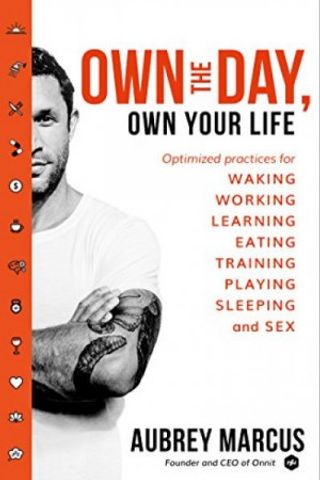

Own the Day, Own Your Life
(you don’t want to do cold immersion when you’re sick or already under a simultaneous acute stress load). Contrast is not necessary, but for me it seems to produce the best effect. Listen to your body, not to your mind. Learn to distinguish the voices of resistance and prudence. After all, wrapped up in this concept of hormesis, of exposure to good, acute stress, is recognizing the appropriate dose. A hormetic stressor is only as good as the body’s ability to fully recover from the resistance it overcomes. If the body can’t, then the stressor isn’t promoting growth, it’s toxic and it’s prompting decay. Chronic stress is literally killing us, and the traditional medical model offers us very little help to deal with it. Counterintuitively, one of the best ways to deal with chronic stress is to seek certain forms of acute stress. Through a process called hormesis, acute stress will help you adapt and become stronger. Cold exposure is one of the best sources of acute stress, and can be accessed in showers, cold tubs, and cryotherapy. The cold also offers the opportunity to practice an essential life skill—what I call “mental override”—the ability to make yourself do something you don’t want to do. The breath, when used in accordance with the Wim Hof method or other forms of intentional deep breathing, is an invaluable tool to modulate and adapt to acute stressors like cold shock, while also helping to melt away chronic stress on its own. It was the Buddha who said, wisely, “To keep the body in good health is a duty, otherwise we shall not be able to keep our mind strong and clear.” There are two primary reasons to supplement: to remediate potential deficiencies, and to gain access to unusual or hard-to-find nutrients. You don’t need to think of supplements as something that comes in a capsule, either. Getting the right amount of sun, sleep, and food is itself a kind of supplementation, and the first line of defense. The key things to consider supplementing are greens, probiotics, B vitamins, krill oil, vitamin D, and additional minerals. Psychologists even have a term for it: narcotizing dysfunction. In fact, the more you follow the news, in some cases, the less likely you are to be an active, involved citizen, because you’ve confused consuming information with acting on it. To combat the potential negative impact of the commute, as well as to practice greater presence and peace of mind, use conscious breathing techniques along with mindfulness practices like the wide peripheral gaze. Nootropics have been proven to assist with memory and cognitive performance. Huperzia serrata is a great place to start and is a part of one of the most rigorously tested formulas on the market. Whatever is worth doing at all is worth doing well. Even if you work on your own, at some point or another you are going to be interacting with someone who supports what you do. If it’s not a coworker, maybe it’s your spouse, or even your dog. If you don’t walk your dog, then he’s gonna shit in your house, and so you traded a nice sunny walk in support of your teammate for angrily cleaning up the pile of shit he made, left to his own devices. It’s the same when we don’t communicate with people at work and support them in the ways that are most useful to them as opposed to most obvious or convenient to us. Laughter is the diffuser of intensity. One of the greatest Buddhist teachers of our time is the Jamaican-born Mooji, the “laughing buddha.” He got his name because people will travel from all over the world to see him with their problems, and by the time they are ready to tell him what’s wrong, they start laughing. He has an incredible gift of pointing out the silliness and futility of many of our emotional challenges, which diffuses them immediately. In fact, evolutionary biologists credit laughter with exactly that purpose: diffusing what would ordinarily be tense situations. The moment you can laugh about something, the threat is over. Anytime you are pushing the boundaries of what you are capable of, it will be work—hard work—because you are coming up against the internal points of resistance within your mind and your soul. If it wasn’t work, it would be a problem, and I’d be worried. What you will find, once you embrace the grind, whatever your grind may be, is that all of a sudden it isn’t so bad. It is never pain that is the problem; it is the suffering caused by the resistance to that pain. More important than enjoying every minute of the work you do is knowing why you are doing it. This is your mission, and being certain of that mission will allow you to flourish even in challenging situations. To own your work, you have to own your space. This means cultivating optimal conditions for yourself within your environment by paying attention to your posture and movement, as well as the energetic and olfactory conditions of your workspace. Working effectively means accomplishing your best work with the minimum amount of resistance. To do this, you need to minimize distraction, learn to say no, and develop a process of prioritizing what you need to tackle first. Rather than counting your calories, focus on the nutrients you are putting into your body. You want to ingest plenty of macronutrients like proteins, fats, and fiber. Remember, you are what you eat ate, so source your macros well. Micronutrients are abundant in a diverse diet. Seek out these “weird” foods and benefit from a host of protective and performance-enhancing nutrients. Equally important as what you put into your body is what you keep out of it. Avoid antinutrients that come from highly processed, refined, burned, fried, or artificial foods and colorings. sleep is not a binary thing, awake and asleep. There are all different shades of parasympathetic activation that help the recovery process for mind and body. An ideal workout trains multiple power systems, including mobility, flexibility, endurance, cardio, power, and strength. Being in close-knit groups is what being a human is about. We’re social creatures—and even though many of us have hyperactive digital social lives and flesh-and-blood social connections, the fact is that at no time in human history have so many people felt so alone. Our bodies can feel and sense this loneliness, and they are responding the only way bodies know how: by making us sick more often; by sinking us into deep depression; by throwing off our hormonal balance; and by making us find chemical substitutes for the human contact that we so crave. The first thing you do when you come home from work, or emerge from the “productive” part of the day, is reset. at a certain point we stop making really great new friends. In the absence of rituals like school and sports, we don’t take the time to forge deeper connections with people. Whether it is having an all-night bender in Vegas, or a ten-day journey in Peru, extreme experiences have the potential to form the deepest bonds. Loneliness kills. But combating loneliness doesn’t mean having just anyone around you. It’s about forging deeper connections, with yourself first, and with your tribe. To connect with yourself, don’t be shy about creating a little state shift. To connect with others, collapse the judgments that separate you by seeing them as you living a different life. Then play some music, have a laugh, but most important, make the effort to cultivate the sense of community around you. There’s a reason sex is always everywhere. We’re never having enough of it. So we crave it, and we jump at every tantalizing suggestion of it—a fact that advertisers and media conglomerates are fully aware of, and use to their advantage. So why aren’t we better at sex? The answer is actually shockingly simple: we’ve never been taught. As a culture we are absolutely devoid of any kind of practical sexual education, both for teens and adults. What do we have instead? Well, we usually start with lectures on how dangerous and bad and frightening sex is. Everyone is different. Everyone likes different things. No matter how skilled you are (or think you are) as a lover, you will never truly know your partner unless you communicate. What are their desires, fantasies, boundaries, insecurities? What are yours? Get out of your comfort zone, but always be ready for feedback. Great lovers aren’t born; they are made out of good listeners. When I was thinking about what holds people back from having better sex more often, one word kept rising to the surface: ego. The biggest obstacle to improving your sex life is the ego. Think about it. When we’re single, the reason we don’t talk to more potential mates is that we are afraid of rejection. Or sometimes we choose the wrong mate because of our ego. We choose people we are not compatible with because their status or attractiveness will make us feel better about who we are, and maybe make others think better of us too. In relationships, we don’t ask our partners what they like, because even the idea that we aren’t already exactly what they want is too much for our fragile ego to handle. The ego leads us to believe, sometimes consciously and sometimes not, that we were born as the kings and queens of all sexual performance. Of course, this only leads to all of us walking around terrified of not performing. We are afraid of how we look, or smell, or taste because the ego has wild expectations. We might not even admit to ourselves that we are not having as much sex as we should because the ego doesn’t want to admit our sex life needs some help. We might lie to ourselves about our addiction to pornography; we might be seeking high-risk, low-yield sex to unhealthily fulfill an emotional need. All things the ego will brush over, bury, or rationalize away. The truth is this: the ego likes to hold us to an unrealistic standard of perfection. It is always thinking about what happened in the past, or will happen in the future. The tongue is the most important sex organ on the body. Not because you lick with it, but because you communicate with it. Let down your ego. Talk to your partner about your likes, dislikes, and fantasies. Laugh if something you didn’t expect happens. Don’t take it too seriously. Your sex does not define you. If you enjoy your sex, you are going to have more of it. The more sex you have, the healthier you will be. Limit your indulgence in pornography, explore power exchange, be adventurous, and level up your sex game by mastering the squeeze. The cell phone has become the adult’s transitional object, replacing the toddler’s teddy bear for comfort and a sense of belonging. Writing things down also reduces the instinct to go over that thought again and again in your head, making it easier for you to relax. Knowing that you won’t forget anything, because it’s written down right there for you, also smoothes your transition into sleepy time and makes waking up to own the day a pleasure instead of a panic. just as writing down my mission gets it out of my head and makes it real, writing down my pain gets it out of my head and confines it to the page, which makes it much more manageable. If you don’t turn off, you won’t ever properly turn on. The stress of carrying the weight of the day into the night will compound over time and slow you down. Let your phone go. It will be there waiting for you in the morning, I promise. One of the most effective ways to deal with stress is to pick up a pen or open a Google doc and start journaling. First you want to make sure you set your mission and objective for the following day. Then you want to purge anything you no longer want to carry, and memorialize those things you don’t want to forget but also don’t want to burden your psyche with. The last hour before bed is time to really wind down and cuddle with yourself or someone you love. It’s the time for reading, a relaxing game, or maybe even your favorite show. Give your body some love with the personal care it needs, and get ready to sleep your face off. The famous nineteenth-century German philosopher Arthur Schopenhauer once said, “Sleep is the interest we have to pay on the capital which is called in at death. The higher the interest rate and the more regularly it is paid, the further the date of redemption is postponed.” The reality is, there are four phases to sleep: awake and resting; light sleep; deep sleep; and REM sleep. And while each of these phases is helpful, the two most important are deep sleep and REM sleep. In deep sleep, you release all the hormones to repair and rebuild your body. In REM sleep, you are basically rebooting the mental hard drive. A typical sleep cycle lasts ninety minutes and transitions from awake and resting, to light sleep, to deep sleep, finally ending in REM. If thirty-five sleep cycles per week is the goal, that means the typical day should theoretically include four or five sleep cycles. Fortunately, they don’t all have to come at night. In the siesta model, our Spanish and Egyptian friends sleep three or four cycles at night, and one cycle in the afternoon. In Littlehales’s model, sleep is even more fluid. A thirty-minute nap like the one we talked about in chapter 9, which is only one-third of a full cycle, still counts as one point toward your sleep-cycle goal. It’s not extra or a bonus, it’s part of your sleep regimen. So if you sleep six hours at night, you get four points. If you take a thirty-minute power nap that day, you get an additional point, bringing you to five. Do that every day of the week and you have met your thirty-five-point goal. If you get 7.5 hours of sleep one night, that’s five points right there. Knowing what to do and why to do it are a big part of owning the day. Before you implement what you have learned, you are inevitably going to face a force called resistance. It will hit you from the outside and from within, so you need to acquire the tools to overcome it. You need to learn how to forgive yourself for past failings, how to motivate yourself to keep going, how to visualize your success, how to give yourself a pat on the back, and how to let your tribe know about your journey so they can support you in the struggle and celebrate you in success. Do it for them as much as you do it for yourself. Most small businesses fail. Most books don’t make it to “The End,” and, according to OG podcaster Jordan Harbinger, host of The Art of Charm, 95 percent of podcasts don’t make it to their thirteenth episode. Why is this? Usually it isn’t because the ideas are bad (though sometimes, the ideas are really bad), it’s because we weren’t able to win the mental battle necessary to get us there. We got discouraged when we ran into unforeseen obstacles. We got derailed when we didn’t get the results we were expecting. Or worse, we listened to the flood of voices giving us a million good reasons why we should stop. Sometimes the voices come from outside Sometimes the voices come from inside our own heads, telling us we’re not good enough, or we don’t deserve it, or it’s too late and we should have started earlier. The author Steven Pressfield has heard those same voices, too. He even gave them a name. He called them, collectively, Resistance. Resistance is that force that will oppose you every time you attempt to ascend, to improve, to achieve. Pressfield heard it all the way up until he was about forty years old and decided that he was finally going to fulfill his lifelong vocation and become a professional writer. He wrote four screenplays that were made into movies over the next ten years, and published his first book when he was fifty-two years old. It was called The Legend of Bagger Vance, and it went on to become a massive bestseller as well as a feature film five years later. His second book, Gates of Fire, was a piece of historical fiction about the three hundred Spartan men who made a stand at a place in Greece called the Hot Gates. They faced an army of 100,000 Persian fighters. They didn’t retreat. They didn’t surrender. They died fighting to the last man, because they were Spartans. How did they defeat Resistance? Silence those voices that told them they could never win, that there was no point, that it was hopeless? They had an ethos. Never give up, never surrender. Easier said than done. Ask anyone what the hardest thing is about doing something new or different or unheard of, and they’ll tell you it’s sticking with it. That’s why we’re going to help you build an ethos in this chapter that will give you the encouragement you need to silence the voices and overcome the resistance. But building an ethos isn’t the only technique you’re going to need. You will need to visualize your success. You will need to employ positive self-talk, and rid yourself of self-ridicule. You will need the support of your tribe. But the first step you will need to take may be the hardest of all. It is, for me. It’s forgiveness. There is a good chance you have tried diets and transformational programs before and failed. Guess what, so has everyone. But you are not the same person you were then, and this is not the same program. You are the person who learned from those experiences, who appreciates owning life even more than you did then. For that knowledge to turn into wisdom, though, you have to forgive yourself for all your past failings. You did your best then, and your best now is different. There is a scene deep into the first season of one of my favorite shows on television, Billions, when genius fund manager Bobby Axelrod is talking to his brilliant psychotherapist about why he uncharacteristically blew a trade that cost his fund a billion dollars. After hours of banter, he realizes that it was his guilt surrounding the manipulation of his friend for his own financial gain that caused him to subconsciously seek retribution … on himself. He needed to pay the price to level out his internal scales of justice. This isn’t just something from fiction, though. I’ve seen it a hundred times. It is the motivation behind many forms of self-destruction. Whether in love, or in business, or in health, if we don’t feel like we deserve a positive outcome, or even worse, like we deserve to be punished, we will manifest that outcome with the subconscious choices we make. If we don’t forgive ourselves, all that knowledge from our past failures will instead petrify into useless information, and we will continue to believe deep down that we deserve to get beaten down by life. We will find ourselves, again and again, on the short side of the trade. The reason this whole thing has to start with forgiveness is that your choices will never be perfect. Maybe you got frustrated in the car this morning, or sat too long in one position at work this afternoon, or ignored your kids when you got home tonight. That’s okay. Your day is never going to be perfect. If there is anything about your day or your life that you need to own, it’s that. What’s worse, if we allow the inner critic to punish us every time we fail to meet the standards of perfection, we’ll stop trying altogether. We’ll decide that it is better to pretend that it’s someone else’s fault, hiding behind excuses and rationalizations. If we know that when we fail, we will forgive ourselves, then we get to play from inspiration rather than fear. We’ll be able to look our mistakes right in the eye, take the medicine, and move on. It’s what any good coach does for his players. In my coaching course “Go for Your Win,” I have everyone choose a single phrase they can tell themselves whenever times get tough. They need it (we all do, frankly) because in the absence of success or in the presence of obstacles, forgiveness will only take you halfway. Positive self-talk is what picks up the baton for the final leg and brings you across the finish line of your day, of your mission, of your life. No one is an island. And while all the individual, personal work I’ve talked about in this chapter is essential to conquering resistance and owning the day, it’s not yet enough, because we are tribal creatures, and we need the support of our tribe to truly thrive. Psychologists agree that there are four keys to compelling positive action: (1) know what to do and how to do it; (2) believe it will work; (3) see the value; and (4) get support from your community/tribe/family. Part of the problem with our current condition is that there is a ton of conflicting information. When people are confused about what they should do and how they should do it, they don’t do anything at all. The Hawaiian kahunas (shamans) have a practice for radical forgiveness they call Ho’oponopono, the purpose of which is to get you to a completely clean slate, a state of mind called the zero state (also the title of a book by Joe Vitale). It is a simple dialogue you have with yourself or a loved one, which requires you to say four things. We’re going to focus it on yourself for now, but keep this in your medicine bag when you need to resolve a conflict with anyone else. “I love you.” Love is the appropriate bond that can unify all aspects of yourself. To express this love sets the foundation for all the communication to follow. “I’m sorry.” This is to clear you of any guilt you may carry for the times you’ve done yourself wrong—from negative self-talk to forcing your body to cope with way too much cheap tequila. “Forgive me.” The humble act of asking for forgiveness, when sincere, is not often opposed. Grant yourself the forgiveness you seek. “Thank you.” This is an expression of gratitude to your body and your mind, not only for the forgiveness but for everything it has given you. It’s gotten you this far, after all, right? Say it to yourself: I love you, I’m sorry, forgive me, thank you. The hero is simply someone who does battle with his demons every day. The reason is twofold. For one, to be of service, you have to be fit for service. A leaky cup can’t effectively serve water. There’s a reason they tell you to put your own oxygen mask on first before assisting others in case of emergency on an airplane. You need to be strong and vital to be of any use to other people. The second reason is that by owning the day and taking control of your life, you can be the living proof to others of what is possible. You can lead by example. Why is it that when someone first does a new trick on a skateboard or a motocross bike that was previously believed to “never be possible,” then all of a sudden a year later three more people can do the same trick? It’s because when you do it, other people believe they can do it too. Creating an ethos is a shortcut to mastering mental override. It prevents you from the anguish of deliberation over your choices and starts to define the person you want to be. Create your ethos and support yourself with positive self-talk. We are social creatures, designed to live in community with others. It is no surprise that accountability and support from our tribe is essential to creating any form of lasting change. Pick the day you want to own, begin the process, and let everyone you love know about it. Ask for their support, hold yourself accountable to your word, and you won’t just own that day, you will be setting yourself on the path to owning your life. ==========
Estatísticas
Avaliações
3.8 / 4- 5 estrelas0%
- 4 estrelas75%
- 3 estrelas25%
- 2 estrelas0%
- 1 estrelas0%