Without calculus, we wouldn’t have cell phones, TV, GPS, or ultrasound. We wouldn’t have unraveled DNA or discovered Neptune or figured out how to put 5,000 songs in your pocket. Though many of us were scared away from this essential, engrossing subject in high school and college, Steven Strogatz’s brilliantly creative, down-to-earth history shows that calculus is not about complexity; it’s about simplicity. It harnesses an unreal number—infinity—to tackle real-world problems, breaking them down into easier ones and then reassembling the answers into solutions that feel miraculous. Infinite Powers recounts how calculus tantalized and thrilled its inventors, starting with its first glimmers in ancient Greece and bringing us right up to the discovery of gravitational waves (a phenomenon predicted by calculus). Strogatz reveals how this form of math rose to the challenges of each age: how to determine the area of a circle with only sand and a stick; how to explain why Mars goes “backwards” sometimes; how to make electricity with magnets; how to ensure your rocket doesn’t miss the moon; how to turn the tide in the fight against AIDS. As Strogatz proves, calculus is truly the language of the universe. By unveiling the principles of that language, Infinite Powers makes us marvel at the world anew.
Infinite Powers: How Calculus Reveals the Secrets of the Universe -
Steven Strogatz
Edições (1)
Ver mais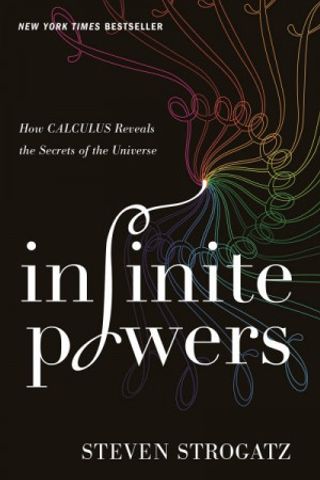

Minhas notas do livro
So in everyday life, the gulf between the discrete and the continuous can often be bridged, at least to a good approximation. For many practical purposes, the discrete can stand in for the continuous, as long as we slice things thinly enough. In the ideal world of calculus, we can go one better. Anything thats continuous can be sliced exactly (not just approximately) into infinitely many infinitesimal pieces. Thats the Infinity Principle. With limits and infinity, the discrete and the continuous become one. Planck length = â ħG / c3 . When we plug in the measured values of G, ħ, and c, the Planck length comes out to be about 1035 meters, a stupendously small distance thats about a hundred million trillion times smaller than the diameter of a proton. The corresponding Planck time is the time it would take light to traverse this distance, which is about 1043 seconds. Space and time would no longer make sense below these scales. Theyre the end of the line. These numbers put a bound on how fine we could ever slice space or time. We will never know all the digits of pi. Nevertheless, those digits are out there, waiting to be discovered. As of this writing, twenty-two trillion digits have been computed by the worlds fastest computers. Yet twenty-two trillion is nothing compared to the infinitude of digits that define the actual pi. Think of how philosophically disturbing this is. I said that the digits of pi are out there, but where are they exactly? They dont exist in the material world. They exist in some Platonic realm, along with abstract concepts like truth and justice. Theres something so paradoxical about pi. On the one hand, it represents order, as embodied by the shape of a circle, long held to be a symbol of perfection and eternity. On the other hand, pi is unruly, disheveled in appearance, its digits obeying no obvious rule, or at least none that we can perceive. Pi is elusive and mysterious, forever beyond reach. Its mix of order and disorder is what makes it so bewitching. With its yin and yang binaries, pi is like all of calculus in miniature. Pi is a portal between the round and the straight, a single number yet infinitely complex, a balance of order and chaos. Calculus, for its part, uses the infinite to study the finite, the unlimited to study the limited, and the straight to study the curved. The Infinity Principle is the key to unlocking the mystery of curves, and it arose here first, in the mystery of pi. This is such an honest account of what its like to do creative mathematics. Mathematicians dont come up with the proofs first. First comes intuition. Rigor comes later. This essential role of intuition and imagination is often left out of high-school geometry courses, but it is essential to all creative mathematics. In analysis, one solves a problem by starting at the end, as if the answer had already been obtained, and then works back wishfully toward the beginning, hoping to find a path to the given assumptions. Its what kids in school think of as working backward from the answer to figure out how to get there. Synthesis goes in the other direction. It starts with the givens, and then, by stabbing in the dark, trying things, you are somehow supposed to move forward to a solution, step by logical step, and eventually arrive at the desired result. Synthesis tends to be much harder than analysis because you dont ever know how youre going to get to the solution until you do. The ancient Greeks regarded synthesis as carrying more logical force, more persuasive power, than analysis. Synthesis was considered the only valid way to prove a result; analysis was a practical way to find the result. If you wanted a rigorous demonstration, you had to do synthesis. Thats why, for example, Archimedes used his analytical method of balancing shapes on seesaws to find his theorems but then switched to the synthetic method of exhaustion to prove them. Many people find logarithms confusing, but they make a lot of sense if you think about them by analogy with carpentry. Logarithms and other functions are like tools. Different tools have different purposes. Hammers are for pounding nails into wood; drills are for boring holes; saws are for cutting. Likewise, exponential functions are for modeling growth that feeds on itself, and power functions are for modeling less violent forms of growth. Logarithms are useful for the same reason that staple removers are useful: they undo the action of another tool. Specifically, logarithms undo the actions of exponential functions, and vice versa. FROM A TWENTY-FIRST-CENTURY vantage point, calculus is often seen as the mathematics of change. It quantifies change using two big concepts: derivatives and integrals. But the function itself is not the line. The function is the rule that produces the line. Art, said Picasso, is a lie that makes us realize truth. The same could be said for calculus as a model of nature. This is why it was so important to be able to find the area under an arbitrary curve. Because of its intimate connection to the backward problem, the area problem is not just about area. Its not just about shape or the relationship between distance and speed or anything that narrow. Its completely general. From a modern perspective, the area problem is about predicting the relationship between anything that changes at a changing rate and how much that thing builds up over time. More succinctly, an infinitesimal is smaller than everything but greater than nothing. We could play the same A with a violin or a piano, and both would sound colorful and warm. Even though they too emit vibrations at a fundamental frequency of 440 cycles per second, they sound different from a tuning fork (and from each other) because of their distinct set of overtones. Thats the musical term for the waves like sin 3x and sin 5x in the earlier formula for the triangle wave. Overtones add color to a note by adding in multiples of the fundamental frequency. In addition to the sine wave at 440 cycles a second, a synthesized triangle wave includes a sine-wave overtone at three times that frequency (3 × 440 = 1320 cycles per second). That overtone is not as strong as the fundamental sin x mode. Its relative amplitude is only 1/9 as large as the fundamental, and the other odd-numbered modes are even weaker. In musical terms, these amplitudes determine the loudness of the overtones. The richness of the sound of a violin has to do with its particular combination of softer and louder overtones. The unifying power of Fouriers idea is that the sound of any musical instrument can be synthesized by an array of infinitely many tuning forks. All we need to do is strike the tuning forks with the right strengths and at the right times and, incredibly, out pops the sound of a violin or a piano or even a trumpet or an oboe, although were using nothing more than colorless sine waves. This is essentially how the first electronic synthesizers worked: they reproduced the sound of any instrument by combining a large number of sine waves. According to this narrative, calculus began with a bang, thanks to the breakthroughs of Newton and Leibniz. Their discoveries sparked a gold-rush mentality in the 1700s, a period marked by playful, almost giddy exploration during which the golem of infinity was allowed to run wild. By giving it free rein, mathematicians produced a raft of spectacular results but also generated a lot of nonsense and confusion. So in the 1800s, the next few generations of mathematicians, a more rigorous lot, prodded the golem back into its cage. They expunged infinity and infinitesimals from calculus, shored up the foundations of the subject, and finally clarified what limits, derivatives, integrals, and real numbers actually meant. By around 1900, their mopping-up operation was complete. Calculus, to me, is defined by its credo: to solve a hard problem about anything continuous, slice it into infinitely many parts and solve them. By putting the answers back together, you can make sense of the original whole. Ive called this credo the Infinity Principle. From this point of view, calculus is the sprawling collection of ideas and methods used to study anythingany pattern, any curve, any motion, any natural process, system, or phenomenonthat changes smoothly and continuously and hence is grist for the Infinity Principle. Early in the 1800s, the French mathematician and astronomer Pierre Simon Laplace took the determinism of Newtons clockwork universe to its logical extreme. He imagined a godlike intellect (now known as Laplaces demon) that could keep track of all the positions of all the atoms in the universe as well as all the forces acting on them. If this intellect were also vast enough to submit these data to analysis, he wrote, nothing would be uncertain and the future just like the past would be present before its eyes. A further difficulty is that we dont even know if some of those systems harbor patterns akin to those uncovered by Kepler and Galileo. Nerve cells apparently do, but what about economies or societies? In many fields, human understanding is still in the pre-Galilean, pre-Keplerian phase. We havent found the patterns. So how can we find deeper theories that would give insight into those patterns? Biology and psychology and economics are not Newtonian yet, because they arent even Galilean and Keplerian. We have a long way to go. A system of reasoning humans invented is somehow in tune with the harmony of nature. Its reliable not just at the scales where it was inventedat the everyday scales of ordinary life, with its spinning tops and its bowls of soupbut also at the smallest scales of atoms and at the grandest scales of the cosmos. So it cant just be a trick of circular reasoning. Its not that were stuffing things into calculus that we already know, and calculus is handing them back to us; calculus tells us about things weve never seen, never could see, and never will see. In some cases, it tells us about things that never existed but couldif only we had the wit to conjure them. This, to me, is the greatest mystery of all: Why is the universe comprehensible, and why is calculus in sync with it? I have no answer, but I hope youll agree its worth contemplating. Instead of being an arena for the drama, space became an actor in its own right. In Einsteins theory, matter tells space-time how to curve, while curvature tells matter how to move. The dance between them makes the theory nonlinear.
Estatísticas
Avaliações
5 / 7- 5 estrelas100%
- 4 estrelas0%
- 3 estrelas0%
- 2 estrelas0%
- 1 estrelas0%