Most accounts explain the postwar globalization of financial markets as a product of unstoppable technological and market forces. Drawing on extensive historical research, Eric Helleiner provides the first comprehensive political history of the phenomenon, one that details and explains the central role played by states in permitting and encouraging financial globalization. Helleiner begins by highlighting the commitment of advanced industrial states to a restrictive international financial order at the 1944 Bretton Woods conference and during the early postwar years. He then explains the growing political support for the globalization of financial markets after the late 1950s by analyzing five sets of episodes: the creation of the Euromarket in the 1960s, the rejection in the early 1970s of proposals to reregulate global financial markets, four aborted initiatives in the late 1970s and early 1980s to implement effective controls on financial movements, the extensive liberalization of capital controls in the 1980s, and the containment of international financial crises at three critical junctures in the 1970s and 1980s. He shows that these developments resulted from various factors, including the unique hegemonic interests of the United States and Britain in finance, a competitive deregulation dynamic, ideological shifts, and the construction of a crisis-prevention regime among leading central bankers. In his conclusion Helleiner addresses the question of why states have increasingly embraced an open, liberal international financial order in an era of considerable trade protectionism.
States and the Reemergence of Global Finance: From Bretton Woods to the 1990s -
Eric Helleiner
Cornell University Press
1996
262 páginas
8h 44m
ISBN-13: 9780801483332
Edições (1)
Ver mais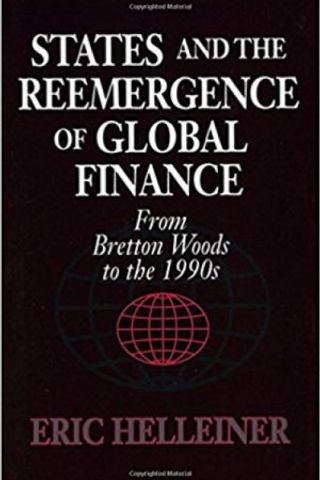
Estatísticas
Avaliações
3.5 / 1- 5 estrelas0%
- 4 estrelas100%
- 3 estrelas0%
- 2 estrelas0%
- 1 estrelas0%