Poetry. Film. Translated from the Russian by Philip Metres and Dimitri Psurtsev. "Tarkovsky now joins the ranks of Mandelstam, Akhmatova, and Brodksky. Philip Metres and Dimitri Psurtsev's translations—succinct and allusive, stingingly direct and yet sweeping, mournful and celebratory—are marvels."—PEN/Heim citation "How does one translate the work of Russian classic, Arseny Tarkovsky? Imagine trying to translate Yeats: high style rhetoric, intense emotion, local tonalities of language, complicated historical background, the old equation of poet vs. state, the tone of a tender love lyric, all meshed into one, all exquisite in its execution—and all so impossible to render again. And yet, one tries. In the case of Philip Metres and Dimitri Psurtsev, one tries brilliantly, with gusto, with passion, with attentiveness that is akin to that of a prayer, with the ear of real poets. The result? The gravity and directness of Tarkovsky's tone is brought into English without fail, it is here, honest and pained, piercing and even shy at times, like a deer that looks straight at you before it runs. Tarkovsky's ambition was to seek us—those who live after him—through earth, through time. He does so in this brilliant translation."—Ilya Kaminsky "Arseny Tarkovsky was ten years old at the time of the Russian Revolution and died six months before the opening of the Berlin Wall. He spent his career as a poet creating elegant and starkly interior transfigurations of simple happiness and pure grief, triumphs of the individual self against the brutal realities of daily life in wartime and Communist Russia. Through this meticulous translation of his work, readers will encounter a metaphysical complex poetry, at once searing and brooding, very much in dialogue with such great Soviet poets as Osip Mandelstam and Anna Akhmatova. Tarkovsky writes of a country where 'we lived, once upon a time, as if in a grave, drank no tea' but still succeeded in making 'bread from weeds,' where the 'blue sky is dim' but nonetheless manages to be the 'wet-nurse of dragonflies and birds.'"—Michael Dumanis "These translations seem most intent on capturing Tarkovsky's simple yet hermetic voice in a contemporary American idiom, one that renders his tortured, haunted, and at times quite mystical worldview comprehensible to our auto-tuned, tone-deaf ears, which prefer free verse and colloquial speech rhythms to the rich and various soundscapes instinctive to Russian verse traditions. Metres, speaking of the much-vaunted failures of translation, writes that they "are not failures between languages as much as a property of language itself" (183). Despite the many shortcomings of our vernacular, though, Metres and Psurtev succeed in fashioning rough-and-ready parallels in a spare, enveloping style gray-lit with despair and revelation. The translations rarely if ever seem sententious or heavy-handed, giving each phrase enough breathing room to ramify and implicate. "Between the lines my fate was burned, " Tarkovsky says, "while my soul sloughed off its skin" (123). Religious and orphic longings abound in Tarkovsky's work, and the translators have succeeded not only in producing the tenuous metaphysical quality of the lines themselves but also in stealing something of the fire that's between them.--DIAGRAM Shortlisted for the Institute of Translation's Read Russia! Prize, 2016 Shortlisted for PEN Translation Award, 2016 National Translation Award Longlist, 2016
I Burned at the Feast - Selected Poems of Arseny Tarkovsky
Arseny Tarkovsky
Cleveland State University Poetry Center
2015
232 páginas
7h 44m
ISBN-13: 9780996316705
Edições (1)
Ver mais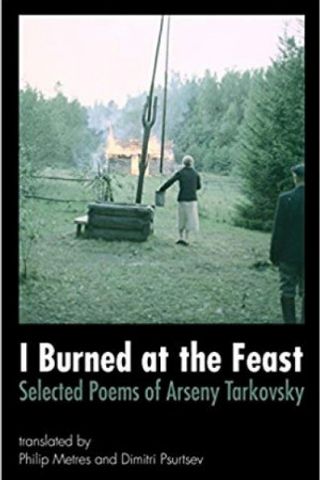
Resenhas (2)Ver mais
@psi.adriana.scarpin16/12/2020Resenhou um livro
3 curtidas
Estatísticas
Avaliações
4.7 / 3- 5 estrelas67%
- 4 estrelas33%
- 3 estrelas0%
- 2 estrelas0%
- 1 estrelas0%