Phylogenetic diversity is now a key concept for biodiversity conservation due to its link to option value, evolutionary potential and to the possibility of guiding conservation across scales. Present facilities for obtaining molecular sequences and metagenomes are powering this research field, rendering available detailed information of phylogenetic diversity for a wide taxonomic sample in a short time frame. Along with modern methods of Systematic Conservation Planning this will certainly contribute to more explicit identification of conservation priorities and options. This book brings an updated state of the art of phylogenetic diversity in conservation biology. Nineteen chapters written by scientists from research institutions of fourteen countries demonstrate that approaches for preserving the evolutionary heritage are now very tuned into human impacts and sustainability issues. The questions, methods and applications around which it is organized show the importance of phylogenetic diversity in avoiding biodiversity losses in the present extinction crisis. They touch important points such as the way we value phylogenetic diversity, the importance of thinking at a much wider sample of the Tree of Life, the choice of adequate measures. In methods section, new solutions, such as dealing with abundances, sampling effort, or with information coming from conflicting phylogenetic trees are provided. Application section includes study cases of different groups of organi sms, such as mammals, amphibians, butterflies and plants, in aquatic and terrestrial ecosystems, showing that phylogenetic diversity can be applied in a very wide range of situations, including as a way for predicting conservation status of species. This highlights the interest of this book not only for students and scientists of related disciplines but also for stakeholders and policy-makers working on the implementation of global, regional, and local agendas for biodiversity conservation.
Biodiversity Conservation and Phylogenetic Systematics (Topics in Biodiversity and Conservation) - Preserving our evolutionary heritage in an extinction crisis
Roseli Pellens, Philippe Grandcolas
Springer
2016
390 páginas
13h 0m
ISBN-10: B078232RVN
Edições (1)
Ver mais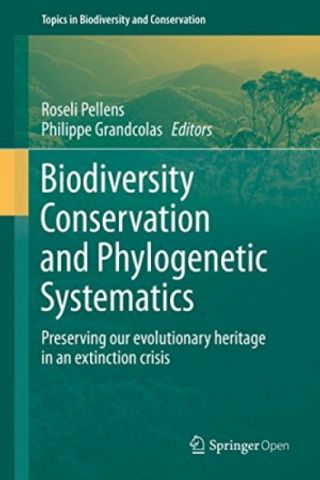
Estatísticas
Avaliações
0 / 0- 5 estrelas0%
- 4 estrelas0%
- 3 estrelas0%
- 2 estrelas0%
- 1 estrelas0%