From the author of Proust and the Squid, a lively, ambitious, and deeply informative epistolary book that considers the future of the reading brain and our capacity for critical thinking, empathy, and reflection as we become increasingly dependent on digital technologies. A decade ago, Maryanne Wolf’s Proust and the Squid revealed what we know about how the brain learns to read and how reading changes the way we think and feel. Since then, the ways we process written language have changed dramatically with many concerned about both their own changes and that of children. New research on the reading brain chronicles these changes in the brains of children and adults as they learn to read while immersed in a digitally dominated medium. Drawing deeply on this research, this book comprises a series of letters Wolf writes to us—her beloved readers—to describe her concerns and her hopes about what is happening to the reading brain as it unavoidably changes to adapt to digital mediums. Wolf raises difficult questions, including: Will children learn to incorporate the full range of "deep reading" processes that are at the core of the expert reading brain? Will the mix of a seemingly infinite set of distractions for children’s attention and their quick access to immediate, voluminous information alter their ability to think for themselves? With information at their fingertips, will the next generation learn to build their own storehouse of knowledge, which could impede the ability to make analogies and draw inferences from what they know? Will all these influences, in turn, change the formation in children and the use in adults of "slower" cognitive processes like critical thinking, personal reflection, imagination, and empathy that comprise deep reading and that influence both how we think and how we live our lives? Will the chain of digital influences ultimately influence the use of the critical analytical and empathic capacities necessary for a democratic society? How can we preserve deep reading processes in future iterations of the reading brain? Who are the "good readers" of every epoch? Concerns about attention span, critical reasoning, and over-reliance on technology are never just about children—Wolf herself has found that, though she is a reading expert, her ability to read deeply has been impacted as she has become, inevitably, increasingly dependent on screens. Wolf draws on neuroscience, literature, education, technology, and philosophy and blends historical, literary, and scientific facts with down-to-earth examples and warm anecdotes to illuminate complex ideas that culminate in a proposal for a biliterate reading brain. Provocative and intriguing, Reader, Come Home is a roadmap that provides a cautionary but hopeful perspective on the impact of technology on our brains and our most essential intellectual capacities—and what this could mean for our future.
Reader, Come Home - The Reading Brain in a Digital World
Maryanne Wolf
Harper
2018
272 páginas
9h 4m
ISBN-13: 9780062388780
Edições (1)
Ver mais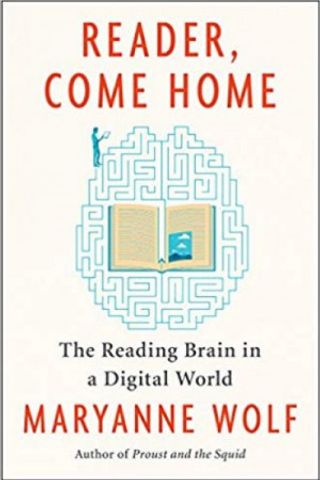
Resenhas (1)Ver mais

Vinicius Tega01/08/2025Resenhou um livro
Livros, sempre eles
8 curtidas
Estatísticas
Avaliações
4 / 3- 5 estrelas0%
- 4 estrelas100%
- 3 estrelas0%
- 2 estrelas0%
- 1 estrelas0%

Maryanne Wolf
Maryanne Wolf é pesquisadora, professora e defensora de crianças e letramento ao redor do mundo. Ela é diretora do Center for Dyslexia, Diverse Learners, and Social Justice na UCLA Graduate School of Education and Information Studies. Foi titular da cátedra John DiBiaggio of Citizenship and Public Service e diretora do Center for Reading and Language Research no Eliot-Pearson Department of Child Study and Human Development da Universidade Tufts. Também autora de Tales of Literacy for the 21st Century (Oxford University Press, 2016) e de mais de 160 publicações científicas, além de ter sido organizadora da obra Dyslexia, Fluency, and the Brain (Pro Ed, 2001). Pela Editora Contexto publicou "O Cérebro no mundo digital" e "O Cérebro leitor".
6 Livros
6 Seguidores