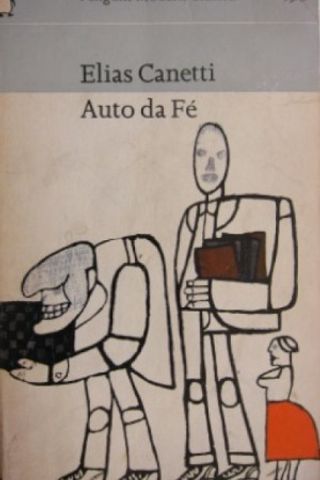
The story starts out unpretentiously introducing the main character, Peter Kien, who, though apparently a bit eccentric, strikes an initial vein of empathy, which is systematically and gradually destroyed, revealing a gullible, misanthropic, and misogynistic sinologist. The characters are all described by their actions as well as their oneiric and/or hallucinatory digressions, a kind of mad, wild, and absurd stream of consciousness used throughout the novel. In that sense, I suppose one could compare it to Kafka or Camus, though their absurdness was more logical and moral rather than literal, as it is here. Canetti uses this frenzied artifice so much that immediately upon finishing the last chapter, one may ask: "Was the whole story a dream/nightmare?" "Was Canetti on drugs when he wrote this?" In the beginning, it is quite interesting, but, from two thirds of the way through to the end, it can get a little strenuous and tiring.
It is a given that when reading fiction one must suspend reality, but, in this case, it became an absolute necessity. I suppose that could be construed as humor, and even though I did find a couple of humorous spots, I found it more odd than humorous. I also realize that one should always reflect on the possible different interpretations of a literary work, regardless of the plausibility of the story. So, regarding the story itself, I grasped the criticism that was being exacted on society, but some of the characters were so allegorical that I had difficulty in interpreting what they represented. The time in which the story was written, and finding out that Canetti was in fact Jewish and lived in Germany made me better understand the allegorical roles of some of the characters in the story. For example, the caretaker, Benedikt Pfaff, who was a violent and controlling retired policeman (who possibly abused his daughter and/or caused his wife's death) could be a representation of the then emergent Nazi regime, which were not only violent, but also, so controlling that they burned many books in those days, accounting for the final fire/burning allegory and the title of the novel. The hunchbacked dwarf Fischerle, a con man and a Jew, represented the way Jewish people were perceived at the time. The blind man who was not blind, represented the people who refused to acknowledge the terrible things that were being done in Germany in those days. This character also represents the callousness of human beings, since he does not think twice about swindling Kien even though in the beginning of the story Kien actually scorns someone for giving the blind man a button instead of a coin. And so on…
The book is enjoyable in the beginning, and a difficult read towards the end, but it is worth the reading. There are no likable characters in the story; they're all bizarre personalities who rarely understand each other. All have ulterior motives for which they scheme and rationalize to achieve what they want. Sounds familiar? … That is our society today. The sad thing is that Canetti wrote this in 1935! That reminds me of (I think) a Sting song, which says "history… teach us nothing!!"