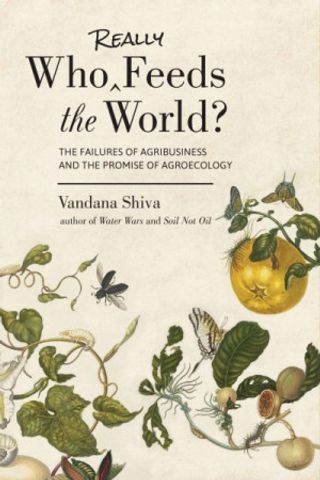
Who Really Feeds the World? - The Failures of Agribusiness and the Promise of Agroecology

    Vandana Shiva

    North Atlantic Books
    2016
    182 páginas
    6h 4m
    ISBN-10: B0165HVSSE

    Debunking the notion that our current food crisis must be addressed through industrial agriculture and genetic modification, author and activist Vandana Shiva argues that those forces are in fact the ones responsible for the hunger problem in the first place. Who Really Feeds the World? is a powerful manifesto calling for agricultural justice and genuine sustainability, drawing upon Shiva’s thirty years of research and accomplishments in the field. Instead of relying on genetic modification and large-scale monocropping to solve the world’s food crisis, she proposes that we look to agroecology—the knowledge of the interconnectedness that creates food—as a truly life-giving alternative to the industrial paradigm. Shiva succinctly and eloquently lays out the networks of people and processes that feed the world, exploring issues of diversity, the needs of small famers, the importance of seed saving, the movement toward localization, and the role of women in producing the world's food.

    Edições (1)

    Ver mais
    • book cover
    Resenhas (1)Ver mais
    Gabriela Alves picture
    Gabriela Alves27/01/2024Resenhou um livro
    5 (Perfeito)

    Quem realmente alimenta o mundo?

    Nesse livro fundamental para pensar a respeito da crescente crise alimentar que o mundo está atravessando, Vandana Shiva faz uma pergunta: quem realmente alimenta o mundo? A resposta para essa pergunta depende do ponto de vista adotado, que aqui ela chama de paradigma; e o paradigma escolhido por Shiva é o da agroecologia. Nesse paradigma, Shiva apresenta 8 respostas para a pergunta, respostas que intitulam 8 dos 10 capítulos. 1. A agroecologia alimenta o mundo, não um paradigma violento; 2. O solo vivo alimenta o mundo, não fertilizantes químicos; 3. Abelhas e borboletas alimentam o mundo, não venenos e pesticidas; 4. Biodiversidade alimenta o mundo, não monoculturas tóxicas; 5. Pequenos produtores alimentam o mundo, não grandes indústrias alimentícias; 6. A liberdade das sementes alimenta o mundo, não a ditadura da semente; 7. O local alimenta o mundo, não o global; e 8. Mulheres alimentam o mundo, não as corporações. Para cada um desses capítulos, Shiva tem um comprometimento ímpar em demonstrar, com dados e fatos, que sua perspectiva é possível de ser aplicada, não é uma utopia. No capítulo final, ela apresenta o caminho que devemos adotar para romper com o paradigma violento do agronegócio e implantar a agroecologia. Um livro fenomenal!

    curtir

    Estatísticas

    Avaliações

    4.8 / 2
    • 5 estrelas100%
    • 4 estrelas0%
    • 3 estrelas0%
    • 2 estrelas0%
    • 1 estrelas0%