Pearls From Poor Richard By Michelle Singletary Sunday, January 4, 2004; Page F01 Since I suspected some of you would be recovering from a stress- and debt-filled holiday, I decided to make the Color of Money Book Club choice for January an oldie but a goodie penned by Benjamin Franklin. This month I'm recommending Franklin's "The Way to Wealth" (Applewood Books, $9.95). At just 30 pages, this pocket-size book takes less than a half-hour to read but will give you a lifetime of financial wisdom -- that is, if you're wise enough to follow the advice. "The Way to Wealth" is an essay first published in 1758 as a preface to Franklin's Poor Richard's Almanack. The essay begins with Franklin's fictitious Father Abraham being asked to talk about taxes by a crowd waiting for an auction to start. Father Abraham, who quotes Poor Richard, lectures the consumers on topics ranging from the perils of idleness to business ownership to frugality to the dangers of debt. Franklin's most well-known quotes can be found in this essay. Here are just a few: "Early to bed and early to rise makes a man healthy, wealthy and wise." "Never leave that till tomorrow, which you can do today." "God helps those who help themselves." It is in "The Way to Wealth" that you will find Franklin's most famous maxims about money. In fact, Arthur Levitt, former chairman of the Securities and Exchange Commission, gave out copies of "The Way to Wealth" at his final investor town-hall meeting. Here's what Franklin's Father Abraham said: On the importance of saving: "If you would be wealthy, think of saving, as well as of getting. Away, then, with your expensive follies, and you will not have then so much reason to complain of hard times." These words ring so true today. In fact, if current savings patterns continue, there will be an annual shortfall of at least $45 billion by 2030 between the amount retirees need to cover basic expenses and what they have accumulated, according to a new study by the Employee Benefit Research Institute in collaboration with the Milbank Memorial Fund, a New York research foundation. For many middle-income folk, the personal shortfall could be avoided if they saved just 5 percent of their annual income every year, the authors of the study concluded. On the foolishness of always searching for a sale "Many have been ruined by buying good pennyworths . . . and yet this folly is practiced every day at auctions." Think Wal-Mart or Target: Bargain shoppers get positively giddy when boasting how they saved money on various items (I know I used to). But if you buy one item and get the second at half off, you haven't saved any money. You're still spending. "You can go broke saving money," Jeff Lychwick, one of my readers, often says. On the constant need to buy clothes and goods: "What use is this pride of appearance, for which so much is suffered? It cannot promote health, nor ease pain: it makes no increase of merit in person, it creates envy, it hastens misfortune." Father Abraham then asks the crowd "what madness it must be to run in debt for these superfluities?" How often do we all (me included) succumb to the clever marketing of stuff we don't need? "The blurring of this needs/wants distinction helps fuel our consumer society," wrote Knight Kiplinger in the January issue of Kiplinger's Personal Finance magazine. "The success of this process over the past two decades has resulted in what I call the democratizing of luxury. Today as never before, American households at virtually every income level seek products whose price, quality and prestige clearly exceed the functional need to be met." Just look at how DVDs have become an electronic "necessity." For goodness' sake, people were pushing and shoving for a chance to buy a $29 DVD player at Wal-Mart during the holiday season. Madness! On the accumulation of debt: "Think what you do when you run into debt; you give to another power over your liberty." Franklin goes on to write: "When you have got your bargain, you may, perhaps, think a little of payment; but, as Poor Richard says, creditors have better memories than debtors. . . . The day comes round before you are aware, and the demand is made before you are able to satisfy it." "The Way to Wealth" should be required reading, especially for teens and young adults -- before they get credit cards. It's no wonder Franklin is on the $100 bill. His timeless insight on money management is worth a handsome sum.
Estatísticas
Avaliações
3.5 / 2- 5 estrelas0%
- 4 estrelas50%
- 3 estrelas50%
- 2 estrelas0%
- 1 estrelas0%
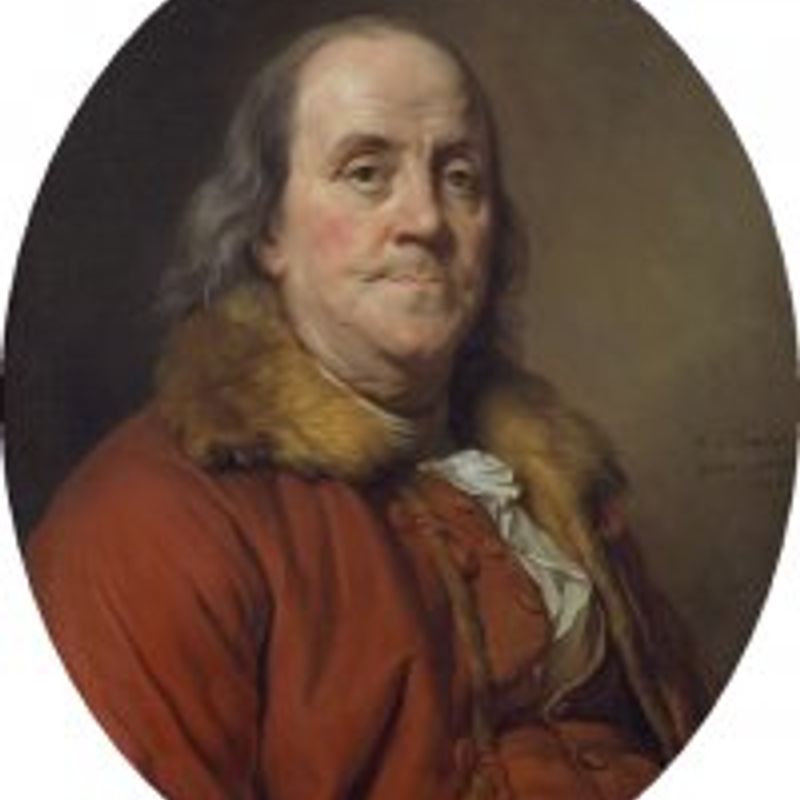
Benjamin Franklin
Benjamin Franklin (Boston, 17 de Janeiro de 1706 — Filadélfia, 17 de Abril de 1790) foi um jornalista, editor, autor,filantropo, abolicionista, funcionário público, cientista, diplomata, inventor e enxadrista americano. Foi um dos líderes da Revolução Americana, conhecido por suas citações e experiências com a electricidade. Em 1732 ele começou a publicar o famoso Almanaque do Pobre Ricardo (Poor Richard's Almanac), no qual se baseia uma boa parte da sua reputação popular nos EUA. Provérbios deste almanaque tais como "um tostão poupado é um tostão ganhado", são hoje muito conhecidos, mesmo em todo o mundo. Em 1758, o ano em que ele deixou de escrever para o almanaque, imprimiu O sermão do pai Abraão, hoje considerado como o texto mais famoso da literatura produzida na América dos tempos coloniais.
6 Livros
13 Seguidores