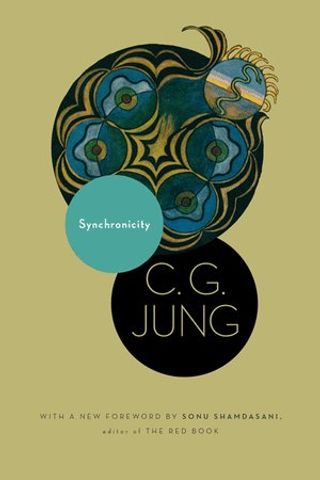
To begin with, I must say that I'm by no means properly graduated or qualified to try and validate or refute Jung's arguments. Most of the authors and philosophers he mentions as reference, I have read little to nothing about. So, these notes and quotes are simply things that caught my attention for some unknown reason and might be useful or resonate with someone. ( also I forgot to write the page number for each quote, sorry)
About cause and effect it is said: "the connection of events may in certain circumstances be other than causal, and requires another principle of explanation."
"Absolutely unique and ephemeral events whose existence we have no means of either denying or proving can never be the object of empirical science"
personal note: that left me a bit confused thinking now, because in the conclusion he describes synchronicity as an empirical concept intellectually necessary ( but then again, my interpretation may be certainly faible)
rewritten with my words for my own comprehension: Even if many or most events can be defined as "chance" by causality and causality is only relatively valid, then there is still a number of events that need another mean of explanation, not causality because they ( the events) don't show a causal connection
* Just because acausal events are rarer, it doesn't mean they don't exist
* Jung questions if people's names are meaningful coincidences and have impact in their lives and gives lots of examples - page 20
* Jung talks a lot about Schopenhauer ( philosopher )
* Scientists used calculus to calculate the probability of telepathic communication and other acausal events - That makes me reflect and believe that Jung was really careful in striving to be as scientific as possible, probably, no pun intended, because he knew how discredited and excluded he could've been ( and I actually think he was) by the "academy", "true scientists" and "non-mystic" thinkers.
"Distance is physically variable, and may in certain circumstances be reduced to vanishing ( disappearing ) point by a psychic condition."
He reinforces his point in disconsidering "causality" to explain "synchronicities" or meaningful coincidences by saying:
"Events of this kind cannot be considered from the point of view of causality, for causality presupposes the existence of space and time in so far as all observations are ultimately based upon bodies in motion"
Good topic for study, mentioned throughout the book - ESP Fact or fancy Robert A, MConnell
"It is currently impossible to explain ESP or meaningful coincidence with the phenomenon of energy"
"Synchronicity is therefore described as the simultaneous occurrence of a certain psychic state with one or more external events which appear as meaningful parallels to the momentary subjective state - and in certain cases, vice versa"
"The unconscious knows more than the conscious"
Humble and again not study based personal note about the quote above (just based on some previous Jung reading) :
Maybe this could be why it is undeniable that to reveal the "self" and learn better about the world around, it would be essential to make unconscious aspects become conscious through therapy, self analysis and so forth.
Two factors for synchronicity to happen:
1. An unconscious image comes into consciousness either directly (litteraly) or indirectly ( ideas, dreams, premonition).
2. An objective situation coincides with this content, the one is as puzzling as the other.
Jung raises the question: How does the unconscious image arise, and how coincidence
"People prefer to doubt the reality of these things.
Later, in the study, I'll try to answer the question posed above"
from page 41 on...
"How often have we not seen the truth condemned!"
"It is sad but unfortunately true that man learns nothing from history"
"The melancholy fact will present us with the greatest difficulties as soon as we set about collecting empirical material that would throw a little light on this dark subject, for we shall be quite certain to find it where all the authorities have assured us that nothing is to be found."
"the great majority of 'professional' psychologists and psychiatrists seem to be completely ignorant of these researches" ( he's talking about the ESP researches)
Jung mentions and quotes - I Ching - Book of Changes
- intuitive technique
"Unlike the Greek-trained western mind, the chinese mind does not aim at grasping details for their own sake, but at a view which sees the detail as part of a whole."
He also says that the grasping of the whole is also the aim of science but lies very far off because science proceeds experimentally and statistically
rewritten but not changing meaning for my better understanding the following:
Experiment asks definite questions disregarding what is considered disturbing or irrelevant. It makes condidions, imposes them on nature, therefore forcing nature to give answers that not necessarily consist of its wholeness.
It is created on artificial laboratory condition and that compels ( forces) nature to give unequivocal answers to a question devised by _man_
from page 46 on....
Jung talks a little about the importance of numbers and I took some notes to study further about them afterwards
*since the beginning of times humans have used numbers to represent meaningful coincidences - coincidences that can be interpreted .
from 1 to 9 - considered sacred ( I'll study about that later)
10, 12, 13, 14, 28, 32 and 40 = also have a special significance
* number is the archetype of order that has become conscious
"It is equally possible that numbers were either invented by man or simply discovered - in that case they wouldn't be just concepts but rather more autonomous entities with more significance."
"They could condition consciousness rather than being conditioned by it"
Entering the part where he investigates further into astrology - one of the hardest parts of the book in my opinion
Jung says that according to astrology "Mars to Venus reveal a love relation, but a marriage is now always a love relation, and a love relation is not always a marriage"
I think I didn't take a lot of notes on this part of the book because it contains a lot of tables and calculations that got me a bit lost.
Jung appears to criticize statistics
"The fallacy of the statistical picture : it's one-sided, in as much as it represents only the average aspect of reality and excludes the total picture" - Carl Gustav Jung
"The statistical view of the world is a mere abstraction and therefore incomplete and even fallacious, particularly so when it deals with man's psychology"
"In as much chance maxima and minima occur, these are facts whose nature I set out to explore"
"Statistics would not even make sense without the exceptions"
"That's why we need a complementary principle for a complete description and explanation of nature."
from page 73 on...
* The synchronicity phenomena may draw the observer and make them accessory to the deed. That is the danger inherent in all parapsychological experiments
note to study: the effective agents in the unconscious are the archetypes
Jung tells a story about dream premonition, when the guy had access to something that happened at the same time but different place, Jung says:
"We must assume that there was a lowering in the threshold of consciousness that gave him access to 'absolute knowledge'."
The fire was in a sense "burning" him as well
"For the unconscious psyche, space and time seem to be relative; that is to say, knowledge finds itself in a space-time continuum in which space is no longer space, and time is no longer time."
"If, therefore, the unconscious should develop or maintain a potential in the direction of consciousness, it is then possible for parallel events to be perceived or 'known'."
"The synchornistical events will be interpreted as 'miracles' only by persons insufficiently acquainted with the statistical character of natural law"
"We must remember that the rationalistic attitude of the west is not the only possible one and it's not all-embracing, but is in many ways a prejudice and a bias that ought perhaps to be corrected"
According to Jung Lao-tzu's description of Tao is translated better by Richard Wilhelm not to "God" but to "Meaning"
Jung quotes from this chinese philosophy some passages:
"We put thirty spokes togetherand call it a wheel
But it is on the space where there is nothing that the utility of the wheel depends.
We turn clay to make a vessel
But it is on the space where there is nothing that the utility of the vessel depends.
We pierce doors and windows to make a house
And it is on these spaces where there is nothing that the utility of the house depends
Therefore just as we take advantage of what is, we should recognize the utility of what is not."
Jung says: "Nothing" can be interpreted as "meaning" or "purpose" and it is only called "nothing" because it does not appear in the world of senses, but it's only its organizer.
Another passage quoted in the book:
"Because the eye gazes but can catch no glimpse of it,
It is called elusive.
Because the ear listens but cannot hear it
It is called rarefield
Because the hand feels for it but cannot find it,
It is called the infinitesimal
These are called the shapeless shapes.
Forms without form
Vague semblances
Go towards them, and you can see no front;
Go after them, and you can see no rear"
Apparently these above were quoted from Tao Teh Ching
"The relation between meaning and reality cannot be conceived under the category of cause and effect" - says Jung
He mentions "Chuang- tzu" - philosopher
"If you have insight, you use your inner eye, your inner ear to pierce to the heart of things, and have no need of intellectual knowledge"
-This, according to Jung, is an allusion to the absolute knowledge of the unconscious, and to the presence in the microcosm of macrocosmic events.
"The theory of 'correspondentia' propounded by natural philosophers of the middle ages, and partially the classical idea of the sympathy of all things."
page 84 - Jung mentions: Hippocrates, Philo, Pico della Mirandela
"The world is one being"
personal note and question:
Just like in space where organisms collapse, merge and get destroyed and replaced by something else, have humans repeated this "pattern" throughout history through destruction, chaos and war?
Back to quoting Jung
"The ancients had said: 'all things are full of gods. These gods were 'divine' powers which are diffused in things"
"Agrippa shares with the platonists the view that 'there is in the lower beings a certain virtue through which they agree in large measure with the higher'."
* No matter how we twist them, "final causes" necessarily postulate a foreknowledge of some kind
and according to Jung this knowledge cannot be connected with the ego and consequently is not a conscious knowledge but an unconscious one which he calls "absolute knowledge"
"... every kind of natural or living power has a certain 'similitude'."
Leibniz is mentioned - philosopher
"Each 'simple substance has connections 'which express all the others' it is a perpetual living mirror or the universe."
According to Jung, Leibniz calls the monads of living organisms "souls"
"The soul follows its own laws, and the body its own likewise, and they accord by virtue of the harmony pre-established among all substances, since they are representations of one and the same universe."
According to Leibniz, says Jung: "Souls in general are the living mirror of images of the universe of created things"
"Synchronicity postulates a meaning which is a priori in relation to human consciousness and apparently exists outside man" - Jung
He says that this kind of assumption is found in the philosophy of Plato
"It was modern psychology and parapsychology which proved that causality does not explain a certain class of events and that in this case we have to consider a formal factor, namely synchronicity, as a principle of explanation." -Jung
rewritten in my words for better understanding:
* To be able to understand or accept the concept of synchronicity, we must be able to separate the psyche and the brain activity, and remember the meaningful or intelligent behaviours of lower organisms that don't even have a brain.
We must ask if the relation between body and soul can be perceived from the same angle, understood as a synchronistic phenomenon rather than a causal relation.
"The synchronicity principle possesses properties that may help to clear up the body-soul problem." - says Jung
"Synchronicity is not a philosophical view but an empirical concept which postulates an intellectually necessary principle"
"Schopenhauer knew far too little about the empirical foundation of correspondence to realize how hopeless his causalistic attempt at explanation was."
"ESP experiences have a probability chance (calculated) of 1: 10^35, being equivalent to the number of molecules in 250,000 tons of water"
"The exaggerated skepticism in regard to ESP is really without a shred of justification"
Jung says:
"The main reason for it (the skepticism) is simply the ignorance, which nowadays, unfortunately, seems to be the inevitable accompaniment of specialism and screens off the necessary limited horizon of specialist studies from all higher and wider point of view in the most undesirable way" - really hard time here but he feels sarcastic almost
When concluding about the meaningful coincidences and ESP events, Jung says:
"Their inexplicability is not due to the fact that the cause is unknown, but to the fact that a cause is not even thinkable in intellectual terms."
These were the things that mostly caught my attention in my first time reading this book. I definitely need and intend to study further into the concepts, authors and references mentioned as well as other Essays and Works of Jung. As I said, I believe I can give no proper validation nor criticism yet due to lack of study, so this is my humble contribution.