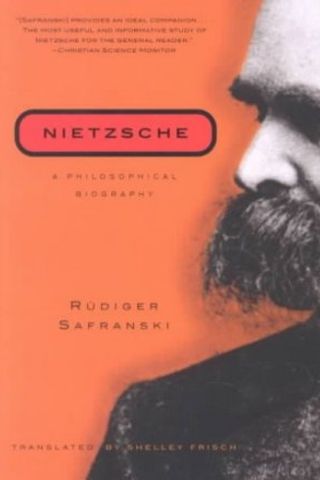
This book is not a traditional philosopher's biography offering an even balance of life and thought, but rather a rich interpretation of Nietzsche's philosophy as it evolved during his life, with a coda tracing his influence after his death. Biographical details are sparing: neither Nietzsche's birth nor death is described, and there are few juicy bits about his passion for Lou Salomé. Most of the book is a reading of Nietzsche's developing ideas, beginning with his autobiographical sketches in high school and continuing chronologically from his early attachment to Schopenhauer through his hopes for and disappointment in Wagner's music drama, such great achievements as Daybreak and Thus Spoke Zarathustra, and his last works before his descent into madness. To close, there is a chapter on the different ways Nietzsche influenced 20th-century artists, the Nazis, Heidegger, Foucault, Rorty and others. Throughout, certain themes recur, elucidated sympathetically but with "ironic reserve," including the death of God, the divided self, the will to power, eternal recurrence, philosophy as art and truth as power play. Safranski (Heidegger: Between Good and Evil), in clear English from Rutgers University Germanist Frisch, brings out contradictions and tensions in Nietzsche's thought without dismissing him; on the contrary, Safranski sees Nietzsche as a thinker "who organized his gardens of theory in such a way that anyone on the lookout for their central arguments would almost inevitably fall flat on his face," but who leads one to return profitably to "[o]ne's own thinking." The author offers no summary conclusions, preferring to leave Nietzsche's philosophical biography open, as "a story without an end." Safranski has made a worthwhile contribution to that story, though it will be of interest mainly to those with an interest in engaging the work directly.