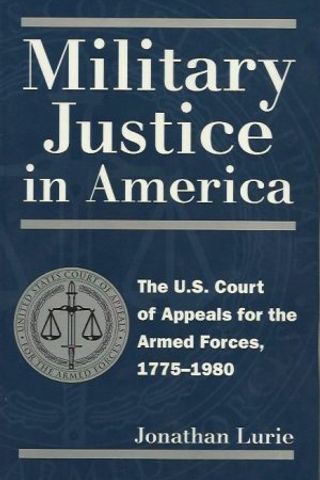
the Armed Forces marks its fiftieth anniversary in 2001. In Military Justice in America, Jonathan Lurie chronicles the struggles leading to the Court's creation, as well as its subsequent efforts to fulfill a difficult and sometimes controversial mission. Illuminating and fairminded, Lurie's work provides a new and valuable perspective on the uneasy relations between civil and military authority. Both comprehensive and detailed, Military Justice in America explores the history of the Court, which finally emerged in the wake of the national debates over the confrontation between civilian commitment to due process and individual rights and the military's demand for discipline. Deftly summarizing the Court's prehistory, Lurie then examines the Court's performance during its early years, amidst a growing civil rights movement and an increasingly unpopular war in Vietnam. He also shows how the Court matured as an institution, with its own procedures and personality, and analyzes its stormy relationship with the office of the Judge Advocate General. Along the way, he gives due attention to civilian control of the military, the essential differences between civilian and military jurisprudence, the ongoing interplay between law and politics.