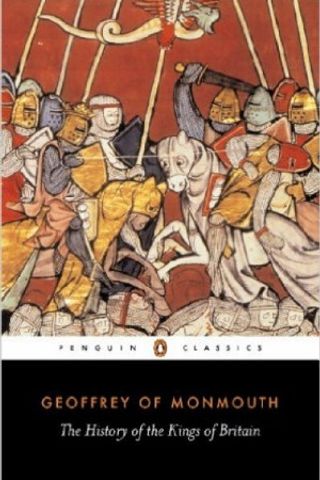
Completed in 1136, this classic chronicle traces the story of the realm from its supposed foundation by Brutus to the coming of the Saxons some two thousand years later. Vividly portraying legendary and semi-legendary figures such as Lear, Cymbeline, Merlin the magician, and the most famous of all British heroes, King Arthur, it is as much myth as it is history, and its veracity was questioned by other medieval writers. But Geoffrey of Monmouth’s powerful evocation of illustrious men and deeds captured the imagination of subsequent generations, and his influence can be traced through the works of Malory, Shakespeare, Dryden, and Tennyson. Lewis Thorpe’s translation from the Latin brings us an accurate and enthralling version of Geoffrey’s remarkable narrative. His introduction discusses in depth the aims of the author and his possible sources, and describes the impact of this work on British literature.
The History of The Kings Of Britain -
Geoffrey of Monmouth


The History that is a Story.
The History of the Kings of Britain or Historia regum Britanniae is a 12th century work by Geoffrey of Monmouth. This is the "history" of Great Britain, but in reality it is an imagined pseudo-history, but seriously treated as factual for long time. In this work have one of the first references to King Arthur and the Wizard Merlin. It is interesting that the author tries a British lineage from the Trojans, in the same way that Virgil did in the Aeneid, and consequently they would be "brothers" of the Romans. Brutus, the grandson of Aeneas, would have been the first to colonize the British Isles, hitherto empty. Hence arises a succession of legendary or semi-legendary kings. (The History of the Kings of Britain ou Historia regum Britanniae é a obra escrita por Geoffrey of Monmouth do século XII. Trata-se da "história" da Grã Bretanha, mas na realidade é uma pseudo-história que foi imaginada, mas seriamente tratada como factual por muito tempo. Nesta obra está uma das primeiras referências ao Rei Arthur e ao Mago Merlin. É interessante que o autor busca uma linhagem britânica a partir dos troianos, da mesma forma que Virgílio fez na Eneida, e consequentemente seriam "irmãos" dos romanos. Brutus, o neto de Enéias, foi o primeiro a colonizar as ilhas britânicas, até então vazias. Daí surge uma sucessão de reis lendários ou semi-lendários. The King arthur still doesn't appear as grand as in other stories, but Arthur's history (story) is amazing. He faces of a lot battles defending The Bretons, but without the Merlin's helps, because the Wizard appear in other moment before of the Arthur's birth. The Wizard Merlin was responsable for bring the Stonehenge from Ireland to Britain, through of magic. (O rei arthur ainda não aparece tão grandioso quanto em outras histórias, mas essa “história” do Arthur é incrível. Ele enfrenta muitas batalhas defendendo os bretões, mas sem a ajuda de Merlin, pois o Mago aparece em outro momento antes do nascimento de Arthur. O Mago Merlin foi o responsável por trazer o Stonehenge da Irlanda para a Grã-Bretanha, através de magia.) Geoffrey of Monmouth makes the Middle Age like a amazing períod, having Giants and dragons. He created our imaginary medieval. But this book have a difficult obstacle: somewhat archaic English. Many linguist constructions and vocabulario are old, -ed is changed for -th ("loadeth" lnstead of "loaded"). But that's not a problem, but a oportunity for learning. (Geoffrey de Monmouth faz da Idade Média um período incrível, tendo gigantes e dragões. Ele criou nosso imaginário medieval. Mas este livro tem um obstáculo difícil: um inglês um tanto arcaico. Muitas construções lingüísticas e vocabulários são antigos, como -eth no lugar -ed ("loadeth" em vez de "loaded"). Mas isso não é um problema, mas sim uma oportunidade de aprendizagem.)
Estatísticas
Avaliações
4.3 / 5- 5 estrelas40%
- 4 estrelas60%
- 3 estrelas0%
- 2 estrelas0%
- 1 estrelas0%