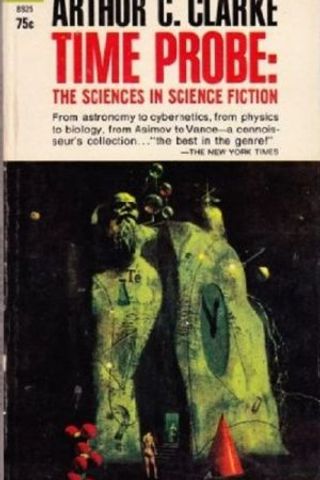
Time Probe: The Sciences In Science Fiction -- A Science Fiction Anthology -- Collected & Introduced by "the best-known SF writer in the world" Arthur C. Clarke (Editor) / Paul Lehr; (Illustrator) / (Mass Market Paperback) / Published 1966 - 1967, London (UK) by Victor Gollancz Ltd. [ISBN: 9780575009134]. [Contents]: 1. --And He Built a Crooked House by Robert A. Heinlein (Mathematics) 2. The Wabbler by Murray Leinster (Cybernetics) 3. The Weatherman by Theodore L. Thomas (Meteorology) 4. The Artifact Business by Robert Silverberg (Archaeology) 5. Grandpa by James H. Schmitz (Exobiology) 6. Not Final! by Isaac Asimov (Physics) 7. The Little Black Bag by Cyril Kornbluth (Medicine) 8. The Blindness by Philip Latham (Astronomy) 9. Take A Deep Breath by Arthur C. Clarke (Physiology) 10. The Potters of Firsk by Jack Vance (Chemistry) 11. The Tissure-Culture King by Julian Huxley (Biology) Robert A. Heinlein's "-- And He Built a Crooked House" (_Astounding Stories of Super-Science [aka] Astounding Science Fiction Magazine_, 1940), Murray Leinster's "The Wabbler" (_Astounding_, 1942), Theodore L. Thomas' "The Weather Man" (_Analog Science Fact & Fiction.Magazine_, 1962), Robert Silverberg's "The Artifact Business" (_Fantastic Universe_, 1957), James H. Schmitz's "Grandpa" (_Astounding_, 1955), Isaac Asimov's "Not Final!" (_Astounding_, 1941), Cyril Kornbluth's "The Little Black Bag" (_Astounding_, 1950), Philip Latham's "The Blindness" (_Astounding_, 1946), Arthur C. Clarke's "Take a Deep Breath" (_Infinity_, 1957), Jack Vance's "The Potters of Firsk" (_Astounding_, 1950), and Julien Huxley's "The Tissue Culture King" (_Amazing_, 1927). Most of the stories originally came from _Astounding / Analog_ under the editorship of John W. Campbell, Jr. ==== The Heinlein story is the one about the house built in the form of a tessarect and the problems its unlucky tenants encounter. The Schmitz is about the adventures of a young human colonist on an alien planet with an elegantly developed ecosystem. The Asimov is about an unexpected discovery in physics that reminds me of Clarke's dictum: "If an elderly scientist says that something is possible, he is probably right; if he says that something is impossible, he is probably wrong". The Latham is about the "future return" of Halley's Comet in 1987. All right, you say. It didn't _really_ happen that way when the time came. But I defy you to say that Latham's account doesn't make a better tale. The Huxley is about a sinister biological discovery in the darkest jungle that raises some questions about scientific ethics. As Clarke says, this story was written almost twenty years before Hiroshima; but its ending touches on some very modern issues (...). Algis Budrys once noted that few readers today are likely to appreciate hard science fiction because fewer modern readers have the scientific or technical education to play The Game well. But I believe that Budrys overlooked the fact that much modern hard sf is not purely a puzzle. If you look at hard sf stories carefully, you can find other sources of pleasure. Clarke did this, and the result is an excellent anthology... ==== Arthur C. Clarke was one of the most important and influential figures in 20th century science fiction. He spent the first half of his life in England, where he served in World War Two as a radar operator, before emigrating to Ceylon in 1956. He is best known for the novel and movie 2001: A Space Odyssey, which he co-created with the assistance of Stanley Kubrick. Clarke was a graduate of King's College, London where he obtained First Class Honours in Physics and Mathematics. He is past Chairman of the British Interplanetary Society, a member of the Academy of Astronautics, the Royal Astronomical Society, and many other scientific organizations. Author of over fifty books, his numerous awards include the 1961 Kalinga Prize, the AAAS-Westinghouse science writing prize, the Bradford Washburn Award, and the John W. Campbell Award for his novel Rendezvous With Rama. Clarke also won the Nebula Award of the Science Fiction Writers of America in 1972, 1974 and 1979, the Hugo Award of the World Science Fiction Convention in 1974 and 1980, and in 1986 became Grand Master of the Science Fiction Writers of America. He was awarded the CBE in 1989.
TIME PROBE - The Sciences in Science Fiction
Arthur C. Clarke
Dell Publishing
1967
242 páginas
8h 4m
ISBN-10: B0000CNCHE



Resenhas (7)Ver mais

Thaisa Meyka25/02/2020Resenhou um livro
4 curtidas
Estatísticas
Avaliações
4 / 129- 5 estrelas28%
- 4 estrelas40%
- 3 estrelas28%
- 2 estrelas3%
- 1 estrelas1%

Arthur Charles Clarke
Arthur Charles Clarke, mais conhecido como Arthur C. Clarke foi um escritor britânico, autor de obras de divulgação científica e de ficção científica como o conto The Sentinel, que deu origem ao filme 2001: Uma Odisséia no Espaço e a premiada série Encontro com Rama.
389 Livros
797 Seguidores