In 1828, scientist-explorer Alexander von Humboldt (1769-1859) summons the great mathematician Carl Gauss (1777-1855) to join his party to Berlin, where he is to be feted before embarking on an expedition across Russia to the Urals. The perpetually testy Gauss, whose great trial in life is that everyone else thinks so slowly, which makes virtually any kind of human interaction infuriatingly boring for him (though he does fancy a fine young figure), would go back to sleep, but his wife, Minna, whom he barely tolerates, rousts him out and gets him on the road with youngest son Eugen. They no sooner arrive at Humboldt's mansion than Kehlmann diverges to recap his two principals' lives and careers in chapters alternately concerned with globe-trotting aristocrat Humboldt and genius-from-the-gutter Gauss, who willingly leaves home only to earn a living and escape Minna. The uncomfortable humor of being, in Gauss' case, too brilliant (he frequently bemoans having to live before the innovations he foresees can be constructed or even understood); in Humboldt's, too focused (he scrupulously abjures whole theaters of human experience to concentrate on measuring), suffuses Kehlmann's heady historical novel, which may especially delight science-fiction connoisseurs. Ray Olson Copyright ©
Edições (1)
Ver mais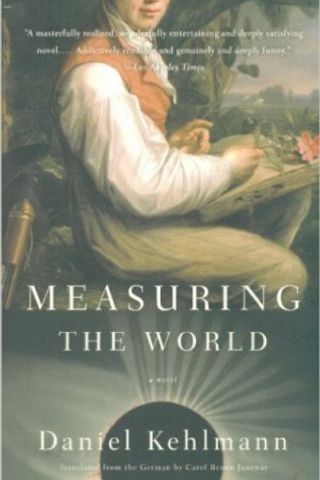
Estatísticas
Avaliações
5 / 1- 5 estrelas100%
- 4 estrelas0%
- 3 estrelas0%
- 2 estrelas0%
- 1 estrelas0%