Esta obra de matemática, a primeira dessa área que nos chegou na sua inteireza da antiguidade clássica, é composta por 13 livros em que, além de definições, postulados e noções comuns/axiomas, demonstram-se 465 proposições, em forte seqüência lógica, referentes à geometria euclidiana, a da régua e compasso, e à aritmética, isto é, à teoria dos números. Os seis arimeiros livros dão conta da geometria plana; os três seguintes, da teoria dos números; o livro X, o mais complexo, estuda uma classificação de incomensuráveis/irracionais; e os três últimos abordam a geometria no espaço/estereometria. Esta é a primeira tradução completa para o português feita a partir do texto grego.
Resenhas (5)Ver mais

Davi Nascimento20/02/2024Resenhou um livro
Tecnicamente inspirador
5 curtidas
Estatísticas
Avaliações
4.5 / 59- 5 estrelas63%
- 4 estrelas22%
- 3 estrelas12%
- 2 estrelas2%
- 1 estrelas2%
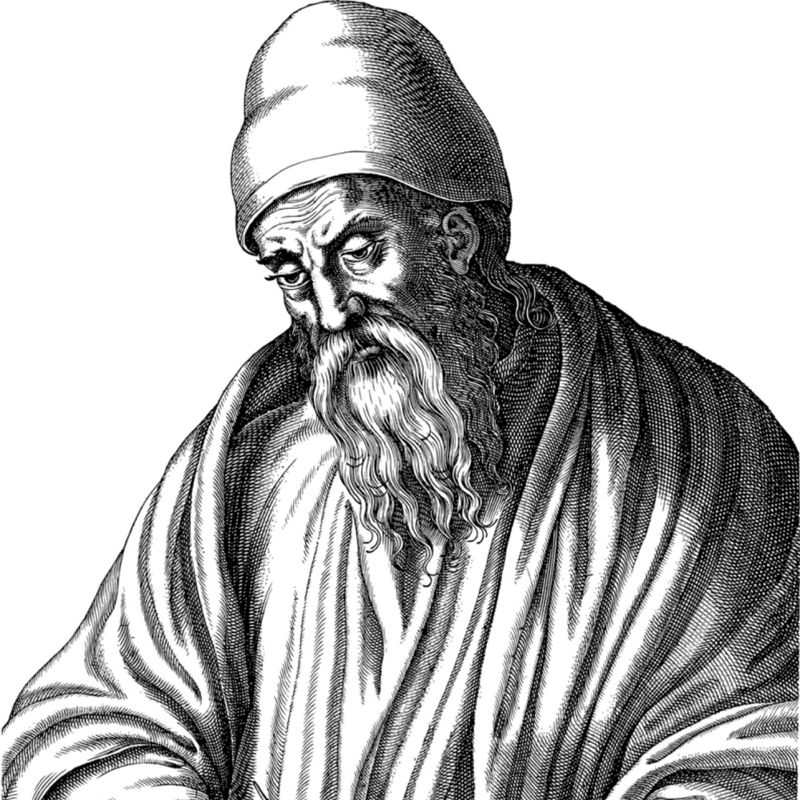
Εὐκλείδης
Euclid (/ˈjuːklɪd/; Ancient Greek: Εὐκλείδης; fl. 300 BC) was an ancient Greek mathematician active as a geometer and logician.[2] Considered the "father of geometry",[3] he is chiefly known for the Elements treatise, which established the foundations of geometry that largely dominated the field until the early 19th century. His system, now referred to as Euclidean geometry, involved innovations in combination with a synthesis of theories from earlier Greek mathematicians, including Eudoxus of Cnidus, Hippocrates of Chios, Thales and Theaetetus. With Archimedes and Apollonius of Perga, Euclid is generally considered among the greatest mathematicians of antiquity, and one of the most influential in the history of mathematics. Very little is known of Euclid's life, and most information comes from the scholars Proclus and Pappus of Alexandria many centuries later. Medieval Islamic mathematicians invented a fanciful biography, and medieval Byzantine and early Renaissance scholars mistook him for the earlier philosopher Euclid of Megara. It is now generally accepted that he spent his career in Alexandria and lived around 300 BC, after Plato's students and before Archimedes. There is some speculation that Euclid studied at the Platonic Academy and later taught at the Musaeum; he is regarded as bridging the earlier Platonic tradition in Athens with the later tradition of Alexandria. In the Elements, Euclid deduced the theorems from a small set of axioms. He also wrote works on perspective, conic sections, spherical geometry, number theory, and mathematical rigour. In addition to the Elements, Euclid wrote a central early text in the optics field, Optics, and lesser-known works including Data and Phaenomena. Euclid's authorship of On Divisions of Figures and Catoptrics has been questioned. He is thought to have written many lost works.
3 Livros
1 Seguidor