For anyone who has ever wondered why suspension bridges don't collapse under eight lanes of traffic, how dams hold back-or give way under-thousands of gallons of water, or what principles guide the design of a skyscraper or a kangaroo, this book will ease your anxiety and answer your questions. J. E. Gordon strips engineering of its confusing technical terms, communicating its founding principles in accessible, witty prose.
Structures - Or Why Things Don't Fall Down
J. E. Gordon
Da Capo Press
2003
424 páginas
14h 8m
ISBN-13: 9780306812835
Edições (1)
Ver mais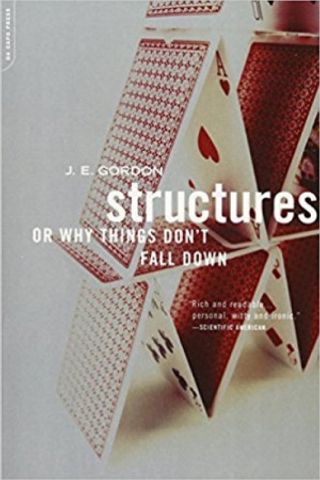
Resenhas (1)Ver mais

Mario06/12/2023Resenhou um livro
Necessity knows no laws
How wondrous it is for us, a grand structure, to navigate diverse equations through the analog computer of our minds? This intricate machinery, with such intricate details, possesses the capability to compute our spatial position and movements by assimilating information from our nervous system, muscles, skeletal articulations, and the inner recesses of our ear canal. Such craftsmanship has allowed us to attain equilibrium, distribute our bodies in space, and, in the eloquent words of Shakespeare, be "express and admirable in form and moving, an Angel in action and a God in apprehension." For centuries, our existence has involved constructing structures and technologies without putting much science into it. Consider, for instance, the sonar in bats, "discovered" only during the Second World War, or how about the crafted wings of flying birds. Undoubtedly, these are structured phenomena. The essence lies in the fact that structures are composed of materials, almost always accompanied by systems to build them, akin to our visual sense. This book encapsulates a compendium of structural concepts, primarily interwoven with inanimate solids, mechanical forces, and sustainable loads. Mr. Gordon initiates the narrative by providing a succinct overview of the evolution of engineering and architecture, traversing from Newton's to Hooke's theories and from majestic church structures to Gothic architecture, extending to what he deems as "boring" buildings. Subsequently, he paints a comprehensive picture of properties essential for making predictions and constructing structures. He explicates the behavior and conceivable trajectories of thrust, concluding with an exploration of the plausible "whys" behind structural failures. Also, Mr. Gordon draws correlations between most properties and biological structures and culminates the discourse with historical insights into structural disasters. As the author astutely observes, individuals unfamiliar with Hooke's law or Young's modulus can intuitively gauge the stiffness of a table or a chicken. We possess an instinctive approach to design, applying elasticity and strength with remarkable precision through experience and common sense. What astonishes me is the relatively recent necessity that prompted the development of improved methods, exemplified by Gordon's favorite illustration: ships disintegrating during the First World War due to issues with joints and torsion, often constructed using unorthodox methods, faith, and poetry. When embarking on construction endeavors, myriad considerations come into play. Boiling down to fundamental truths, one must analyze elasticity, stiffness, strength, stress, and consider factors such as safety, ignorance, thrust lines, tension, joints, the environment, and various foundations. It is imperative to acknowledge that technological structures inherently harbor fundamental defects. Many real situations are so complex that they elude mathematical models, presenting a real challenge to predict diverse forces required for operational efficacy or scaling up from previous experiences. Additionally, I would like to echo Mr. J.E.'s concluding sentiment: constructing remarkable structures without accounting for the environment and Mother Nature's infinite subtleties, coupled with human fallibility, leads to both creation and destruction of valuable entities. Rather than merely cataloging countless accidents, there is much to be done to convert the human propensity for error into profound technical insights. This perspective is not mine alone; it resonates from the experiences recounted by the founding father of material science and biomechanics, Mr. J. Gordon. Link to my highlights: https://drive.google.com/file/d/1OsHuAdNOVUO71UxZ0zCR6Sxzwhde4oJk/view?usp=sharing
curtir
Estatísticas
Avaliações
0 / 0- 5 estrelas0%
- 4 estrelas0%
- 3 estrelas0%
- 2 estrelas0%
- 1 estrelas0%