In August 1859, Bernhard Riemann was made a corresponding member of the Berlin Academy, a great honor for a young mathematician (he was 32). As was customary on such occasions, Riemann presented a paper to the Academy giving an account of some research he was engaged in. The title of the paper was: “On the Number of Prime Numbers Less Than a Given Quantity.” In it, Riemann investigated a straightforward issue in ordinary arithmetic. To understand the issue, ask: How many prime numbers are there less than 20? The answer is eight: 2, 3, 5, 7, 11, 13, 17, and 19. How many are there less than one thousand? Less than one million? Less than one billion? Is there a general rule or formula for how many that will spare us the trouble of counting them? Riemann tackled the problem with the most sophisticated mathematics of his time, using tools that even today are taught only in advanced college courses, and inventing for his purposes a mathematical object of great power and subtlety. One-third of the way into the paper, he made a guess about that object, and then remarked: "One would, of course, like to have a rigorous proof of this, but I have put aside the search for such a proof after some fleeting vain attempts because it is not necessary for the immediate objective of my investigation." That casual, incidental guess lay almost unnoticed for decades. Then, for reasons I have set out to explain in this book, it gradually seized the imaginations of mathematicians, until it attained the status of an overwhelming obsession.
Prime Obsession - Bernhard Riemann And The Greatest Unsolved Problem In Mathematics
John Derbyshire
Joseph Henry Press
2003
422 páginas
14h 4m
ISBN-13: _ 0309085497_
Edições (1)
Ver mais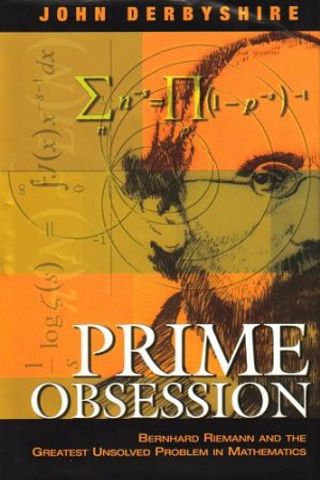
Estatísticas
Avaliações
4.7 / 3- 5 estrelas67%
- 4 estrelas33%
- 3 estrelas0%
- 2 estrelas0%
- 1 estrelas0%