In this brief but significant book, the authors, a grandfather-grandson team, explore how using positive psychology in everyday interactions can dramatically change our lives. Clifton (coauthor of Now, Discover Your Strengths) and Rath suggest that we all have a bucket within us that needs to be filled with positive experiences, such as recognition or praise. When we're negative toward others, we use a dipper to remove from their buckets and diminish their positive outlook. When we treat others in a positive manner, we fill not only their buckets but ours as well. The authors illustrate how this principle works in the areas of business and management, marriage and other personal relationships and in parenting through studies covering a 40-year span, many in association with the Gallup Poll. While acknowledging that most lives have their share of misfortune, the authors also make clear that how misfortune affects individuals depends largely on their level of positive energy and confidence. The authors also underscore that our human interactions provide most of the joys or disappointments we receive from life. The book comes with a unique access code to www.bucketbook.com, which offers a positive impact assessment and drop-shaped note cards that can be used to give praise and recognition to others. Copyright © Reed Business Information, a division of Reed Elsevier Inc. All rights reserved.
Edições (2)
Ver mais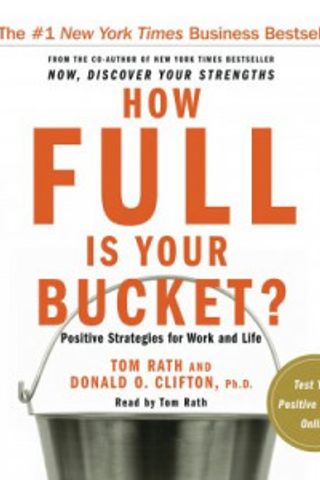
Resenhas (1)Ver mais

Felipe Moitta26/01/2019Resenhou um livro
How Full Is Your Bucket?
In that study, which has now been replicated multiple times, we conducted a randomized survey with more than a thousand employees - asking them where their manager focused the most time and attention: a) On employees' strengths b) On employees' weaknesses c) Neither of the above; the manager ignored employees We found that one person, specifically the manager in this context, can eliminate almost all of the active disengagement in a workplace if he or she primarily focuses on an employee's strengths. When people reported that their manager did not focus on their strengths or their weaknesses (the manager ignored employees), there was a 40% chance of them being actively disengaged on the job. If their manager focused primarily on weaknesses (and presumably was at least paying attention), things actually got better, and there was only a 22% chance of them being disengaged. But when a manager primarily focused on an employee's strengths, there was just a 1% chance of that employee being very negative or actively disengaged on the job. As you can see from the results of this study, it appears that disengagement is a curable problem. our lives are shaped by our interactions with others. Whether we have a long conversation with a friend or simply place an order at a restaurant, every interaction makes a difference. The results of our encounters are rarely neutral; they are almost always positive or negative. And although we take these interactions for granted, they accumulate and profoundly affect our lives. Each of us has an invisible bucket. It is constantly emptied or filled, depending on what others say or do to us. When our bucket is full, we feel great. When it's empty, we feel awful. Each of us also has an invisible dipper. When we use that dipper to fill other people's buckets - by saying or doing things to increase their positive emotions - we also fill our own bucket. But when we use that dipper to dip from others' buckets - by saying or doing things that decrease their positive emotions - we diminish ourselves. Like the cup that runneth over, a full bucket gives us a positive outlook and renewed energy. Every drop in that bucket makes us stronger and more optimistic. But an empty bucket poisons our outlook, saps our energy, and undermines our will. That's why every time someone dips from our bucket, it hurts us. So we face a choice every moment of every day: We can fill one another's buckets, or we can dip from them. It's an important choice - one that profoundly influences our relationships, productivity, health, and happiness. We have all experienced situations when it seems like nothing will go right no matter what you say or do. Maybe you feel like everyone is out to get you, and you even start to fixate on negative things about yourself. Spiraling downward isn't hard to do when your bucket is being emptied. Not only do you feel down, but you are less productive because of it, and you bring others down with you by reactively dipping from their buckets. 65% of Americans received no recognition in the workplace last year Managers, take note: Praise is rare in most workplaces. One poll found that an astounding 65% of Americans reported receiving no recognition for good work in the past year. And we have yet to find anyone who reports suffering from overrecognition. No wonder so many employees are disengaged. Although we need and want recognition and praise, the fact is, we don't get enough - and organizations suffer because of it. But offering Tammy meaningful and specific praise made her day. Her bucket was filled quickly. And the funny thing is, Karen might have thought she was just making a simple comment in passing; she probably couldn't imagine the positive impact. Essentially, you were hired for a job, then you were expected to change who you were to fit the role. If you struggled, then you may have had to endure a program designed to fix the problem. The weakness-based approach follows us throughout our lives, from school to the workplace. They Missed It These recent studies show that negative emotions can be harmful to your health and might even shorten your life span. We already know that one negative person can ruin an entire workplace, but negative emotions can also destroy relationships, families, and entire careers. In contrast, other discoveries suggest that positive emotions are an essential daily requirement for survival. Not only do they improve your physical and mental health, but they can also provide a buffer against depression and illness. According to Nobel Prize-winning psychologist Daniel Kahneman, we experience approximately 20,000 individual moments in a waking day. Each moment lasts a few seconds. They had predicted divorce with 94% accuracy - based on scoring the couples' interactions for 15 minutes. This ratio is critical in the workplace as well. One study found that workgroups with positive-to-negative interaction ratios greater than 3 to 1 are significantly more productive than teams that do not reach this ratio. So while this book focuses primarily on ways to increase positive emotions, it's important to note that we don't recommend ignoring negativity and weakness; positivity must be grounded in reality. A "Pollyanna" approach, in which the negative is completely ignored, can result in a false optimism that is counterproductive - and sometimes downright annoying. there are times when it's absolutely necessary to correct our mistakes and figure out how to manage our weaknesses. To put this in perspective, consider that cigarette smoking has been shown to reduce life expectancy by 5.5 years for males and 7 years for females. So, negative emotions might cut more years off of life expectancy than smoking. There's no surgeon general's warning about toxic emotions, but perhaps there should be. we should gather to celebrate all the great things that a person has done while he or she is still around to be part of the celebration. When he went to funerals, it bothered him that so many people waited until they were eulogizing a loved one to liberally fill his or her bucket. "Why not do this while they are alive?" All of the caring, attention, and genuine bucket filling were making a major difference in my life. My bucket was overflowing, and this allowed me to concentrate on filling the buckets of everyone around me. Ted's boss knew the key to great bucket filling: Recognition is most appreciated and effective when it is individualized, spec~fic, and deserved. Clearly, he understood that writing an e-mail and copying Ted's peers would give Ted a real boost. And perhaps Ted's boss also knows that the same approach won't work for Ted's colleagues, some of whom may prefer a quiet pat on the back or perhaps more boisterous praise in a meeting. The point is, there are unique and specific ways to fill each person's bucket - and most certainly inappropriate ways as well. Generic, one-size-fits-all awards don't work. Neither does recognition that seems forced or false. The lesson here is clear: If you want people to understand that you value their contributions and that they are important, the recognition and praise you provide must have meaning that is specific to each individual. Not only is individualized bucket filling more effective in boosting productivity in the workplace, it builds sustainable relationships and changes people's lives forever. The Five Strategies STRATEGY ONE Prevent Bucket Dipping STRATEGY TWO Shine a Light on What Is Right STRATEGY THREE Make Best Friends STRATEGY FOUR Give Unexpectedly STRATEGY FIVE Reverse the Golden Rule After hearing the Theory of the Dipper and the Bucket, one man we know decided to put it to the test. He was looking for a way to eliminate his own dipping from others' buckets. So he developed a simple habit of asking himself if he was adding to or taking from the other person's bucket in each interaction. He told us it was a difficult habit to get into at first, but after some time, he realized it was working. By catching himself before he uttered a negative comment - and in some cases, making a positive one instead - he started making himself and the people around him feel better. ask yourself: "What would it take for me to reach that `magic ratio' of five positive interactions for every one negative interaction that I read about in Chapter Three?" Never underestimate the long-term influence of filling others' buckets. According to one expert, these positive emotions create "chains of interpersonal events," the farreaching results of which you may or may not get to see in person. But they are there and happening. Every time you fill a bucket, you're setting something in motion. the vast majority of people prefer gifts that are unexpected. Expected gifts do fill our buckets, but for some reason, receiving things unexpectedly fills our buckets just a little more. It's about the element of surprise. And the gift doesn't have to be anything big to be successful. An unexpected gift doesn't have to be tangible either. It can be a gift of trust or responsibility. Sharing something personal or entrusting a friend with a secret can fill his or her bucket. In your own interactions, look for opportunities to give small gifts to others out of the blue - maybe a funny little trinket, a hug, or an offer to grab a cup of coffee. Even a smile can be an unexpected and cherished gift. Consider unexpected sharing as well. What books, articles, or stories could you send someone that would positively influence his or her day? In the case of bucket filling, "Do unto others as you would have them do unto you" doesn't apply. Instead, we suggest a slight variation: "Do unto others as they would have you do unto them." When it comes to robust and meaningful bucket filling, individualization is key. As you learned from Matt, the customer service representative who received the portrait of his daughters, the things that make you unique also determine what really fills your bucket - and vice versa. Now here's our challenge: Set a goal to write at least five drops, or give five specific forms of recognition every month.
curtir
Estatísticas
Avaliações
4.6 / 4- 5 estrelas75%
- 4 estrelas25%
- 3 estrelas0%
- 2 estrelas0%
- 1 estrelas0%

Tom Rath
Cientista sênior e consultor no Instituto Gallup, além de um escritor com presença constante nas listas de mais vendidos. É autor de O poder da amizade, Eat Move Sleep, Strengths Based Leadership e How Full is Your Bucket?. Ele se formou na Universidade de Michigan e na Universidade da Pensilvânia. Atualmente mora com a esposa, Ashley, e os dois filhos em Arlington, Virgínia.
13 Livros
2 Seguidores