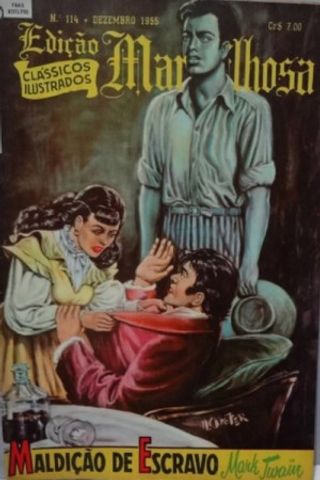
[Edição Maravilhosa — 1ª Série, Número 114. Publicado em Dezembro de 1955] Mark Twain — Maldição de Escravo (Clássicos Ilustrados) / Direção: Adolfo Aizen. (Brochura - Formato Americano - Quadrinhos em Preto e Branco). Originalmente "Pudd'nhead Wilson" - Classics Illustrated n° 93/1952 - The Gilberton Company, Inc. (1942–1967). ==== https://pt.wikipedia.org/wiki/Edição_Maravilhosa https://en.m.wikipedia.org/wiki/Classics_Illustrated https://en.m.wikipedia.org/wiki/Pudd'nhead_Wilson https://en.m.wikipedia.org/wiki/Mark_Twain http://guiaebal.com/maravilhosa1.html http://guiaebal.com/maravilhosa2.html http://guiaebal.com/maravilhosa3.html http://www.guiadosquadrinhos.com/artista/mark-twain/6114 http://www.guiadosquadrinhos.com/edicao/edicao-maravilhosa-1-serie-n-114/ed001100/55340 ==== The Tragedy of Pudd'nhead Wilson (1894) '-' At the beginning of Pudd'nhead Wilson a young slave woman, fearing for her infant's son's life, exchanges her light-skinned child with her master's. From this rather simple premise Mark Twain fashioned one of his most entertaining, funny, yet biting novels. On its surface, Pudd'nhead Wilson possesses all the elements of an engrossing nineteenth-century mystery: reversed identities, a horrible crime, an eccentric detective, a suspenseful courtroom drama, and a surprising, unusual solution. Yet it is not a mystery novel. Seething with the undercurrents of antebellum southern culture, the book is a savage indictment in which the real criminal is society, and racial prejudice and slavery are the crimes. Written in 1894, Pudd'nhead Wilson glistens with characteristic Twain humor, with suspense, and with pointed irony: a gem among the author's later works. Mark Twain's satire humorously and pointedly lambastes everything from small-town politics and religious beliefs to slavery and racism. The setting is the fictional Missouri frontier town of Dawson's Landing on the banks of the Mississippi River in the first half of the 19th century. David Wilson, a young lawyer, moves to town, and a clever remark of his is misunderstood, which causes locals to brand him a "pudd'nhead" (nitwit). His hobby of collecting fingerprints does not raise his standing in the eyes of the townsfolk, who consider him to be eccentric and do not frequent his law practice. The novel features the technological innovation of the use of fingerprints as forensic evidence. "The reader knows from the beginning who committed the murder, and the story foreshadows how the crime will be solved. The circumstances of the denouement, however, possessed in its time great novelty, for fingerprinting had not then come into official use in crime detection in the United States. Even a man who fooled around with it as a hobby was thought to be a simpleton, a 'pudd'nhead'."
Maldição de Escravo (Gibi Edição Maravilhosa #114) - Quadrinização de "Pudd'nhead Wilson" de Mark Twain (Clássicos Ilustrados)
Mark Twain, Samuel L. Clemens, Samuel Langhorne Clemens
EBAL / Editora Brasil-América
1955
52 páginas
1h 44m
ISBN-13: 9780140430400
Português Brasileiro




Resenhas (1)Ver mais

Marcos Augusto31/05/2023Resenhou um livro
1 curtida
Estatísticas
Avaliações
4 / 2- 5 estrelas50%
- 4 estrelas0%
- 3 estrelas50%
- 2 estrelas0%
- 1 estrelas0%