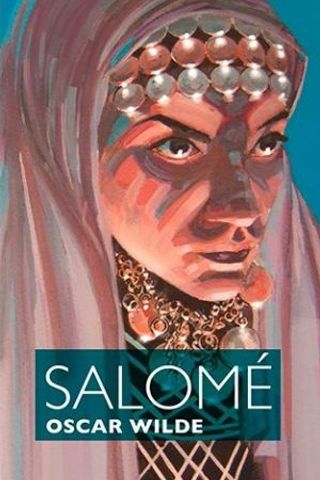
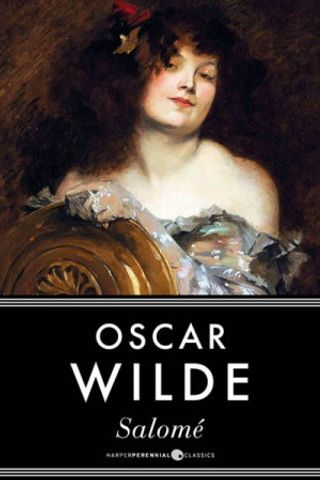
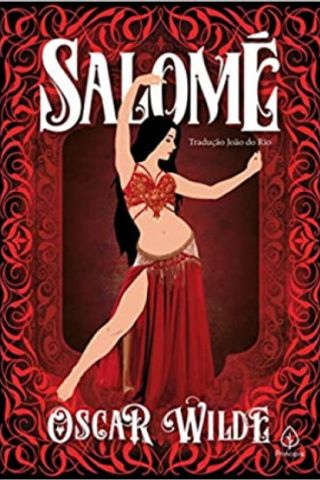
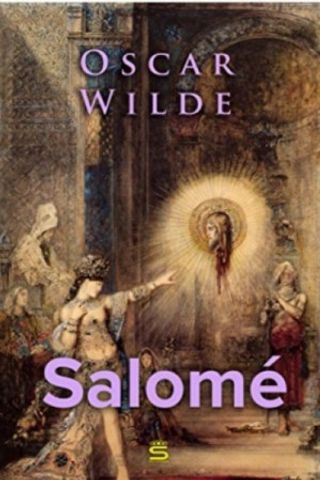
-WITH SIXTEEN DRAWINGS BY AUBREY BEARDSLEY Salome (French: Salomé, pronounced: [salome]) is a tragedy by Oscar Wilde. The original 1891 version of the play was in French. Three years later an English translation was published. The play tells in one act the Biblical story of Salome, stepdaughter of the tetrarch Herod Antipas, who, to her stepfather's dismay but to the delight of her mother Herodias, requests the head of Jokanaan (John the Baptist) on a silver platter as a reward for dancing the dance of the seven veils. Wilde had considered the subject since he had first been introduced to Hérodias, one of Flaubert's Trois Contes, by Walter Pater, at Oxford in 1877. His interest had been further stimulated by descriptions of Gustave Moreau's paintings of Salome in Joris-Karl Huysmans's À rebours. Other literary influences include Heinrich Heine's Atta Troll, Laforgue's Salomé in Moralités Légendaires and Mallarmé's Hérodiade. Wilde's interest in Salomés image had been stimulated by descriptions of Gustave Moreau's paintings in Joris-Karl Huysmans's À rebours. Many view Wilde's Salomé as a superb composite of these earlier treatments of the theme overlaid, in terms of dramatic influences, with Belgian playwright Maurice Maeterlinck's characteristic methodical diction,[clarification needed] and specifically Maeterlinck's La Princesse Maleine, 'with its use of colour, sound, dance, visual description and visual effect'.[8] Wilde often referred to the play in musical terms and believed that recurring phrases 'bind it together like a piece of music with recurring motifs. ' Although the "kissing of the head" element was used in Heine and even Heywood's[who?] production, Wilde's ingenuity was to move it to the play's climax. While his debts are undeniable, there are some interesting contributions in Wilde's treatment, most notably being his persistent use of parallels between Salomé and the moon. Scholars like Christopher Nassaar point out that Wilde employs a number of the images favored by Israel's kingly poets and that the moon is meant to suggest the pagan goddess Cybele, who, like Salomé, was obsessed with preserving her virginity and thus took pleasure in destroying male sexuality. Following the prelude three demarcated episodes follow: the meeting between Salome and Iokanaan, the phase of the white moon; the major public central episode, the dance and the beheading, the phase of the red moon; and finally the conclusion, when the black cloud conceals the moon. An argument is made by Brad Bucknell in his essay, “On "Seeing" Salome” that the play can be seen as a struggle between the visual, in the form of various characters’ gazing as well as Salome’s dance, and the written word. Salome’s dance (which is never described) overpowers Iokannan’s prophecies, and Salome herself dies due to Herod’s command to crush her. As Bucknell writes of Salome’s dance, “The power of the word is inverted, turned back upon its possessors, the prophet and the ruler-figure of the tetrarch.” The idea of the gaze—specifically the male gaze—is also explored by Linda and Michael Hutcheon in ""Here's Lookin' At You, Kid": The Empowering Gaze in Salome.” In their essay, the two write that Salome’s body “clearly becomes the focus of the attention—and the literal eye—of both audience and characters. As dancer, Salome is without a doubt the object of the gaze—particularly Herod's male gaze.”
Salome -
Oscar Wilde
LCI
2014
82 páginas
2h 44m
ISBN-10: B00J7YD68I
Resenhas (46)Ver mais

Régis Maz27/12/2023Resenhou um livro
Um início promissor que vai esvanecendo aos poucos
78 curtidas
Estatísticas
Avaliações
3.8 / 614- 5 estrelas26%
- 4 estrelas31%
- 3 estrelas32%
- 2 estrelas8%
- 1 estrelas2%