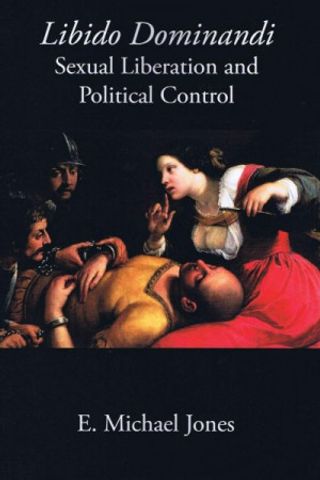
Writing at the time of the collapse of the Roman Empire, St. Augustine both revolutionized and brought to a close antiquity's idea of freedom. A man was not a slave by nature or by law, as Aristotle claimed. His freedom was a function of his moral state. A man had as many masters as he had vices. This insight would provide the basis for the most sophisticated form of social control known to man. Fourteen hundred years later, in a world eager to reject the intellectual patrimony of the West, a decadent French aristocrat turned that tradition on its head when he wrote that "the freest of people are they who are most friendly to murder." Like St. Augustine, the Marquis de Sade would agree that freedom was a function of morals. Freedom for the Marquis de Sade, however, meant willingness to reject the moral law. Unlike St. Augustine, the Marquis de Sade proposed a revolution in sexual morals to accompany the political revolution then taking place in France. Libido Dominandi - the term is taken from Book I of Augustine's City of God - is the definitive history of that sexual revolution, from 1773 to the present. Unlike the standard version of sexual revolution, Libido Dominandi shows how sexual liberation was from its inception a form of control. The logic is clear enough: Those who wished to liberate man from the moral order needed to impose social controls as soon as they succeeded because liberated libido led inevitably to anarchy. Over the course of two hundred years, those techniques became more and more refined, eventuating in a world where people were controlled, not by military force, but by the skillful management of their passions. It was Aldous Huxley who wrote in his preface to the 1946 edition of Brave New World that "as political and economic freedom diminishes, sexual freedom tends compensatingly to increase." This book is about the converse of that statement. It explains how the rhetoric of sexual freedom was used to engineer a system of covert political and social control. Over the course of the two-hundred-year span covered by this book, the development of technologies of communication, reproduction, and psychic control - including psychotherapy, behaviorism, advertising, sensitivity training, pornography, and, when push came to shove, plain old blackmail - allowed the Enlightenment and its heirs to turn Augustine's insight on its head and create masters out of men's vices. Libido Dominandi is the story of how that happened.
Libido Dominandi - Sexual Liberation and Political Control
E. Michael Jones
Saint Austine Press
1999
668 páginas
22h 16m
ISBN-10: 189031837X



Resenhas (2)Ver mais

Pedro LDC Viegas23/06/2022Resenhou um livro
Libido Dominandi
17 curtidas
Estatísticas
Avaliações
4.2 / 8- 5 estrelas38%
- 4 estrelas63%
- 3 estrelas0%
- 2 estrelas0%
- 1 estrelas0%

Eugene Michael Jones
Eugene Michael Jones (1948–) é um escritor americano, professor aposentado, comentador midiático e atual editor da revista Culture Wars. É conhecido por suas publicações a respeito do declínio da cultura católica nos EUA a partir da segunda metade do século XX e sua assimilação pela cultura americana de massa. Escreveu prolificamente sobre a revolução sexual, a história da Igreja, os judeus, o poder financeiro e a modernidade. Dentre seus muitos livros, constam os mais conhecidos Degenerate Moderns: Modernity as Rationalized Sexual Misbehavior, e sua seqüência Dionysos Rising: The Birth of Cultural Revolution out of the Spirit of Music, bem como The Jewish Revolutionary Spirit and Its Impact on World History.
20 Livros
17 Seguidores
Pensilvânia, Estados Unidos