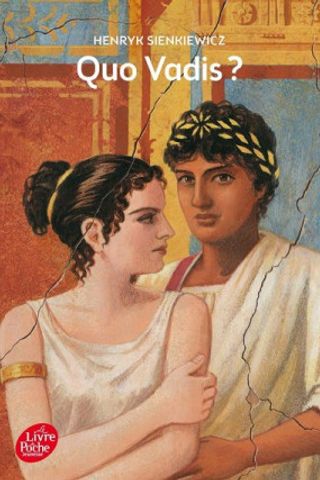
Rome during the reign of Nero was a glorious place for the Emperor and his court; there were grand feasts, tournaments for poets, and exciting games and circuses filling the days and nights. The pageantry and pretentious displays of excess were sufficient to cloy the senses of participants as well as to offend the sensitive. Petronius, a generous and noble Roman, a man of the world much in favor at the court of Nero, is intrigued by a strange tale related by his nephew Marcus Vinitius of his encounter with a mysterious young woman called Ligia with whom Vinitius falls madly in love. Ligia, a captured King's daughter and a one-time hostage of Rome, is now a foster child of a noble Roman household. She's also a Christian. The setting of the narrative was prepared with utmost care. Sienkiewicz visited the Roman locations many times and thoroughly educated himself in the novel's historical background. As an attempt to create the spirit of antiquity, the novel met with unanimous acclaim, earning Sienkiewicz the Nobel Prize in Literature in 1905. As a vision of ancient Rome and early Christianity it remains unsurpassed more than a century later. "Quo vadis Domine" is Latin for "Where are you going, Lord?" and alludes to the apocryphal Acts of Peter, in which Peter flees Rome but on his way meets Jesus and asks him why he is going to Rome. Jesus says, "I am going back to be crucified again", which makes Peter go back to Rome and accept martyrdom. The novel Quo Vadis tells of a love that develops between a young Christian woman, Ligia, and Marcus Vinicius, a Roman patrician. It takes place in the city of Rome under the rule of emperor Nero, c. [circa] A.D. 64. Sienkiewicz studied the Roman Empire extensively prior to writing the novel, with the aim of getting historical details correct. Consequently, several historical figures appear in the book. Published in installments in three Polish dailies in 1895, it came out in book form in 1896 and has since been translated into more than 50 languages. Quo Vadis contributed to Sienkiewicz's Nobel Prize for literature in 1905. ==== '(...) Sienkiewicz was said to have been inspired to write the novel when visiting the Chiesa del Domine Quo Vadis, Rome, and the novel is strongly imbued with a pro-Christian sentiment, along with many detailed descriptions of the opulence and debauchery of Nero’s Rome. It is informative, exciting, and ultimately uplifting! '-' ==== https://pt.m.wikipedia.org/wiki/Igreja_Domine_Quo_Vadis https://classicalcarousel.com/quo-vadis-henryk-sienkiewicz/ https://www.supersummary.com/quo-vadis-a-narrative-of-the-time-of-nero/summary/ https://fictionpredilection.weebly.com/blog/-contemplating-quo-vadis
"Quo Vadis": A Narrative of the Time of Nero -
Henryk Sienkiewicz
Franklin Classics
2018
552 páginas
18h 24m
ISBN-10: 0342704214


Estatísticas
Avaliações
5 / 1- 5 estrelas100%
- 4 estrelas0%
- 3 estrelas0%
- 2 estrelas0%
- 1 estrelas0%