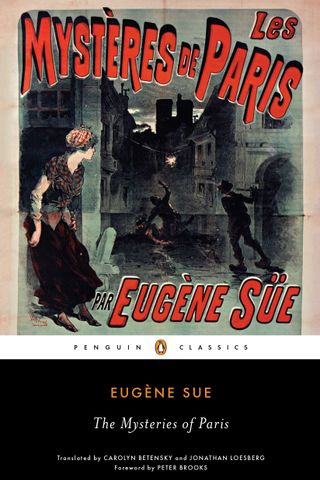
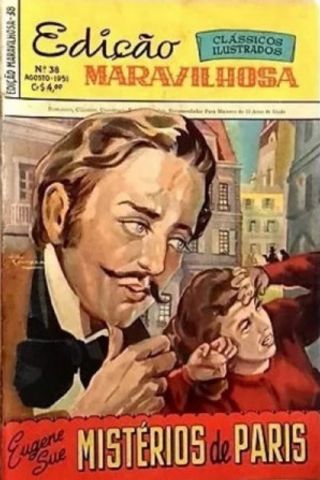
[Edição Maravilhosa — 1ª Série, Número 38. Publicado em Agosto de 1951] Eugène Sue — Mistérios de Paris (Clássicos Ilustrados) / Direção: Adolfo Aizen. (Brochura - Formato Americano - Quadrinhos em Preto e Branco). Originalmente "Mysteries of Paris" - Classics Illustrated n° 44/1948 - The Gilberton Company, Inc. (1942–1967). ==== https://pt.wikipedia.org/wiki/Edição_Maravilhosa https://en.m.wikipedia.org/wiki/Classics_Illustrated https://en.m.wikipedia.org/wiki/The_Mysteries_of_Paris https://en.m.wikipedia.org/wiki/Eugène_Sue https://pt.wikipedia.org/wiki/Eugène_Sue https://pt.wikipedia.org/wiki/Eugène-François_Vidocq https://en.wikipedia.org/wiki/Eugène_François_Vidocq http://www.guiadosquadrinhos.com/edicao/edicao-maravilhosa-1-serie-n-38/ed001100/55264 https://www.guiadosquadrinhos.com/artista/antonio-euzebio/3673 http://guiaebal.com/maravilhosa1.html http://guiaebal.com/maravilhosa2.html http://guiaebal.com/maravilhosa3.html ==== [Wikipédia] Mistérios de Paris é um Romance Popular (Folhetim) do escritor francês Eugène Sue. Foi publicado em série em 90 partes no Journal des débats de 19 de junho de 1842 até 15 de outubro de 1843, tornando-se um dos primeiros romances em série publicados na França: "Les Mystères de Paris" founded the "city mysteries" genre, spawning many imitations. . . Eugène Sue was the first author to bring together so many characters from different levels of society within one novel, and thus his book was popular with readers from all classes. Its realistic descriptions of the poor and disadvantaged became a critique of social institutions, echoing the socialist position leading up to the Revolutions of 1848.[citation needed] "Sue made a fortune even as he made a political statement, seeking to convince his readers that the suffering classes are victims rather than criminals." Sue showed how vice was not the only cause of suffering, but also caused by inhumane social conditions. The novel is a melodramatic depiction of a world where good and evil are clearly distinct. Rodolphe, the Prince, embodies good. Ferand, a lawyer and representative of a new commercial order, embodies evil. The novel was partly inspired by the Memoirs (1828) of Eugène François Vidocq, a French criminal and criminalist whose life story inspired several other writers, including Victor Hugo and Honoré de Balzac.Its greatest inspiration, however, was the works of James Fenimore Cooper: Sue took the plot structure of the Natty Bumppo novels and moved them to the city where buildings replaced trees and underworld gangs replaced Indians. The hero of the novel is the mysterious and distinguished Rodolphe, who is really the Grand Duke of Gerolstein (a fictional grand duchy of Germany) but is disguised as a Parisian worker. Rodolphe can speak in argot, is extremely strong and a good fighter. Yet he also shows great compassion for the lower classes, good judgment, and a brilliant mind. He can navigate all layers of society in order to understand their problems, and to understand how the different social classes are linked. Rodolphe is accompanied by his friends Sir Walter Murph, an Englishman, and David, a gifted black doctor, formerly a slave. The first figures they meet are Le Chourineur and La Goualeuse. Rodolphe saves La Goualeuse from Le Chourineur's brutality, and saves Le Chourineur from himself, knowing that the man still has some good in him. La Goualeuse is a prostitute, and Le Chourineur is a former butcher who has served 15 years in prison for murder. Both characters are grateful for Rodolphe's assistance, as are many other characters in the novel. Though Rodolphe is described as a flawless man, Sue otherwise depicts the Parisian nobility as deaf to the misfortunes of the common people and focused on meaningless intrigues. For this reason, some, such as Alexandre Dumas, have considered the novel's ending a failure. Rodolphe goes back to Gerolstein to take on the role to which he was destined by birth, rather than staying in Paris to help the lower classes. . .
Mistérios de Paris (Clássicos Ilustrados) (Gibi Edição Maravilhosa #38) - Quadrinização de "The Mysteries of Paris" de Eugène Sue
Eugène Sue
EBAL / Editora Brasil-América
1951
52 páginas
1h 44m
ISBN-13: 9780143107125
Português Brasileiro

Estatísticas
Avaliações
5 / 1- 5 estrelas100%
- 4 estrelas0%
- 3 estrelas0%
- 2 estrelas0%
- 1 estrelas0%