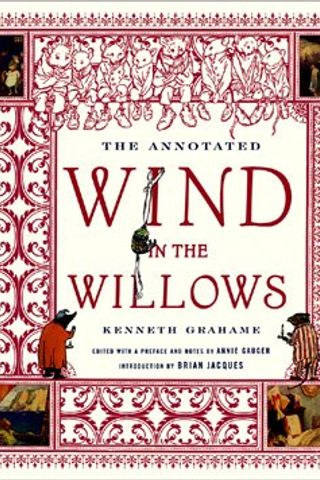
“Believe me, my young friend, there is nothing—absolutely nothing—half so much worth doing as simply messing about in boats.”—the Water Rat to the Mole An instant bestseller upon its initial publication in 1908, The Wind in the Willows has become one of the beloved stories of all time. How could Ratty and Mole have known when they took to the river over one hundred years ago that they would begin a phenomenon that would produce one of the most oft-quoted lines in British literature, and inspire everyone from the creator of Winnie-the-Pooh to Pink Floyd? Drawing from more than a decade of research, Annie Gauger, one of the world’s leading experts on Kenneth Grahame and The Wind in the Willows, now presents a fascinating new annotated edition that reintroduces readers to Otter, curmudgeonly Badger, and rollicking, boastful Toad, while revealing the secrets behind this treasured classic. In The Annotated Wind in the Willows, readers will discover the sheer joy of the original text, restored to the original 1908 version, illustrated with hundreds of full-color images—including the beloved drawings by E. H. Shepard and Arthur Rackham. This edition also includes Shepard’s famous map of the Wild Wood and rarely seen images by illustrators Graham Robertson, Paul Bransom, Nancy Barnhart, and Wyndham Payne. In an illuminating preface, Gauger explains how Grahame came to write the novel, which began as a bedtime story and then became a series of letters he wrote to his son, Alastair. This edition reproduces the original letters in their entirety and includes nearly a thousand delightful annotations on everything from automobiles (Toad drove an Armstrong Hardcastle Special Eight) and early motorcar etiquette to modern manifestations (Disneyland’s Mr. Toad’s Wild Ride). She reveals how William John Cavendish Bentinck-Scott, the peculiar Fifth Duke of Portland, built an extensive network of underground tunnels, thus inspiring the character of Badger, and she puts Grahame’s work in literary context, comparing him to Dickens, Rudyard Kipling, A. A. Milne, and Sir Arthur Conan Doyle. Finally, new to this edition, long buried in the Kenneth Grahame papers, are the notes, letters, and writings by Alastair Grahame and his governess, including several pieces by Kenneth Grahame himself that have never been published before. With a stunning, lyrical tribute to Grahame by Brian Jacques, the internationally best-selling author of the Redwall series, The Annotated Wind in the Willows should prove a most beautiful and enduring tribute to Grahame’s masterpiece.
The Annotated Wind in the Willows -
Kenneth Grahame
W. W. Norton & Company
2009
468 páginas
15h 36m
ISBN-10: 0393057747





Resenhas (5)Ver mais
jonasbrother1621/11/2024Resenhou um livro
2 curtidas
Estatísticas
Avaliações
3.8 / 59- 5 estrelas22%
- 4 estrelas36%
- 3 estrelas34%
- 2 estrelas8%
- 1 estrelas0%

Kenneth Grahame
Grahame nasceu em Edimburgo, Escócia, mas já na infância, depois de perder a mãe, foi mandado pelo pai junto com seus irmãos (sem condições de criá-los) para viver com sua avó às margens do Rio Tâmisa. Era um excelente aluno no St. Edward's School em Oxford, mas não pôde estudar na universidade devido a falta de dinheiro. Ao invés disso, foi mandado para trabalhar no Bank of England em 1879. Aposentou-se em 1907 por causa da saúde, talvez por ter sido baleado certa vez num assalto ao banco alguns anos antes. O casamento com Elspeth Thomson foi infeliz. Só tiveram um filho, Alastair, cego de um olho e com diversos problemas de saúde. The Wind in the Willows foi um livro escrito para Alastair. Alastair suicidou-se numa linha de trem, dois dias antes de seu vigésimo aniversário. Kenneth Grahame faleceu em Pangbourne, Berkshire, em 1932. Foi enterrado no Holywell Cemetery, em Oxford. Seu epitáfio contém a seguinte frase, escrita por seu primo: "À bela memória de Kenneth Grahame, esposo de Elspeth, pai de Alastair, que atravessou o Rio em 6 de Julho de 1932, deixando a infância e a literatura mais abençoados para todos os momentos."
25 Livros
2 Seguidores